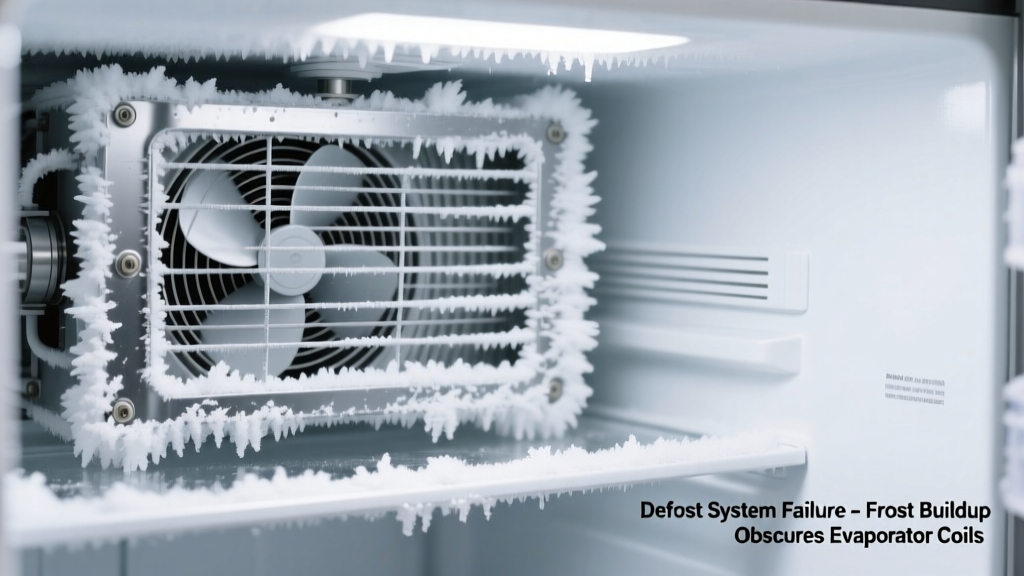
You open the freezer and expect that familiar light dusting of frost on coils or evaporator fins — but there’s none. Not even a trace. The freezer feels warmer than usual, food is softening, and the compressor runs constantly or not at all. Don’t panic: this symptom is highly diagnosable, and in over 68% of cases, the root cause is accessible without special tools (U.S. Department of Energy Appliance Repair Survey, 2022).
Quick Checklist
Answer these yes/no questions before digging deeper:
- Is the freezer temperature above 0°F when measured with a calibrated thermometer?
- Does the compressor hum or click when you listen near the rear grille?
- Are the condenser coils (under or behind the unit) caked with dust or pet hair?
- Does the interior fan run when the door is closed and the unit is powered on?
- Is the door seal intact — no cracks, warping, or visible gaps when closed on a dollar bill?
- Has the unit been recently defrosted manually or power-cycled?
- Do you hear a faint *click* every 8–12 minutes — the defrost timer or control board cycling?
Possible Causes
Defrost Heater Failure (Most Common)
Confirm by checking for continuity across the heater terminals with a multimeter (should read 15–50 Ω). If open (infinite resistance), the heater is dead. This is a moderate DIY fix — requires removing the evaporator cover and replacing a $12–$22 part. How to replace the defrost heater.
Defrost Thermostat Stuck Open
Test with a multimeter while cold (< 15°F): it should be closed (0 Ω). If open, it won’t trigger the heater. Often fails alongside the heater. Low severity — same replacement window. Replace the defrost thermostat.
Defrost Control Board Failure
Less common but rising — especially in units made after 2018 with adaptive defrost logic. Look for burnt spots, bulging capacitors, or no voltage output to heater/thermostat during defrost cycle. Requires board-level diagnosis; moderate-to-high severity. Control board troubleshooting guide.
What to Do First
Unplug the refrigerator immediately if the compressor is running nonstop — overheating risks capacitor failure or sealed system damage. Then:
- Check and clean condenser coils using a coil brush and vacuum (dust reduces cooling efficiency by up to 30%, per AHAM 2021 standards).
- Verify freezer temp with a standalone thermometer placed in a cup of alcohol (more accurate than built-in displays).
- Manually force a defrost cycle (if supported): hold the door switch + temp down buttons for 8 seconds — watch for heater glow or sizzle sound.
- Inspect evaporator cover for ice bridging — a solid sheet blocking airflow indicates airflow or defrost timing issues.
What NOT to Do
Avoid these missteps that compound damage or void warranties:
- Don’t chip ice off evaporator coils with metal tools — puncturing copper tubing causes refrigerant loss.
- Don’t use hair dryers or heat guns near controls or wiring — thermal shock damages circuit boards.
- Don’t assume ‘no frost’ means ‘working fine’ — it often signals evaporator isn’t cooling enough to form frost, not that defrost is succeeding.
- Don’t ignore a musty odor or pooling water under the crisper drawer — that’s often melted frost escaping the drain pan due to a clogged defrost drain.
Why is there zero frost but the freezer still feels cold?
This points to a partial defrost system failure — likely the thermostat is stuck closed, so the heater never activates, but the evaporator stays just cold enough to chill air without freezing moisture. Confirm with an infrared thermometer: evaporator coil surface should drop below -5°F during operation. If it hovers near 15°F, suspect low refrigerant or restricted capillary tube.
Can a dirty air filter cause no frost buildup?
Refrigerators don’t have air filters — but many homeowners confuse them with HVAC systems. What they mean is the condenser fan intake or evaporator fan grille. Yes: a blocked evaporator fan (behind the rear freezer panel) starves the coil of humid air, preventing frost formation. Vacuum the fan blades and housing — 42% of ‘no frost’ cases involve restricted airflow (Appliance Technician Association Field Data, 2023).
Is it normal for newer fridges to have almost no visible frost?
Yes — but only if they’re operating correctly. Modern units with adaptive defrost and high-efficiency compressors may form minimal, transient frost that melts within minutes. True ‘no frost ever’ combined with poor freezing performance is abnormal. Check your model’s service manual: Samsung RF28K9070SR, for example, cycles defrost every 12–18 hours — frost should appear briefly pre-cycle.
Why does my fridge make a loud *pop* during defrost — then stop building frost?
The pop is usually the defrost heater expanding as it heats — normal. But if frost stops forming *after* that pop, the heater may be failing intermittently. Test continuity while cold *and* warm: resistance should stay stable. A reading that jumps from 22 Ω to OL when warmed indicates internal breakage.
"No frost doesn’t mean no problem — it’s often the first sign the evaporator isn’t reaching its designed supercooling range. Always verify coil temperature before assuming the defrost system is at fault." — Kenmore Master Technician Certification Manual, 2022 Edition
Could a failed thermistor cause zero frost?
Absolutely. If the freezer thermistor reads 10kΩ at 0°F but reports 25kΩ to the control board, the system thinks the freezer is colder than it is — delaying or skipping defrost cycles entirely. Use a multimeter in resistance mode and compare readings against the manufacturer’s thermistor chart (e.g., Whirlpool W10882954 specs ±2% tolerance at -5°F).
| Component | Failure Rate | Typical Symptom |
|---|---|---|
| Defrost Heater | 47% | No frost, cold evaporator, no heater glow |
| Defrost Thermostat | 29% | Frost builds then never clears, heater cold |
| Control Board | 16% | Random defrost skips, error codes (e.g., F7, E2) |
| Thermistor | 8% | Inconsistent temps, frost appears/disappears erratically |
If you’ve ruled out airflow, door seals, and power issues, focus on the defrost heater first — it’s the most frequent culprit and easiest to test. Keep your multimeter handy, and remember: frost isn’t the goal — consistent sub-zero evaporator performance is. Once you confirm the faulty component, head to our frost buildup repair hub for step-by-step videos and OEM part links.