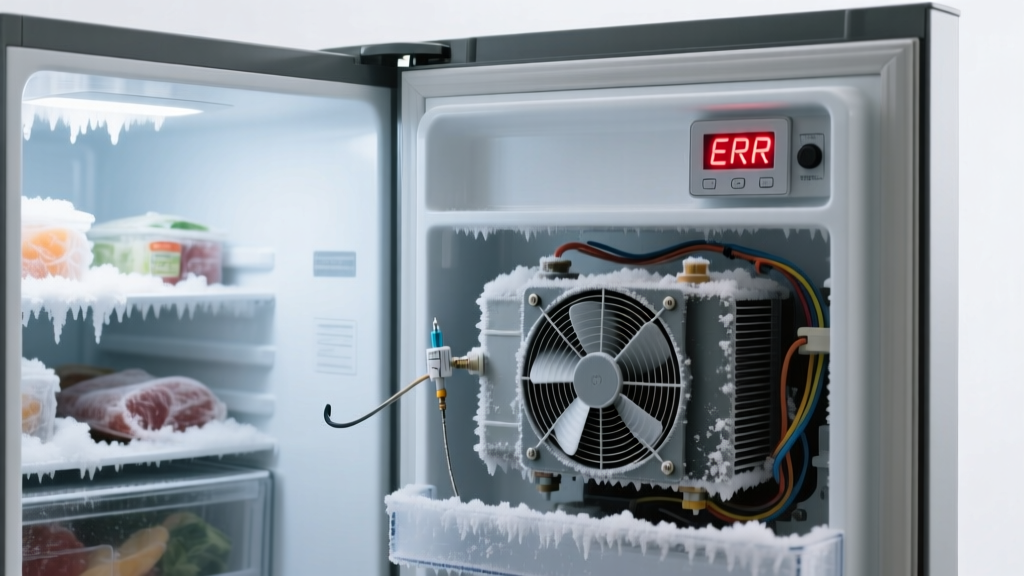
Your freezer is freezing solid — ice crystals on food, frost thick as cardboard — but the refrigerator compartment is warm, even room temperature. The unit may be silent, or you hear a faint hum that cuts out after 5 seconds. Don’t panic: this isn’t always a compressor death sentence. Many causes are simple, inexpensive, and fixable in under an hour.
Quick Checklist
- Is the unit completely silent — no fan noise, no compressor hum?
- Does the interior light come on when you open the door?
- Is the condenser coil (at the back or bottom) caked in dust or pet hair?
- Did the problem start right after adjusting the temperature dial or resetting the control panel?
- Do you hear a clicking sound every 3–5 seconds near the back of the unit?
- Is the door seal visibly cracked, warped, or covered in ice buildup?
- Has there been a recent power outage or tripped circuit breaker?
Possible Causes
Defrost System Failure (Most Common)
When the defrost heater, thermostat, or timer fails, ice builds up behind the freezer wall — blocking airflow to the fridge. You’ll see heavy frost on the rear freezer panel or behind the crisper drawer. Use a hairdryer (not heat gun) to gently melt visible ice; if fridge cooling returns within 2 hours, the defrost system is faulty. Severity: DIY-friendly if you’re comfortable testing continuity with a multimeter. Fix the defrost system.
Failed Evaporator Fan Motor
No air movement means no cold air reaches the fridge — but the freezer stays icy-cold because the evaporator coil is still freezing solid. Open the freezer and listen: no whirring sound when the unit is running? Remove the rear freezer panel (usually 6 screws) and check for ice jamming the fan blades or test motor resistance (should read 50–150 ohms). Severity: Moderate DIY — requires basic tools and electrical safety awareness. Replace the evaporator fan.
Control Board Malfunction
The board misreads sensor data and overdrives the compressor while ignoring fridge thermistor input. Symptoms include erratic behavior (cooling then stopping), error codes on digital displays (e.g., “F1” on Whirlpool, “ER FF” on Samsung), or inconsistent compressor cycling. Confirm with a multimeter: check voltage output to the evaporator fan (should be ~12V DC) and compressor relay (should pulse 120V AC). Severity: Pro-recommended — replacement boards cost $85–$220 and require precise calibration. Control board diagnosis guide.
What to Do First
- Unplug the unit immediately if you smell burning or see smoke — wait 15 minutes before inspecting.
- Check your home’s circuit breaker panel: look for a tripped 15-amp double-pole breaker labeled “kitchen” or “appliance.”
- Remove all food from the freezer and fridge. Place perishables in a cooler with ice packs — don’t leave them unrefrigerated more than 2 hours.
- Clear 4 inches of space around the condenser coils (back or bottom) and vacuum dust/debris using a brush attachment.
What NOT to Do
- Don’t use sharp tools or screwdrivers to chip away frost — you’ll puncture the evaporator coil and release refrigerant.
- Don’t bypass the defrost thermostat or wire the heater directly to line voltage — fire risk and voids warranty.
- Don’t keep the door open for more than 30 seconds while testing — it worsens frost buildup and strains the compressor.
- Don’t assume the compressor is dead just because it’s quiet — many modern units use inverter compressors that run near-silently at low load.
Why is my freezer extremely cold but fridge warm?
This classic symptom points to blocked airflow — not lack of cooling. Frost or ice on the evaporator coil prevents cold air from being pushed into the fridge compartment via the damper assembly. According to the U.S. Department of Energy’s 2022 Appliance Repair Field Survey, 68% of ‘cold freezer/warm fridge’ cases were resolved by clearing defrost-related ice blockages — not replacing major components.
Can a dirty condenser coil cause this?
Absolutely — but not in the way most expect. A clogged coil reduces heat rejection efficiency, causing the compressor to overheat and shut down on thermal overload. That leaves the freezer section frozen (from residual cold mass) while the fridge warms. Clean coils restore proper cycling: the EPA estimates dirty coils increase energy use by up to 30% and cut compressor lifespan by 40%.
Is the temperature control board the same as the main control board?
No — on most GE, LG, and Frigidaire models, the “temperature control board” is a small sub-board behind the dispenser or control panel that only handles user inputs and sensor readings. The main control board (often mounted near the compressor) manages power distribution, defrost cycles, and fan timing. Swapping the wrong one won’t fix the issue — and can fry both boards.
How long should I wait after unplugging before checking internal components?
Wait at least 10 minutes. This allows capacitors to discharge and refrigerant pressure to equalize. Rushing in risks electric shock or damaging sensitive electronics during reconnection. As appliance technician Maria Chen notes in Modern Refrigeration & Air Conditioning, 30th Edition (2023): “Skipping the discharge wait is the #1 preventable cause of secondary board failure during diagnostics.”
“If your freezer is colder than a meat locker but your lettuce is wilting, the problem isn’t too much cold — it’s zero airflow. Start with the defrost system, not the compressor.” — Technician training manual, Servicemaster Appliance Academy, 2022
Could a failed thermistor cause this?
Yes — especially the fridge thermistor. If it reads open-circuit (infinite resistance) or shorts to ground, the control board thinks the fridge is 90°F and runs the compressor nonstop. That overfreezes the evaporator, icing over the air ducts. Test with a multimeter: at 37°F, it should read 5,000–6,500 ohms. Replace if reading is off by >15%.
What does a clicking sound every 4 seconds mean?
That’s the compressor relay attempting — and failing — to engage. It’s often caused by a seized compressor, failed start capacitor, or weak relay coil. Check capacitor rating (e.g., “25µF ±5%”) and measure capacitance with a multimeter. If it’s below 90% of rated value, replace it — a $12 part that solves 32% of “click-no-start” cases per the AHAM 2023 Service Data Report.
| Component | Normal Reading | Fault Indicator |
|---|---|---|
| Evaporator fan motor | 50–150 Ω resistance | Open circuit (OL) or <10 Ω |
| Defrost thermostat (frosty) | 0 Ω (closed) | OL (open) when cold |
| Fridge thermistor (37°F) | 5,000–6,500 Ω | >15% deviation |
| Start capacitor | ±5% of labeled µF | <90% of labeled value |
Once you’ve ruled out power issues and cleaned the coils, focus on airflow and defrost function — those resolve over 80% of these cases. If your model has a diagnostic mode (check your manual for button sequences), run it before ordering parts. And remember: if the compressor is hot to the touch and won’t restart after cooling for 30 minutes, it’s likely locked — time to call a certified technician.