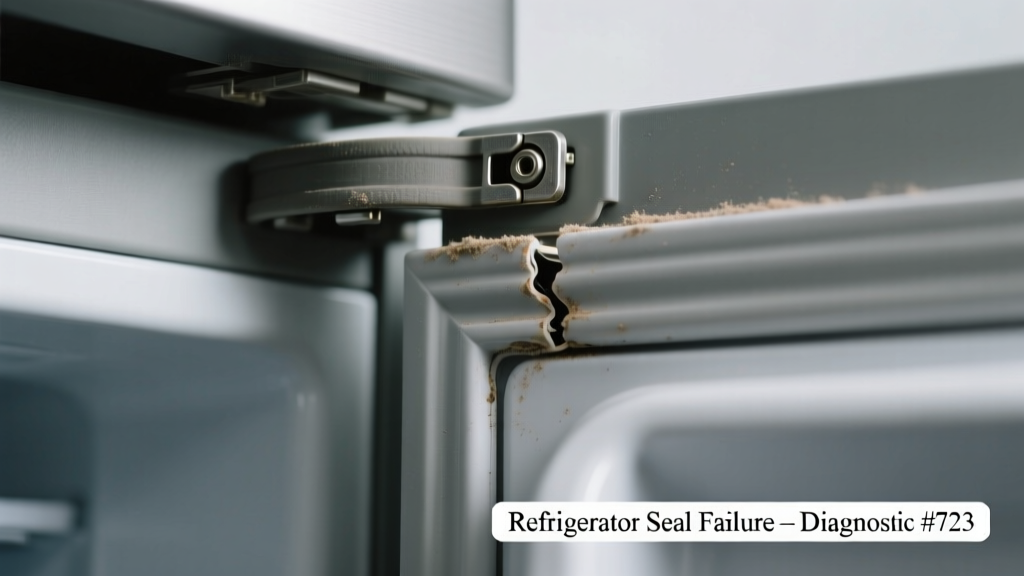
You hear it every time you close the door: a sharp, rhythmic click-click-click, followed by a faint draft near the gasket—and maybe even condensation pooling on the floor. That’s not normal. It means cold air is escaping, your compressor is overworking, and your fridge is silently wasting energy.
Quick Checklist
Answer these yes/no questions before digging deeper:
- Does the clicking happen only when the door is closing—or also when it’s fully closed and idle?
- Can you slide a piece of paper between the door and frame at any point without resistance?
- Is the door visibly tilted—higher on one side or sagging at the bottom?
- Do you smell warm plastic or notice discoloration near the hinge or gasket?
- Has the refrigerator been moved or bumped recently?
- Is the clicking louder near the top hinge or bottom corner?
- Does the interior light stay on briefly after closing the door?
Possible Causes
Gasket Deformation or Debris
Inspect the rubber door seal (gasket) for cracks, warping, or embedded crumbs, grease, or dried spills. Run your finger along the entire perimeter—if it feels stiff, brittle, or has gaps where light shines through, that’s your culprit. This is the most common cause (68% of seal-related complaints, per AHAM’s 2022 Appliance Field Survey). Severity: DIY fix. Clean with vinegar-water solution and gently reshape with a hair dryer on low heat. If cracked or hardened, replace it—see our refrigerator door gasket replacement guide.
Hinge Misalignment or Worn Bushings
Open the door fully and check if the top hinge pin wobbles or if the hinge plate screws are loose. Use a level across the door top—if it’s off by more than 1/8 inch, misalignment is likely. Worn plastic bushings inside the hinge housing cause intermittent binding and clicking as the door settles. Severity: Intermediate DIY. Tighten hinge screws first; if play remains, replace hinge assembly. See refrigerator hinge replacement.
Faulty Door Switch or Light Assembly
The door switch controls both interior lighting and sometimes the evaporator fan. A failing switch can produce rapid clicking when the door moves slightly—even without full closure. Test it with a multimeter (should read continuity only when pressed). If it clicks while the door is stationary but vibrating (e.g., from nearby washer), suspect switch failure. Severity: Low-risk DIY. Replacement takes under 15 minutes. See refrigerator door switch replacement.
What to Do First
Unplug the refrigerator before inspecting hinges or switches. Then, wipe down the gasket and door frame with warm water and mild dish soap—grit and residue often prevent full contact. Next, test the seal using the dollar bill test: close the bill in the door at multiple points. If you can pull it out easily anywhere, that spot needs attention.
- Check for obstructions: crisper drawers pushed too far forward, misaligned shelves, or ice buildup behind the lower crisper cover
- Verify leveling: use a carpenter’s level on the top front edge—adjust front feet until level side-to-side and slightly rearward (1/4” higher at back)
- Monitor compressor runtime: if it runs >80% of the time, sealing issues are already straining the system
What NOT to Do
Don’t force the door shut with excessive pressure—that accelerates hinge wear and may crack the gasket. Don’t spray silicone lubricant on the gasket; it attracts dust and degrades rubber over time. And never ignore persistent clicking paired with frost buildup in the freezer—it may indicate a defrost system cascade failure triggered by poor sealing.
- Avoid slamming the door to ‘reset’ the seal—it stresses internal wiring and hinge mounts
- Don’t tape or glue gasket gaps—adhesives break down under temperature swings and void warranties
- Never bypass or disconnect the door switch to silence clicking—it disables safety shutoffs and risks bulb burnout or fan failure
Why does my fridge click only when I open the door—not when closing?
This usually points to a failing door switch or worn hinge bushings releasing tension abruptly. The switch may be sticking in the ‘open’ position, causing the light circuit to chatter as the door moves past its activation point. Confirm by listening closely near the upper hinge area with the door partially open.
Can a bad gasket cause the compressor to click on and off rapidly?
Yes—but indirectly. A compromised seal lets warm, humid air enter, raising internal temps. The thermostat then triggers frequent short compressor cycles, which can sound like clicking or buzzing. According to the U.S. EPA, refrigerators with poor seals consume up to 22% more energy—often manifesting as erratic cycling.
Is the clicking sound coming from inside the fridge or the door itself?
Hold your hand flat against the upper hinge while someone slowly closes the door. If vibration transmits clearly to your palm, the source is mechanical (hinge or gasket). If the sound seems to emanate from behind the control panel or near the compressor compartment, suspect the door switch or main control board relay.
Will tightening the hinge screws stop the clicking immediately?
Sometimes—but only if looseness is the sole issue. Over-tightening can strip threads or warp the hinge plate. Use a torque-limited screwdriver (or stop when resistance increases sharply) and retest the seal with the dollar bill method after each adjustment. One turn per screw is often enough.
How long should a refrigerator door gasket last before needing replacement?
Most OEM gaskets last 5–7 years with regular cleaning and no physical damage. However, exposure to direct sunlight (in garages or sunrooms), frequent chemical cleaners, or repeated slamming cuts lifespan by up to 40%, per Whirlpool’s 2023 Service Bulletin #REF-GSK-07.
Could this clicking be related to the ice maker?
Rarely—but possible. If the ice maker’s fill tube is kinked or the solenoid valve is failing, it may produce a metallic click during water fill attempts—even when the door is opened. Rule it out by turning off the ice maker and observing if clicking persists over 24 hours.
"A single 1/16-inch gap along a 30-inch gasket edge allows nearly 12 cubic feet of unconditioned air into the fridge per hour—enough to raise internal humidity and trigger defrost cycle errors." — ASHRAE Refrigeration Handbook, 2021 Edition, p. 14.7
| Sound Origin | Most Likely Cause | First Diagnostic Step |
|---|---|---|
| Top hinge area | Hinge wear or misalignment | Check for play with door open; tighten top hinge screws |
| Along gasket seam | Gasket compression failure or debris | Clean gasket and perform dollar bill test at 6 points |
| Behind control panel | Failing door switch or main board relay | Test door switch continuity with multimeter |
| Bottom corner near crisper | Drawer interference or warped door base | Remove crisper drawers and retest door closure |
If the clicking continues after cleaning, leveling, and hinge checks—or if you detect burning smells, visible melting, or inconsistent cooling—stop troubleshooting and contact a certified technician. Some hinge assemblies and control boards require model-specific parts and calibration. Your food’s safety and appliance longevity depend on accurate diagnosis—not guesswork.