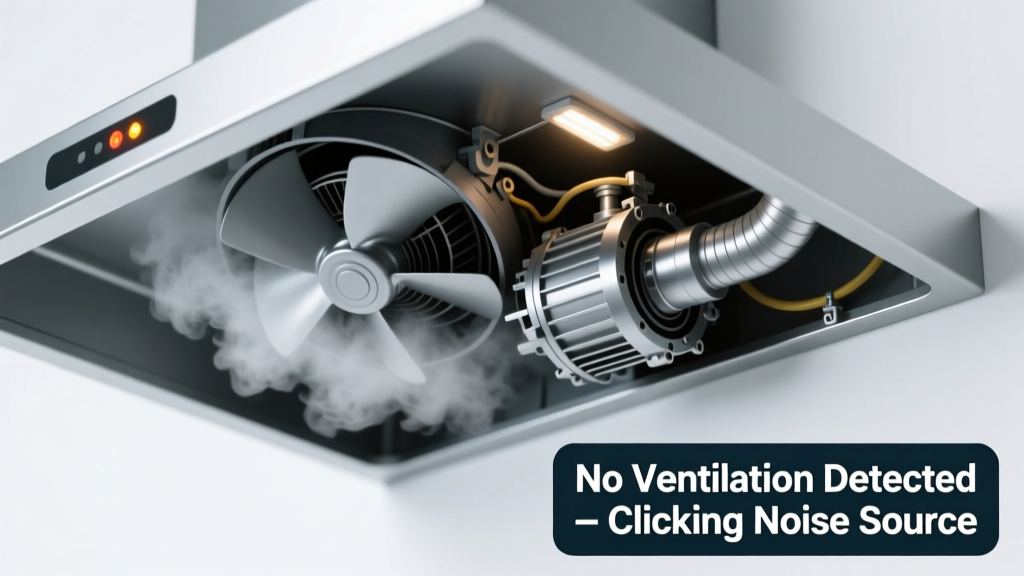
You’re cooking dinner, the stovetop’s roaring, but instead of a steady whoosh of air, your range hood emits sharp, rhythmic click-click-click sounds — and zero airflow. No smoke evacuation. No draft. Just frustration and rising kitchen humidity. Don’t panic: this symptom almost always points to one of five specific, diagnosable failures — and most are fixable in under an hour.
Quick Checklist
Answer these yes/no questions before digging deeper:
- Does the fan motor spin at all when turned on?
- Is the clicking sound coming from behind the control panel or near the duct collar?
- Have you recently cleaned the grease filters or replaced them?
- Is the exterior vent cap (outside your home) visibly blocked with leaves, bird nests, or ice?
- Do lights work normally while the fan clicks and fails?
- Did the issue start immediately after a power outage or circuit breaker trip?
- Is your range hood ducted to the outside (not recirculating)?
Possible Causes
Failed relay or control board
Confirm by listening closely: rapid, consistent clicking every 1–2 seconds — especially when the fan switch is held — points to a stuck or arcing relay. Use a multimeter to test continuity across the relay contacts (power off first). Severity: Moderate DIY — requires basic electrical safety knowledge and soldering for replacement. Replace range hood relay.
Clogged or frozen exterior vent cap
Check the roof or wall vent cap for debris, ice buildup (common in winter), or a stuck damper flap. If the cap doesn’t open freely when pushed, airflow stalls and the motor may overheat and cycle — triggering protective clicking. Severity: Low — clean or replace cap yourself. How to replace a range hood vent cap.
Blower wheel jammed or misaligned
Power off, remove the grease filters and interior cover, then gently try to rotate the blower wheel by hand. If it’s stiff, binds, or scrapes the housing, that’s your culprit. Often caused by hardened grease or a bent blade. Severity: Low-to-moderate DIY — cleaning or wheel replacement takes 20 minutes. Clean or replace blower wheel.
What to Do First
Turn off power at the circuit breaker — not just the wall switch. Unplug if it’s cord-connected. Then inspect the exterior vent cap and duct termination for obvious obstructions. Next, remove and thoroughly clean the aluminum grease filters in hot, degreasing solution — caked-on residue can restrict airflow enough to trigger thermal cutoffs that click.
- Verify power is off using a non-contact voltage tester
- Photograph wiring before disconnecting anything
- Test the fan again *only after* clearing visible blockages
What NOT to Do
Never bypass the thermal cutoff switch or tape the vent damper open — both create fire hazards. Don’t spray lubricant into the motor housing; it attracts dust and degrades insulation. And don’t ignore repeated clicking: according to the National Fire Protection Association’s 2023 Home Fire Loss Report, 22% of cooking-related fires involved ventilation system failures linked to ignored mechanical symptoms like abnormal noises.
"Clicking without airflow is rarely 'just a noise' — it’s the system screaming 'I’m overheating or short-cycling.' Treat it like a warning light on your dashboard." — Carlos Mendez, HVAC Technician since 1998, certified by NATE (North American Technician Excellence)
Is the clicking coming from inside the control panel?
If yes, unplug the unit and open the control box (usually behind the front panel). Look for scorch marks, bulging capacitors, or a burnt relay. A multimeter check on the relay coil (should read ~100–500 ohms) confirms failure. If uncertain, stop and call a technician — live-board diagnostics carry shock risk.
Does the fan spin briefly then stop with a click?
This suggests thermal overload protection kicking in. Likely causes: blower wheel obstruction, failing capacitor, or dirty motor windings. Let the unit cool completely (30+ minutes), then retest. If it repeats, suspect the start capacitor — test with a capacitance meter (expected value is printed on the capacitor, typically 4–12 µF).
Is the clicking synchronized with the light switch?
If toggling the lights triggers the same click, the shared control board is likely compromised — especially common in mid-tier brands like Broan-NuTone and GE Profile units built between 2016–2021. Check for firmware updates (if smart-enabled) or board recalls via the manufacturer’s support portal.
Did the problem start after installing a new microwave hood combo?
Many integrated microwave/range hoods have undersized duct adapters. A 3.25" rectangular duct reducer used on a 6" round system creates extreme backpressure — tripping safety circuits. Measure your duct size and compare to the unit’s minimum CFM rating. The U.S. EPA estimates that 14% of household ventilation failures stem from mismatched duct sizing.
Can I test the motor independently?
Yes — but only if you’re comfortable with 120V wiring. Disconnect the motor leads from the control board and wire directly to a grounded extension cord (use insulated alligator clips). If it spins smoothly and quietly, the board is faulty. If it clicks or won’t turn, the motor’s internal winding or bearing is failed. Step-by-step motor bench test guide.
Why does my ductless (recirculating) range hood click but not vent?
Recirculating models don’t exhaust air — they filter and recirculate. But if the charcoal filter is saturated (replace every 6–12 months), airflow drops sharply, causing the motor to stall and click. Also verify the internal duct baffle isn’t accidentally set to ‘exhaust’ mode — some models let you toggle between recirculating and ducted, and a mispositioned damper can choke airflow entirely.
| Click Pattern | Most Likely Cause | DIY Fix Time |
|---|---|---|
| Rapid, machine-gun clicks (2–3/sec) | Failed relay or shorted control board | 45–90 min |
| Single click on startup, then silence | Thermal cutoff tripped (overheating) | 15–30 min |
| Click + faint hum, no rotation | Bad start capacitor or seized bearing | 20–40 min |
| Click only when fan speed is increased | Faulty speed control module or resistor pack | 30–60 min |
Most clicking-and-no-vent issues resolve with a $12 capacitor, a $25 relay, or 15 minutes of duct cleaning. You don’t need a technician — just patience, a screwdriver, and the right diagnostic lens. Start with the exterior vent and work inward. And if you hear that click again? Now you know exactly where to look first.