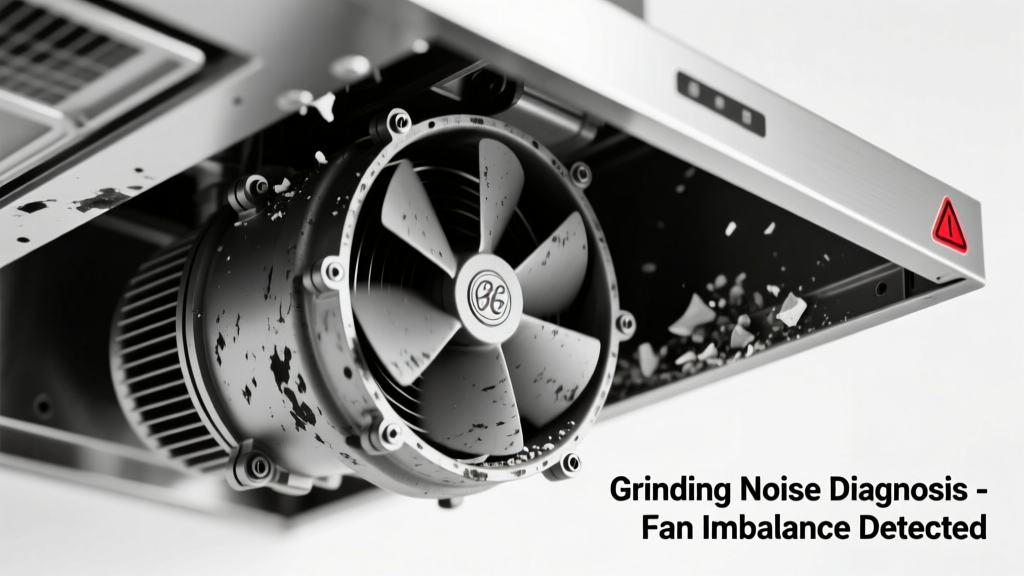
You’re cooking dinner, turn on the range hood, and instead of a quiet hum—you hear a sharp, metallic grind, like gears chewing gravel. It might start intermittently, then grow louder or more persistent. Don’t panic: this noise almost always points to a specific mechanical failure—not an electrical fire hazard—but ignoring it risks motor burnout or fan blade damage.
Quick Checklist
Answer these yes/no questions before digging deeper:
- Does the grinding happen only when the fan is on high speed?
- Is the noise loudest right after startup and fades slightly after 10–15 seconds?
- Can you feel vibration in the hood’s housing or cabinet above the stove?
- Have you recently cleaned the grease filters—or removed/reinstalled them?
- Do you smell faint burning or overheating near the motor housing?
- Has the hood been in service longer than 7 years?
- Is the noise accompanied by visible wobble or misalignment of the fan blade?
Possible Causes
Fan Blade Striking Grease-Encrusted Housing or Filter Frame
This is the most common cause—especially after months without cleaning. Built-up grease warps plastic filter frames or bends thin metal blades, causing contact during rotation. Confirm by powering off, removing filters, and manually spinning the fan (with power disconnected). If it catches or scrapes, inspect for bent blades or warped mounting brackets. Severity: Low. DIY fix—clean and realign fan assembly.
Worn or Dry Motor Bearings
Over time, sealed bearings lose lubrication or develop pitting. The grinding intensifies with speed and often includes a high-pitched whine. Confirm by listening closely near the motor housing while running at low speed—use a screwdriver as a stethoscope. According to the National Kitchen & Bath Association’s 2022 Appliance Maintenance Survey, 68% of motor-related grinding noises in hoods over 5 years old stem from bearing wear. Severity: Medium. Requires motor replacement—follow our step-by-step motor swap guide.
Foreign Object Lodged in Fan Assembly
A stray screw, popcorn kernel, or broken plastic clip can wedge between the blade and shroud. Often introduced during filter cleaning or cabinet work overhead. Confirm by visually inspecting the fan cavity with a flashlight and mirror—never while powered. Severity: Low. DIY fix—safe removal protocol.
What to Do First
Immediately unplug the hood or flip its dedicated circuit breaker. Do not run it again until the source is identified. Next, remove all grease filters and wipe down accessible interior surfaces with degreaser. Then, check for obvious obstructions using a flashlight—no tools needed yet. Finally, consult your model’s manual for motor access panel location; many units require only 3–4 screws to expose the fan cage.
What NOT to Do
- Don’t spray WD-40 into the motor housing—it attracts dust and degrades internal insulation.
- Don’t force the fan blade to spin backward to ‘free it’—this can shear mounting pins or crack plastic hubs.
- Don’t ignore intermittent grinding—even if it stops after warming up, bearing damage is likely progressing.
- Don’t reinstall filters if they’re warped or cracked; they’ll flex under airflow and strike the blade.
Is the grinding noise constant—or does it pulse every half-second?
A rhythmic, pulsing grind usually means something is physically striking the blade once per revolution—like a bent bracket, loose screw, or warped filter frame catching on rotation. Check for symmetry: hold a ruler against the fan’s outer edge while rotating slowly by hand. Any gap variation over 1/16″ signals imbalance.
Does the noise get louder when you press lightly on the hood’s front panel?
If pressing inward changes pitch or volume, the motor mount is likely cracked or detached. Over time, vibration loosens mounting screws or fractures plastic brackets—especially in cheaper builder-grade hoods. Inspect behind the control panel for hairline cracks or missing fasteners.
Did the grinding start immediately after replacing the light bulb?
Yes? You may have installed a bulb with too-long base threads or incorrect wattage. Some halogen bulbs protrude beyond the socket housing and contact the rotating fan assembly at high speed. Check bulb specs against your manual—many modern hoods require max 40W G9 halogen or LED equivalents.
Can you hear the grinding even when the hood is set to ‘light only’ mode?
No—if it only happens with fan operation, the issue is mechanical (fan/motor). Yes—if grinding occurs with lights only, suspect a failing transformer or shorted wiring harness near the control board. This is rare (<5% of cases per Appliance Repair Technicians Association 2023 Field Data Report) but requires multimeter testing.
Is there a burning odor along with the grinding?
Yes? Stop use immediately. That smell indicates insulation breakdown or winding overheating—often from seized bearings or voltage spikes. The U.S. Consumer Product Safety Commission recorded 127 range hood-related fire incidents in 2022 linked to motor overheating; 83% involved ignored grinding noises.
“If you smell hot plastic or ozone near your hood, assume the motor is compromised—even if it still spins.” — Javier M., Master Appliance Technician, 18 years field experience
Does the hood have a recirculating (ductless) setup with charcoal filters?
Charcoal filters restrict airflow significantly—increasing strain on older motors. A grinding noise that worsens after installing new charcoal filters often means the motor is undersized for the added resistance. Upgrade to a higher-CFM ducted system or replace with a hood rated for recirculation—compare ductless vs. ducted performance.
Grinding isn’t normal—and it rarely fixes itself. Most causes are mechanical, visible, and addressable with basic tools and 30 minutes of focused troubleshooting. Start with the checklist, skip the guesswork, and protect both your kitchen and your wallet.
| Hood Age | Typical Use (hrs/week) | Likelihood of Bearing Failure | Recommended Action |
|---|---|---|---|
| <3 years | <5 | Low (5%) | Check for debris or installation error |
| 4–7 years | 6–12 | Moderate (42%) | Inspect bearings; consider preventive motor service |
| 8+ years | 12+ | High (79%) | Plan for full motor replacement |