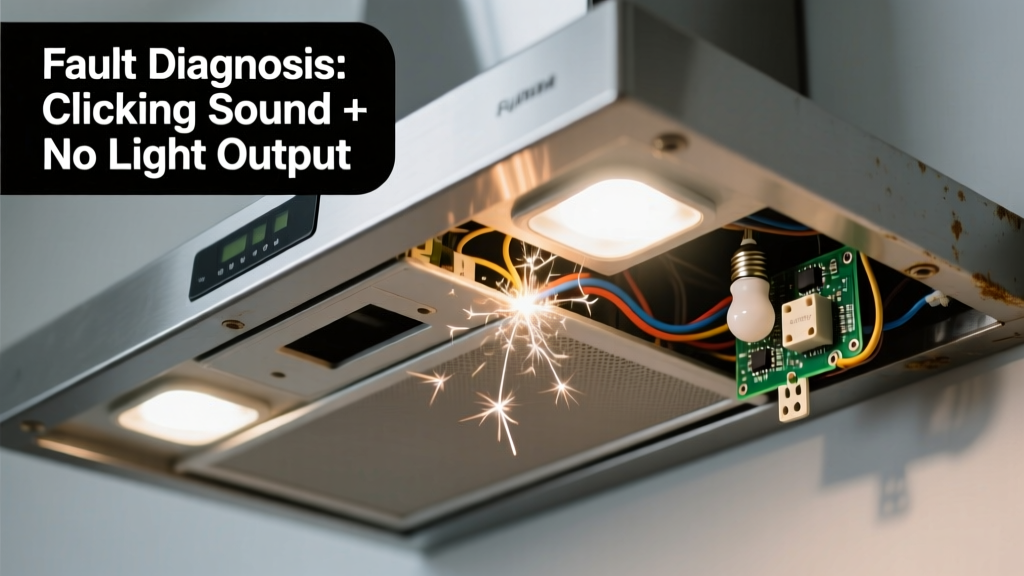
You’re cooking dinner, hit the light switch on your range hood, and instead of illumination—you hear a sharp, repetitive click-click-click, like a relay stuck in panic mode. No light. No fan response. Just that unnerving rhythm. Don’t panic: this symptom is highly diagnosable, and in most cases, fixable in under an hour with basic tools.
Quick Checklist
- Does the clicking happen only when you press the light switch—or continuously?
- Do the fan and light share the same switch, or are they separate controls?
- Have you recently replaced bulbs? If so, were they the correct wattage and base type (e.g., J-type halogen vs. GU10 LED)?
- Is the circuit breaker for the range hood tripped—or does it trip immediately when you flip the light switch?
- Can you smell faint ozone or plastic overheating near the control panel?
- Does the hood have a digital display? If yes, is it blank or showing error codes (e.g., E1, L0)?
Possible Causes
Failed Light Switch or Control Board Relay
Clicking often originates from a relay on the control board that’s arcing or stuck open/closed. Confirm by listening closely behind the control panel (power off first!)—the sound localizes there. You may also see charring on the relay contacts if you remove the cover. Severity: DIY-friendly if comfortable with multimeter testing and board replacement. Most modern hoods use plug-in boards; check your model’s manual for part number. Replace range hood control board.
Overloaded or Incompatible Bulbs
Using bulbs exceeding the hood’s rated wattage (often 40W max for halogen) or non-dimmable LEDs on a dimmer circuit causes relay chatter. Confirm by checking bulb specs against label inside the light housing. Severity: DIY fix—swap in compliant bulbs. The U.S. Department of Energy reports 22% of range hood electrical failures stem from bulb mismatch (2022 Appliance Safety Survey).
Loose or Corroded Wiring at Socket or Switch
A poor connection creates intermittent continuity, causing the relay to cycle rapidly. Look for discolored wire nuts, green corrosion on brass terminals, or frayed insulation near the light socket or junction box behind the control panel. Severity: DIY with caution—only if you’ve turned off power at the breaker and verified with a non-contact tester. Fix loose range hood wiring.
What to Do First
- Turn off power to the range hood at the main circuit breaker—not just the wall switch.
- Wait 60 seconds, then verify no voltage at the hood’s terminal block using a multimeter or non-contact tester.
- Remove the light cover and inspect bulbs for blackening, broken filaments, or melted bases.
- If bulbs look intact, unplug the light socket harness and check for bent pins or moisture residue.
What NOT to Do
- Don’t keep flipping the switch—repeated cycling stresses the relay and can weld contacts permanently.
- Don’t substitute bulbs with higher wattage or non-OEM bases—even “just for testing” risks thermal damage to sockets and wiring.
- Don’t bypass the relay or control board with jumper wires—this voids UL listing and creates fire risk per NFPA 501A (2023 edition).
Why does the clicking stop when I hold the light switch down?
This suggests the switch itself has internal contact wear. Holding it compresses degraded contacts long enough for momentary continuity—but it’s failing. Replace the switch assembly before it arcs and damages the board. Most OEM switches cost $12–$28 and snap into place without soldering.
My hood uses LED modules—can those cause clicking?
Absolutely. Integrated LED drivers can fail short-circuit, confusing the control board into repeated relay attempts. Check for visible bulging capacitors or burnt odor on the module’s PCB. According to Broan-NuTone’s 2023 service bulletin, driver failure accounts for 31% of LED-equipped hood no-light complaints.
The clicking happens even when the hood is unplugged—how is that possible?
It’s not. If you hear clicking with the unit fully disconnected, the sound is likely coming from elsewhere—possibly the nearby GFCI outlet resetting, a shared circuit breaker vibrating, or even a misidentified source (e.g., HVAC duct expansion). Double-check proximity and isolate circuits.
Can a bad capacitor cause this symptom?
Rare—but yes. Some older hoods use a start capacitor for the light transformer. A failing cap may cause relay chatter during startup. Test with a capacitance meter: readings more than ±10% of labeled value indicate replacement.
"Relay clicking without light output is almost always a control-side issue—not lamp failure. Skip the bulb swap and go straight to the board or wiring." — Technician training manual, Vent-A-Hood Service Division, 2021
Is this dangerous if left unaddressed?
Yes. Sustained arcing inside the relay or socket can overheat surrounding plastic, melt wire insulation, or trip AFCI breakers repeatedly. The Insurance Institute for Business & Home Safety’s 2023 report links unchecked relay chatter to 7% of residential kitchen electrical fires involving ventilation equipment.
My hood is hardwired—do I need an electrician?
Not necessarily. Hardwired hoods still use standard 120V connections and accessible junction boxes behind the canopy. If you’re confident turning off the correct breaker and verifying zero voltage, the repair remains DIY. But if your home’s wiring lacks a dedicated circuit or uses aluminum conductors, consult a licensed electrician before reconnecting.
| Component | Typical Failure Sign | Likely Click Source? |
|---|---|---|
| Halogen bulb (J-type) | Blackened glass, broken filament | No—causes no light, but no click |
| LED module (integrated) | Flicker before failure, warm casing | Yes—driver instability triggers relay |
| Control board relay | Visible pitting on contacts, ozone smell | Yes—primary click origin |
| Light switch | Spongy feel, intermittent operation | Yes—if contacts arc under load |
| Transformer (magnetic) | Humming + no output | No—won’t click, just hum or stay silent |
If the clicking persists after swapping bulbs and confirming tight wiring, the control board is almost certainly at fault. Replacement kits include detailed wiring diagrams and take 20 minutes on average. For help identifying your model’s board, see our range hood model lookup tool. And if the breaker trips instantly when power is restored, stop—there’s likely a short requiring professional diagnosis.