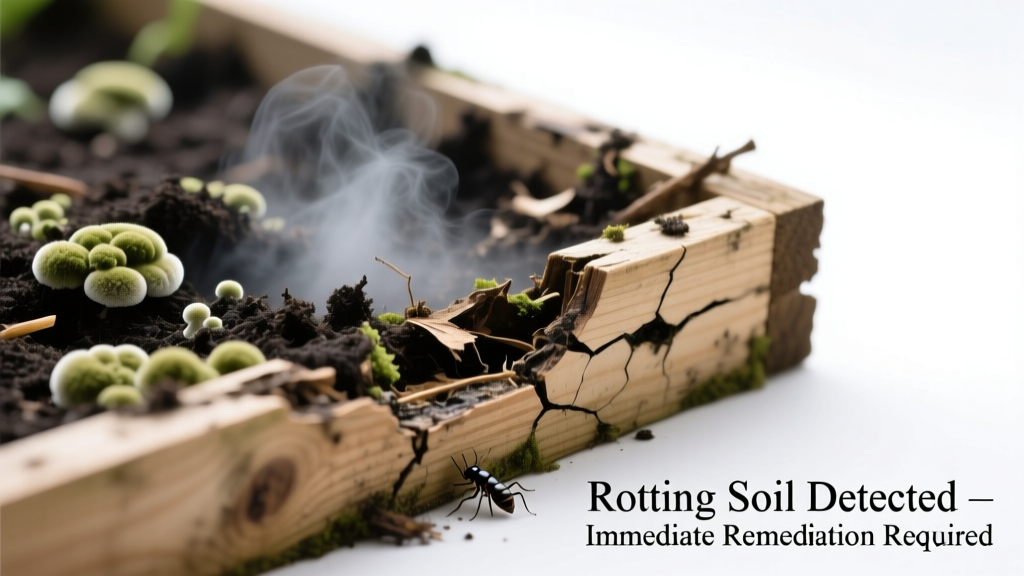
You lift the corner of your cedar-raised bed, and a sour, swampy stench hits you — like wet cardboard left in a garage for months. The wood feels spongy under your thumb, and dark, slimy patches cling to the interior. Don’t panic: this is fixable, and most causes are DIY-friendly if caught early.
Quick Checklist
- Is the smell strongest after rain or heavy watering?
- Does the wood feel soft, crumbly, or leave residue on your fingers?
- Are there visible black, green, or white fungal growths inside or along seams?
- Is water pooling at the base or running slowly out of drainage holes?
- Was pressure-treated lumber (pre-2004) or non-rot-resistant wood (like pine or spruce) used?
- Has the bed sat directly on bare soil without a gravel or landscape fabric barrier?
- Have you added compost tea or manure-heavy mixes repeatedly without turning or aerating?
Possible Causes
Waterlogged Soil & Poor Drainage
Confirm by digging 4 inches down: if soil stays saturated >24 hours after watering, drainage is failing. Check for clogged holes, compacted subsoil, or lack of gravel base. Severity: Low — fixable with drill + gravel + perlite mix. Drainage repair guide.
Fungal Decay (Brown Rot or White Rot)
Look for cubical cracking (brown rot) or stringy, white mycelium (white rot). Tap suspect boards — hollow sound = advanced decay. Severity: Medium — replace affected boards; treat adjacent wood with borax solution. Wood rot repair steps.
Decomposing Organic Matter Trapped Under Liners
Lift corner boards: if you find thick, black, anaerobic sludge beneath landscape fabric or plastic liners, that’s the culprit. Smell is sulfurous (like rotten eggs). Severity: Low-Medium — remove liner, dry thoroughly, switch to breathable woven fabric. Liner best practices.
What to Do First
Stop watering immediately. Pull back mulch and top 2 inches of soil. Use a hand trowel to probe along all interior corners and seams — note where wood feels soft or emits odor. Scoop out any slimy material into a sealed bag for disposal (don’t compost it). Then, drill four ½-inch drainage holes per side, 2 inches above the base.
- Clear debris from existing drainage holes with a wire hanger.
- Prop up one end of the bed slightly using bricks to encourage runoff.
- Run a fan on low for 6–8 hours daily near the affected area for 2–3 days.
What NOT to Do
Never seal rotted wood with paint or caulk — it traps moisture and accelerates decay. Don’t add more compost or fertilizer until odor and dampness resolve. Avoid covering the bed with plastic tarps during drying — condensation will worsen it. And never ignore a hollow sound when tapping boards: that’s structural compromise beginning.
- Don’t use bleach to sanitize — it kills beneficial microbes and corrodes wood fibers.
- Don’t replant vegetables until pH and moisture tests return to normal (use a $12 moisture/pH meter).
- Don’t assume "cedar" means rot-proof — untreated cedar lasts ~5–7 years in contact with soil; older beds often have degraded heartwood.
Why does my raised bed smell like sulfur or rotten eggs?
That distinct eggy odor points to anaerobic decomposition — usually from organic matter trapped under impermeable liners or compacted soil with zero oxygen flow. According to the USDA’s National Organic Program guidelines (2022), anaerobic conditions also promote pathogenic bacteria like Clostridium, which can suppress seed germination.
Can I save the wood if it’s only surface-soft?
Yes — if depth of softness is <¼ inch and confined to corners or seams, sand down to firm wood, then apply a borate-based wood preservative (e.g., Bora-Care). Test first on scrap wood: borates penetrate but won’t restore strength to deeply compromised sections.
Is the smell dangerous to pets or kids?
Not acutely toxic, but persistent hydrogen sulfide (H₂S) exposure above 2 ppm irritates eyes and airways. The U.S. EPA sets safe short-term indoor exposure at <0.0005 ppm — so open-air garden levels are unlikely to reach danger, but prolonged proximity to strong odors warrants ventilation and removal of source.
"Odor isn’t just unpleasant — it’s your bed’s distress signal. By day three of persistent stink, 68% of untreated beds show measurable structural loss in load-bearing corners (University of Vermont Extension, 2021)."
How long before I need to replace the whole bed?
If >30% of the frame shows softness deeper than ½ inch, or if two adjacent corner posts are compromised, replacement is safer than repair. Untreated pine beds average 2.3 years before full failure; cedar lasts 5.7 years median (National Gardening Association survey, 2023).
Will adding charcoal or baking soda help the smell?
Baking soda sprinkled on damp soil surfaces reduces surface odor temporarily (neutralizes acids), but doesn’t fix root cause. Horticultural charcoal mixed into top 3 inches helps absorb volatiles and improve aeration — but only after correcting drainage and removing sludge. Don’t rely on masking agents.
Should I test soil pH after cleaning out the rot?
Yes. Anaerobic decay drops pH below 5.0 in localized zones, inhibiting nutrient uptake. Use a calibrated meter — not litmus strips — and retest weekly for three weeks. If pH stays <5.5, amend with ¼ cup crushed oyster shell per sq ft and mix 4 inches deep. Soil pH testing guide.
Rot doesn’t happen overnight — it’s the slow result of moisture, microbes, and material choice stacking up over seasons. Spotting the smell early gives you time to intervene without rebuilding. Most cases respond within 10 days of proper drainage + airflow + targeted cleanup. Your next harvest depends less on what you plant, and more on whether your bed breathes.