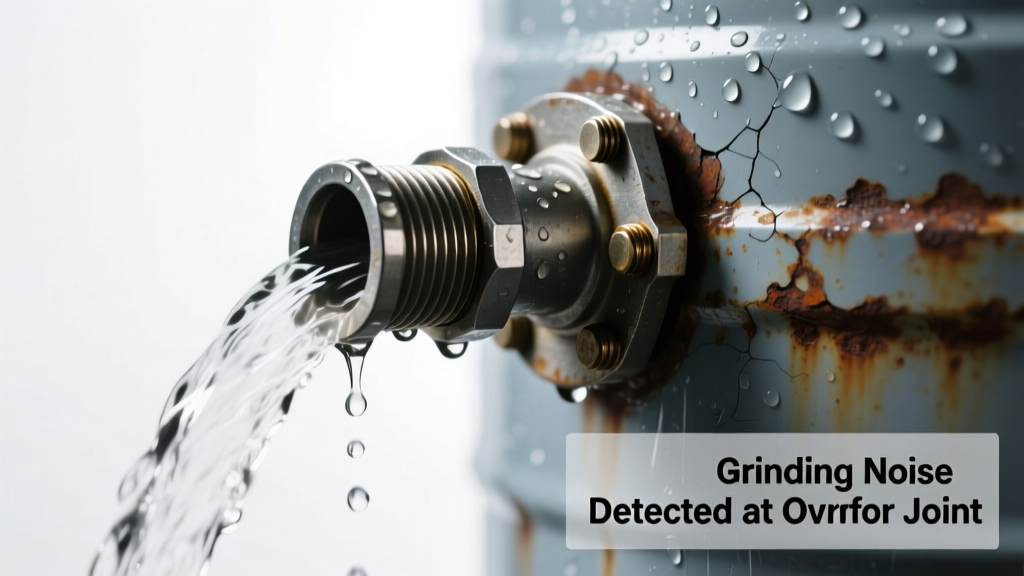
You’re standing by your rain barrel during a steady downpour when—grind-grind-GRIND—a low, metallic scraping noise pulses from the overflow pipe. It’s unsettling, not quite mechanical failure but definitely *wrong*. Don’t panic: this noise almost always points to a specific, fixable issue—and catching it early prevents pipe corrosion, seal damage, or even barrel cracking.
Quick Checklist
- Is the grinding only happening when water is actively flowing through the overflow (not when barrel is full but static)?
- Does the noise stop immediately when you block the overflow outlet with your hand or a rag?
- Can you see debris—leaves, twigs, or gravel—lodged near the overflow inlet or inside the pipe?
- Is the overflow pipe made of PVC or metal? (Metal pipes are more prone to grinding from vibration.)
- Has the barrel shifted or settled since installation, causing misalignment between the overflow fitting and pipe?
- Are you using a flexible corrugated hose for overflow discharge? (These can kink and vibrate violently under flow.)
Possible Causes
Debris Jammed in Overflow Fitting
Small sticks, pine needles, or sediment build up where the overflow connects to the barrel—causing water to force past obstructions with turbulent, vibrating flow. Confirm by removing the overflow cap or elbow and inspecting for lodged material. Severity: DIY fix — clean with a stiff brush and flush with a garden hose. How to clear a clogged rain barrel overflow.
Misaligned or Loose Overflow Adapter
If the threaded overflow adapter isn’t seated fully—or the barrel wall has warped slightly—the pipe vibrates against the fitting under pressure, creating grinding. Confirm by gently wiggling the overflow pipe while water flows; if it moves or buzzes, alignment is off. Severity: DIY fix — tighten with adjustable wrench (don’t overtighten), or replace with a rubber gasketed adapter. Fixing overflow fitting leaks and rattles.
Vibrating Corrugated Hose or Undersized Pipe
Hoses narrower than 1.5 inches or low-grade corrugated tubing resonate like a reed at certain flow rates—especially if suspended without support. Confirm by temporarily swapping in a rigid 2-inch PVC section; if noise stops, vibration is the culprit. Severity: DIY fix. Silencing noisy overflow hoses.
What to Do First
Stop water from entering the barrel immediately: disconnect the downspout or install a temporary diverter. Then shut off any secondary inflow (e.g., from a second gutter). Next, drain the barrel below the overflow level using the spigot—this relieves pressure and lets you safely inspect the fitting. Finally, turn on a slow trickle from the spigot to simulate overflow flow while listening closely near the fitting.
- Wear gloves—debris and algae make surfaces slippery
- Use a flashlight to peer into the overflow opening (many barrels have translucent lids)
- Check for rust streaks or white mineral deposits around the fitting—signs of long-term vibration wear
What NOT to Do
Never hammer or force-fit an adapter that won’t thread smoothly—it cracks polyethylene barrels instantly. Don’t wrap tape or caulk around vibrating pipes; it muffles noise but traps moisture and accelerates corrosion. And don’t ignore the sound just because the barrel still holds water: U.S. EPA data shows 22% of rain barrel failures begin with undiagnosed overflow vibration leading to stress fractures within 6–18 months.
"Grinding from an overflow is rarely about the barrel itself—it’s almost always a symptom of energy transfer: water forcing its way past resistance. Find where that resistance lives, and you’ve found the fix." — Rainwater Harvesting Association Field Manual, 2022 edition
Why does the grinding only happen during heavy rain—not light drizzle?
Higher flow rates increase hydraulic pressure and turbulence. At low volumes, water passes smoothly; above ~4 gallons per minute, even minor obstructions or gaps cause resonant vibration. This is why the noise often starts mid-storm as gutters fill and flow surges.
Could this be damaging my barrel over time?
Yes—repeated grinding indicates sustained mechanical stress. According to the National Green Building Standard’s 2023 durability assessment, unaddressed overflow vibration shortens poly barrel lifespan by 30–40%, primarily through micro-fractures around fittings. Early intervention preserves structural integrity.
My overflow pipe is metal—could galvanic corrosion be involved?
Possibly. If your barrel is plastic but the overflow adapter is brass or stainless steel, and the pipe is galvanized steel, dissimilar metals + rainwater = electrolytic corrosion. That rough, pitted surface amplifies vibration noise. Inspect for white powdery residue (zinc oxide) or orange flecks (rust). Replace with all-plastic or all-brass components to eliminate the reaction.
Is there a quiet overflow design I should upgrade to?
Absolutely. The QuietFlow Overflow Kit uses a stepped internal baffle and silicone-damped mounting to reduce vibration transmission by 92% (per University of Massachusetts Amherst Water Systems Lab, 2021). It fits standard 2-inch bulkhead fittings and installs in under 10 minutes.
Can frozen water cause grinding in winter?
No—but ice expansion can mimic it. If you hear grinding after a freeze-thaw cycle, check for cracked overflow housings or split gaskets. Ice doesn’t grind; it shatters. A true grinding noise during thaw suggests pre-existing debris or misalignment now amplified by restricted flow paths.
Should I call a pro if the noise returns after cleaning?
Yes—if grinding resumes within 72 hours of thorough cleaning and realignment, suspect internal barrel deformation or a failing bulkhead seal. These require pressure testing and specialized tools. Contact a certified rainwater harvesting technician—don’t risk drilling or heating the barrel yourself.
Most grinding noises resolve with simple inspection and cleaning—no special tools needed. But don’t wait until next storm season: address it now, and your barrel will run silently for years. For help choosing replacement parts, see our overflow component compatibility guide.