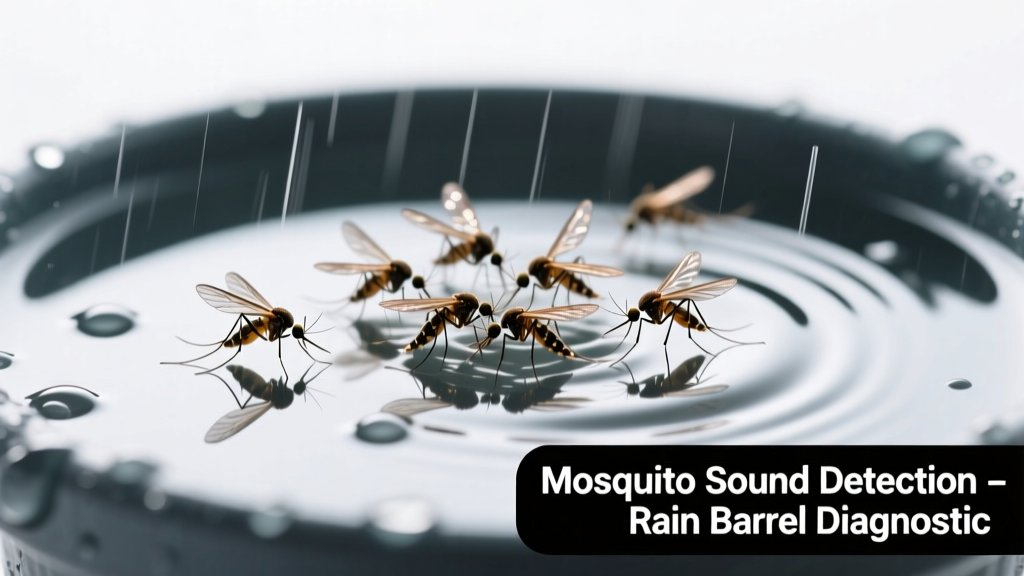
You’re standing near your rain barrel on a still, humid evening when you hear it—a faint, rhythmic click-click-click, like tiny pebbles tapping plastic. It’s not the wind. Not a loose lid. And it’s definitely not coming from inside your house. Mosquitoes don’t click—but something in or around your barrel is, and it’s often a red flag for stagnant water, trapped insects, or mechanical issues.
Quick Checklist
Answer these yes/no questions to narrow down the source:
- Is the clicking most noticeable at dawn or dusk?
- Does the sound increase after heavy rain or prolonged warm weather?
- Can you see mosquito larvae (wrigglers) or pupae (tumblers) in the water?
- Is the barrel covered—but with gaps, holes, or a poorly sealed screen?
- Do you hear buzzing *alongside* the clicking?
- Is the barrel mounted on a hard surface (concrete, pavers) that might amplify vibrations?
- Has the overflow pipe been clogged recently?
Possible Causes
Mosquito pupae tumbling near the water surface
Mosquito pupae (often called "tumblers") don’t bite—but they flip and jerk upward to breathe, striking the water surface or barrel wall with a soft, audible tick. In quiet conditions, multiple pupae can create a collective clicking rhythm. Confirm by shining a flashlight into the barrel at dusk: look for comma-shaped, bobbing forms just below the surface. Severity: Low—DIY fix. Remove standing water and install fine mesh.
Trapped adult mosquitoes vibrating against screen or lid
Adults drawn to moisture may get stuck under a loosely fitted lid or behind fiberglass screening. Their wingbeats—up to 300–600 Hz—can resonate against thin plastic or metal, producing a percussive ‘click’ when wings strike the barrier. Confirm by listening closely near seams or vents; try tapping the lid—if clicking pauses or changes pitch, vibration is likely involved. Severity: Low—DIY fix. Replace with 18-mesh or finer stainless steel screening.
Clogged or vibrating overflow valve or spigot
A partially blocked overflow pipe or worn rubber washer in the spigot can cause water pressure fluctuations that make components rattle or click—especially during filling or draining. Confirm by running clean water into the barrel and listening for clicks near the valve. Severity: Medium—some disassembly required. Inspect and replace washers or install a brass overflow elbow.
What to Do First
Drain the barrel completely using the spigot—don’t rely on evaporation. Scrub interior walls with a stiff brush and diluted vinegar (1:3 ratio), then rinse. Cover all openings with 18-mesh stainless steel screening, secured with stainless steel staples—not duct tape or rubber bands. According to the U.S. EPA, 14% of household water usage is lost to leaks and inefficiencies—including unnoticed rain barrel seepage that attracts pests (EPA WaterSense, 2022).
What NOT to Do
- Don’t pour bleach or insecticides directly into the barrel—this contaminates stored water and harms beneficial insects downstream.
- Don’t ignore the sound just because no larvae are visible—pupae are harder to spot and more acoustically active.
- Don’t use oil-based larvicides (e.g., dormant oil) unless labeled for rainwater harvesting systems—many degrade barrel liners or clog drip irrigation emitters.
- Don’t assume a ‘tight-fitting’ lid is mosquito-proof—most standard lids have micro-gaps larger than 0.5 mm, wide enough for adults to enter.
Why do I only hear the clicking at night?
Mosquito activity peaks at dusk and dawn due to cooler temperatures and higher humidity—conditions that also reduce ambient noise, making subtle clicks more detectable. Nighttime calm amplifies resonance in plastic barrels, especially when mounted on concrete pads that transmit vibration.
Could this be midges instead of mosquitoes?
Yes—non-biting midges (Chironomidae) thrive in the same stagnant water and produce nearly identical pupal clicks. They’re harmless but indicate the same underlying issue: unfiltered, uncovered water. Unlike mosquitoes, midges don’t require blood meals, so their presence alone doesn’t signal disease risk—but it does confirm poor water management.
Is the clicking coming from inside the downspout, not the barrel?
Possible. Debris buildup in vertical downspouts—especially leaf fragments wedged above the diverter—can shift with wind or water flow, creating intermittent taps. Disconnect the diverter and inspect the last 3 feet of downspout with a flashlight. If debris is present, flush with a garden hose on jet setting.
Can temperature changes cause clicking sounds?
Absolutely. Polyethylene barrels expand and contract up to 0.00012 in/in/°F. On hot days followed by cool evenings, rapid contraction can cause rivets, straps, or mounting brackets to ‘pop’—mimicking insect sounds. This usually occurs once per temp swing, not rhythmically. If clicking is irregular and coincides with sunset, thermal stress is likely.
Will adding goldfish solve the problem?
No—and it’s illegal in many municipalities. Goldfish quickly outgrow rain barrels, die from heat stress or low oxygen, and their waste degrades water quality. The Insurance Institute for Business & Home Safety’s 2023 Rainwater Harvesting Guide explicitly warns against vertebrates in aboveground catchment systems due to pathogen risks and maintenance failures.
"Pupal clicking is rarely dangerous—but it’s the loudest early warning system you’ll get that your rain barrel has become a certified mosquito nursery." — Dr. Lena Torres, Urban Entomology Extension Specialist, UC Davis, 2021
| Source | Sound Pattern | Time of Day | Visual Clue |
|---|---|---|---|
| Mosquito pupae | Rhythmic, light ticks (0.5–1 sec intervals) | Dusk/dawn | Comma-shaped, bobbing forms at surface |
| Trapped adults | Irregular buzz-click combos | All day, louder at dusk | Small black specks on underside of lid |
| Overflow valve | Click-hiss-click during fill/drain | Any time water flows | Water dripping from valve base |
| Thermal contraction | Single pop, then silence for hours | Sunset or sunrise | No water involvement; dry barrel |
If the clicking persists after draining, screening, and checking hardware, inspect your gutter-to-barrel diverter for worn gaskets or misalignment—these small gaps let in both bugs and noise triggers. Most cases resolve in under 20 minutes with the right tools and timing. You’ve already taken the hardest step: noticing the sound before it becomes a swarm.