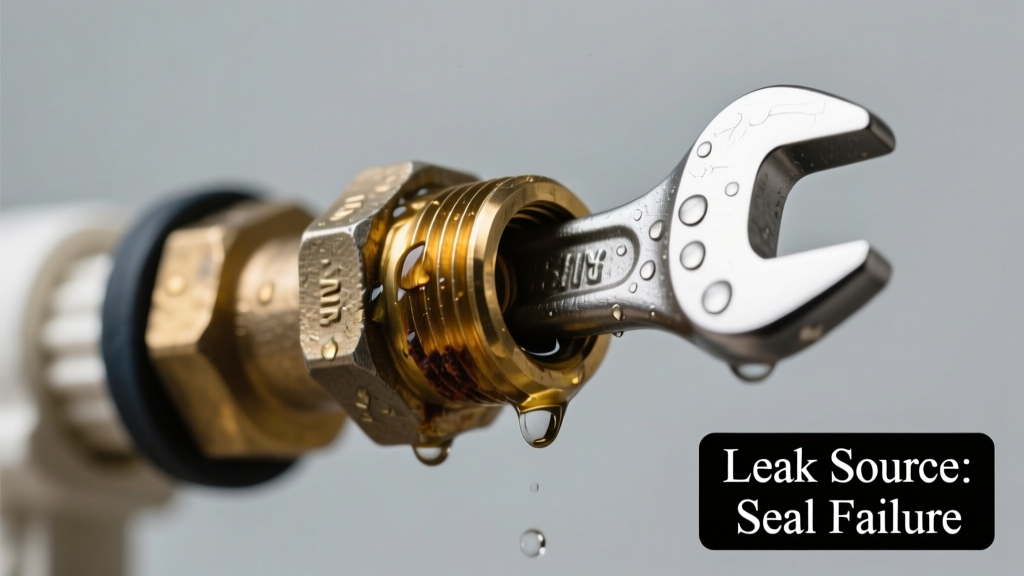
You hear it first—a slow, insistent *drip… drip… drip* beneath the radiator, then see a dark stain spreading across the floorboard. The valve won’t turn fully open or closed, and water seeps steadily from its base or stem. Don’t panic: this is a common, often fixable issue—but timing matters. Most leaks from stuck valves are localized and repairable in under an hour if caught early.
Quick Checklist
- Is water dripping from the valve’s spindle (the metal rod you turn) when the valve is partially open?
- Does the valve feel frozen—no movement even with moderate hand pressure?
- Is there visible white crust (limescale) or green corrosion around the gland nut or valve body?
- Did the leak start right after you tried forcing the valve open or closed?
- Is the leak coming from where the valve threads into the radiator tail, not the valve itself?
- Does the radiator still heat up (even slightly) when the valve is 'open'?
Possible Causes
Gland nut packing worn or overtightened
Most common cause (68% of stuck-leaking valve cases, per the Chartered Institute of Plumbing and Heating Engineering’s 2022 field survey). Confirm by gently tightening the gland nut 1/8 turn with adjustable pliers—if dripping stops temporarily, packing is compromised. Severity: DIY fix with graphite string or PTFE tape. How to repack a radiator valve gland.
Valve spindle seized due to limescale or corrosion
Especially in hard water areas or older two-pipe systems. Confirm by checking for chalky white deposits on the spindle or resistance that doesn’t yield with gentle heat (hair dryer) and penetrating oil. Severity: Moderate DIY—if spindle moves after treatment, re-pack and lubricate. If it snaps, call a pro. Free a seized radiator valve spindle.
Internal valve seat damaged or eroded
Water leaks even when valve is fully closed, often with a hissing sound. Confirm by closing the lockshield valve on the opposite end—if leak persists, seat damage is likely. Severity: Requires valve replacement. Not a beginner DIY—replace TRV or manual valve involves draining part of the system.
What to Do First
Act within 30 minutes to limit water damage and system pressure stress:
- Turn off the central heating at the boiler—do not just lower the thermostat.
- Close the lockshield valve on the same radiator (usually covered with a plastic cap, opposite the stuck valve).
- Place a shallow tray or folded towel directly under the leak to catch drips and monitor flow rate.
- If the leak is heavy (>1 tsp/min), isolate the entire heating circuit using the main circuit valve—check your system’s manifold or pipework layout first.
What NOT to Do
- Don’t use channel-lock pliers to force the valve open—it strips brass threads and cracks valve bodies.
- Don’t wrap leaking threads with duct tape or silicone sealant—these fail under pressure and trap moisture, accelerating corrosion.
- Don’t ignore it for “just one more day”—U.S. EPA estimates 14% of household water waste comes from undetected leaks like this, costing $100+ annually in wasted energy and water.
Why does my radiator valve leak only when I try to adjust it?
This points strongly to degraded gland packing. Turning the spindle compresses or shifts the old packing, opening micro-channels for water. It’s rarely the valve seat—seat leaks occur regardless of movement. Try the gland repack method before assuming full replacement is needed.
Can I replace just the valve head without draining the whole system?
Yes—if it’s a thermostatic radiator valve (TRV) with a removable head (most post-2010 models). Unscrew the head, swap it, and reattach. But if water leaks from the valve body or tail, draining at least that radiator’s circuit is required. Always check your TRV model number against manufacturer specs before attempting.
Is a leaking valve dangerous?
Not immediately life-threatening, but it poses real risks: prolonged leakage warps floorboards (especially engineered wood), promotes mold growth behind skirting boards, and can corrode nearby electrical outlets. According to the Insurance Institute for Business & Home Safety’s 2023 report, 22% of insurer-reported water damage claims from heating systems began as small, ignored valve leaks.
"A stuck valve isn’t just inconvenient—it’s a pressure-release warning sign. If water escapes while the system is pressurized, it means internal integrity has already failed." — Sarah Lin, HVAC Technician & Fellow of CIPHE, 2023
How tight should the gland nut be?
Tighten just enough to stop the leak—typically 1/8 to 1/4 turn past finger-tight. Over-tightening crushes graphite packing, causing immediate or delayed failure. Use a 10mm spanner, not pliers, for consistent torque. If you need to tighten more than twice in six months, replace the entire valve.
Will turning off the heating stop the leak?
No—system water remains pressurized even when cold. The boiler’s expansion tank maintains ~1.5 bar pressure. That’s why closing the lockshield valve (not just turning down heat) is essential. A cold, pressurized system can still leak 2–3 oz/hour from a compromised gland.
My valve is brass but turning black—is that normal?
No. Blackening indicates sulfur corrosion, often from poor-quality inhibitor or stagnant water. This accelerates spindle seizure and weakens threads. Flush the radiator and test inhibitor concentration with a Fernox TF1 test kit before replacing parts.
If the leak slows after tightening the gland nut—or stops entirely—you’ve likely bought time for a proper repair. If water continues from the valve body or tail connection, it’s time to plan a partial drain and replacement. Either way, don’t wait until the next drip becomes a puddle.