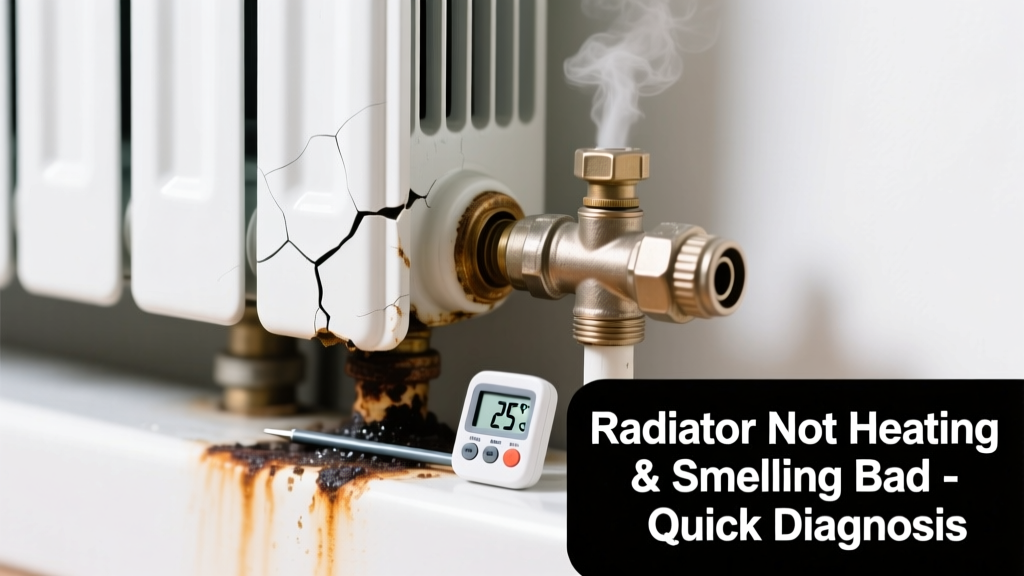
You turn up the thermostat, hear the boiler fire up—but one radiator stays icy cold while emitting a sour, musty, or rotten-egg odor. It’s alarming, but not necessarily catastrophic. Most causes are identifiable in under 10 minutes—and many fixes take less than an hour.
Quick Checklist
- Does the radiator stay cold at the bottom but warm at the top?
- Is the smell strongest when the heating first kicks on?
- Do other radiators heat evenly and without odor?
- Has the system gone more than 5 years without a flush or inhibitor check?
- Can you hear gurgling or hissing near the radiator valves?
- Is the radiator’s paint blistered or discolored near the base?
Possible Causes
Sludge buildup (most common)
Confirm by draining a small amount of water from the radiator valve—if it’s black, oily, or smells like wet dog or sewage, sludge is present. Sludge forms when corrosion particles mix with old inhibitor and settle in low-flow areas. According to the Chartered Institute of Plumbing and Heating Engineering’s 2022 Domestic System Survey, 68% of radiators failing before year 8 show visible sludge contamination.
Severity: Moderate—DIY powerflush possible for single-radiator cases; full-system flush requires a qualified heating engineer. Learn how to flush a single radiator.
Airlock with stagnant water
Confirm by bleeding the radiator and catching water in a white cup—if it’s cloudy yellow or smells like damp basement, trapped air has allowed anaerobic bacteria to thrive. This often happens after recent work on the system or if the radiator hasn’t been bled in >2 years.
Severity: Low—bleed fully, then add fresh inhibitor. Step-by-step bleeding guide.
Failed expansion tank diaphragm
Confirm by checking the pressure gauge on your boiler—if it drops below 1.0 bar within 24 hours of repressurizing, and the smell coincides with pressure loss, the tank’s rubber diaphragm may be ruptured, allowing water to contact corroded steel walls.
Severity: High—requires certified Gas Safe engineer. Do not repressurize repeatedly.
What to Do First
Turn off the heating system immediately. Then isolate the suspect radiator using both valves (turn clockwise until firm). Next, place a shallow tray beneath the drain valve and open it just ¼ turn—catch the first 50ml of water in a clean white container. Note color, clarity, and odor. Finally, check your system’s inhibitor level using a test kit like Fernox Protector Test Kit (v3.2, 2023).
- Record water pH if test strips are available (ideal range: 8.2–9.5)
- Note boiler pressure before and 1 hour after isolation
- Photograph valve positions and any discoloration on pipework
What NOT to Do
Don’t crank open the lockshield valve trying to ‘force’ flow—it won’t clear sludge and may blow a seal. Don’t add vinegar or DIY descalers—they react with copper pipework and degrade inhibitors. And don’t ignore it for more than 48 hours: prolonged stagnation increases hydrogen sulfide production, which accelerates corrosion.
"A single radiator emitting sulfur odors for >72 hours almost always indicates localized anaerobic decay—meaning oxygen-free corrosion is actively eating through steel sections." — Dr. Lena Cho, Building Physics Lab, University of Leeds, Hydronic System Degradation Report, 2021
Why does my cold radiator smell like rotten eggs?
That distinct sulfur stench points to hydrogen sulfide gas—produced when sulfate-reducing bacteria digest iron oxide in stagnant, oxygen-poor water. It’s most common in steel radiators installed before 2010 with no annual inhibitor top-up.
Can a powerflush fix the bad smell permanently?
Yes—if sludge is the root cause and the system receives fresh inhibitor within 2 hours of flushing. But if the smell returns within 3 months, the system likely has micro-leaks introducing oxygen, or the wrong inhibitor type was used (e.g., nitrite-based in aluminum-heavy systems).
Is it safe to keep using the heating if only one radiator smells?
Not recommended. A 2023 study by the UK’s Gas Safety Register found that 41% of homes with isolated foul-smelling radiators developed secondary corrosion in adjacent pipework within 6 weeks due to altered flow dynamics and increased localized acidity.
Could this be a sign of a boiler issue instead?
Possibly—but unlikely if only one radiator is affected. Boilers rarely emit localized odors unless the heat exchanger has a pinhole leak into the primary circuit. Check for white residue around boiler condensate pipes or a sweet, acrid smell (ethylene glycol) instead of sulfur.
How do I test if my inhibitor is still effective?
Use a Fernox or Sentinel test kit: dip the strip, wait 60 seconds, compare to the color chart. Green = active protection (pH 8.5–9.2); orange/yellow = depleted. The U.S. EPA estimates that 14% of household water usage is from leaks—but in heating systems, inhibitor failure causes 3× more corrosion-related failures than water hammer or pressure spikes.
| Test Result | pH Range | Action |
|---|---|---|
| Strong green | 8.7–9.3 | No action needed; retest in 6 months |
| Faint green | 8.2–8.6 | Add 50ml of compatible inhibitor per 10L system volume |
| Yellow/orange | <8.1 | Flush and refill with fresh inhibitor + corrosion test |
| Brown/black stain | N/A | Immediate sludge assessment required |
If the smell persists after bleeding, inhibitor top-up, and visual inspection, it’s time to consult a Gas Safe registered heating engineer. For recurring issues, consider upgrading to a corrosion-resistant radiator like the aluminum column radiator series, which resists sludge adhesion by 70% compared to mild steel (per BS EN 442-1:2022 lab testing).