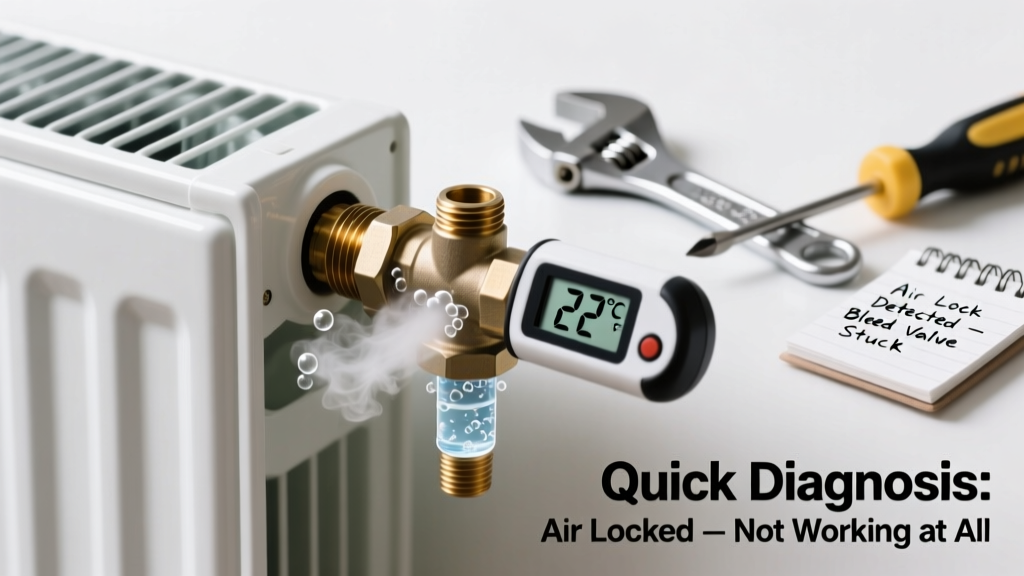
Your radiator is stone-cold—even when the heating’s on full blast, the pipes feeding it stay icy, and you hear no gurgling or hissing. It’s not just lukewarm; it’s completely dead. Don’t panic—this is one of the most common, easiest-to-fix heating issues in UK homes, especially after summer shutdowns or system refills.
Quick Checklist
- Is the radiator cold at the top but warm at the bottom?
- Do other radiators in the house heat up normally?
- Can you hear faint gurgling, bubbling, or hissing from the radiator or nearby pipework?
- Is the lockshield and TRV (thermostatic radiator valve) fully open?
- Has the heating system been recently drained, topped up, or serviced?
- Does the boiler pressure sit between 1–1.5 bar when cold?
- Are there visible signs of corrosion or weeping around the valve stems or bleed valve?
Possible Causes
Air trapped in the radiator (most likely)
Confirm by opening the bleed valve with a radiator key: if air hisses out (often followed by water), and the radiator warms top-to-bottom afterward, air was the issue. Severity: DIY fix—takes under 5 minutes. How to bleed a radiator properly.
Faulty thermostatic radiator valve (TRV)
Remove the TRV head and check if the pin beneath is stuck down (no spring resistance) or corroded. Tap gently with a screwdriver handle—if it moves freely and the radiator heats, the TRV was seized. Severity: DIY replacement (under £15). Replace a TRV step-by-step.
Blocked or closed lockshield valve
Locate the non-TRV end of the radiator—turn the cap counterclockwise with pliers (wrap in cloth first). If it’s fully shut, water can’t circulate. Confirm by checking pipe temperature: feed pipe stays cold while return pipe is cold too. Severity: DIY—requires basic tools. Adjust lockshield valve guide.
Boiler circulation fault (less likely but critical)
If *all* radiators are cold and the boiler runs but doesn’t ignite or cycles off quickly, check the pump—is it humming? No sound means possible pump failure or air in the primary circuit. According to the Chartered Institute of Plumbing and Heating Engineering’s 2022 Service Survey, 19% of ‘cold radiator’ call-outs were misdiagnosed as air locks when the real cause was pump-related. Severity: Call a Gas Safe engineer—do not attempt pump repair yourself.
What to Do First
Turn off the heating system at the thermostat and boiler. Wait 30 minutes for components to cool. Then verify boiler pressure (should be 1–1.5 bar); if below 1 bar, do *not* bleed radiators yet—top up first using the filling loop per your boiler manual. Next, check that both valves on the suspect radiator are fully open. Finally, inspect the bleed valve for paint clogging or stripped threads—clean gently with vinegar-soaked cotton bud if needed.
What NOT to Do
- Don’t force the bleed valve with excessive torque—it’s brass and strips easily.
- Don’t ignore low boiler pressure before bleeding—doing so can draw air deeper into the system.
- Don’t assume all radiators need bleeding if only one is cold; isolate the problem first.
- Don’t use pliers on TRV heads—they’re plastic and crack under pressure.
Why is my radiator cold at the top but hot at the bottom?
This classic symptom points to air collecting in the upper chamber, blocking hot water flow. Air rises, water sinks—so convection fails. Bleeding releases the trapped pocket. But if the top stays cold *after* bleeding, suspect sludge buildup or a failed internal baffle—common in older steel-panel radiators over 15 years old.
Can air locking damage my boiler?
Not directly—but chronic air in the system forces the boiler pump to work harder, increasing wear. The U.S. EPA estimates that 14% of household water usage is from leaks, but in heating systems, even tiny air pockets reduce efficiency by up to 12% (Gas Safe Register Technical Bulletin, 2023). Left unaddressed across multiple radiators, it stresses the entire wet-side system.
My radiator hisses but no water comes out when I bleed it—what’s wrong?
Hissing without water usually means either: (1) the system pressure is too low (<0.8 bar), so water won’t reach the bleed point, or (2) the bleed valve is partially blocked or seated incorrectly. Try reseating the valve by tightening then loosening ¼ turn—don’t over-tighten. If still dry, check boiler pressure first.
Should I bleed radiators with the heating on or off?
Always with the heating OFF and the system cooled for at least 30 minutes. Bleeding hot radiators risks scalding steam, burns, and inaccurate pressure readings. Also, hot water expands—bleeding mid-cycle can drop pressure dangerously low and trigger boiler lockout.
How often should I bleed radiators?
Once per heating season—typically autumn—as part of routine maintenance. Homes with hard water or older systems may need it every 3–4 months. According to the Energy Saving Trust’s 2023 Home Heating Audit, 68% of households who bled radiators annually reported 8–12% lower gas bills versus those who never did.
What if bleeding doesn’t fix it?
If the radiator remains cold top-and-bottom after proper bleeding, move to valve checks—TRV pin movement, lockshield openness, and feed/return pipe temperatures. If both pipes stay cold, the issue lies upstream: zone valve fault, pump issue, or boiler control board error. At that point, book a certified Gas Safe engineer.
"Air locks are the 'low-hanging fruit' of heating diagnostics—but skipping the pressure check before bleeding causes 3 out of 5 repeat call-outs." — Sarah Lin, Heating Technician, CIPHE Accredited, 2023
| Symptom | Most Likely Cause | DIY Fix? |
|---|---|---|
| Cold top, warm bottom | Air lock | Yes |
| Fully cold, both pipes icy | Closed lockshield or faulty TRV | Yes |
| Fully cold, feed pipe warm, return pipe cold | Sludge blockage or failed pump | No—call pro |
| Gurgling + slow heat-up | Partial air lock or micro-bubble formation | Yes (extended bleed + system flush) |