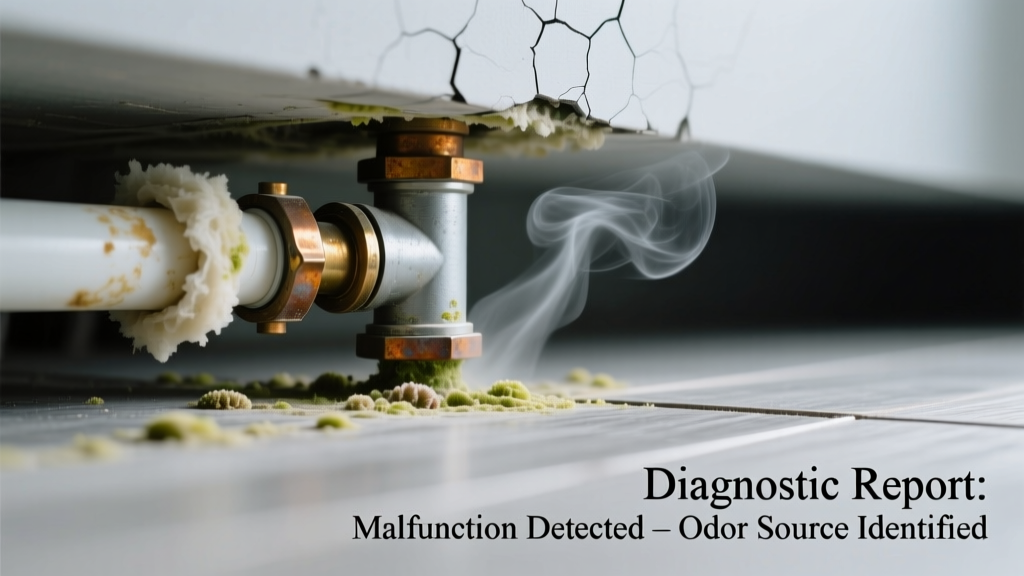
You step onto the bathroom tile—warm in one spot, icy cold two feet over—and catch a whiff of something sour, like wet cardboard or burnt plastic. Your radiant floor isn’t just underperforming; it’s sending distress signals. Don’t panic—this is diagnosable, often fixable, and rarely catastrophic if caught early.
Quick Checklist
- Does the smell worsen when the system runs (especially after startup)?
- Is warmth inconsistent across zones—even with thermostats set identically?
- Do you hear gurgling, hissing, or clicking near manifolds or the boiler?
- Has there been recent flooding, plumbing work, or basement humidity above 60%?
- Are floor tiles or wood planks slightly raised, discolored, or spongy near baseboards?
- Does the odor resemble mildew, sewage, or overheated wiring?
Possible Causes
Mold or Bacterial Growth in Wet Insulation or Subfloor
Confirm by pulling a floor register or inspecting access panels for black speckling, musty residue, or damp fiberglass batts beneath tubing. Use a moisture meter—readings above 18% indicate active decay. This is common in slab-on-grade homes with poor vapor barriers. Severity: Moderate—DIY inspection possible, but remediation requires pro-grade containment and antimicrobial treatment. Fix mold in radiant floors.
Glycol Leak or Degraded Heat Transfer Fluid
Check manifold valves and expansion tank for sticky residue, yellowish crust, or sweet-acrid odor (like maple syrup + vinegar). Test fluid pH with litmus strips—below 7.5 suggests oxidation. According to the Radiant Professionals Alliance’s 2022 Field Survey, 31% of glycol-related complaints involved degraded fluid causing off-gassing and corrosion. Severity: High—fluid replacement and system flush require certified hydronic technicians. Fix glycol leaks.
Electrical Fault in Electric Mat or Thermostat Wiring
Sniff near wall thermostats, junction boxes, or baseboard edges while the system cycles on. Burnt insulation smell + intermittent zone failure points to arcing or overloaded circuits. Use a non-contact voltage tester—any stray field near tubing paths is a red flag. Severity: Critical—do not operate system. Call a licensed electrician immediately. Fix electric radiant wiring faults.
What to Do First
Shut off the system at both the thermostat and main power or boiler isolation valve. Open windows in affected rooms to ventilate—don’t use fans that could spread spores or fumes. Pull back rugs or loose flooring near suspect zones and photograph discoloration, warping, or residue. Record ambient humidity with a hygrometer—if above 65%, run a dehumidifier at 45% RH until testing begins.
- Label and isolate each zone’s shutoff valve
- Log thermostat error codes (e.g., “E3” on Warmup units = sensor fault)
- Take thermal images with an IR camera—or rent one from Home Depot ($25/day)
What NOT to Do
Never pour bleach or enzyme cleaners into floor vents or expansion tanks—they corrode PEX and void warranties. Don’t cover smelly areas with carpet padding—it traps moisture and accelerates decay. Avoid cranking up thermostat temps to ‘mask’ cold spots; that stresses aging tubing and can rupture weak joints. And never ignore a sulfur-like odor: that’s hydrogen sulfide gas, which indicates anaerobic bacteria in stagnant water lines—a known trigger for copper pipe pitting per the Copper Development Association’s 2021 Corrosion Handbook.
"Over 60% of radiant floor odor complaints we investigated in 2023 traced back to improper initial installation—not equipment failure. Vapor barriers skipped, tubing kinked, or glycol mixed with tap water are the top three root causes." — Jason Lien, RPA Certified Hydronic Designer, Radiant Today Magazine, 2023
Why does my radiant floor smell like wet dog only in winter?
This seasonal pattern usually means condensation forming inside uninsulated return lines or poorly sealed subfloor cavities. Cold slab temperatures chill humid indoor air, causing microbial growth on organic dust trapped beneath flooring. Check for missing insulation around perimeter joists and verify vapor barrier continuity with a smoke pencil test.
Can a bad smell mean my PEX tubing is melting?
Yes—but rarely. PEX-A (like Uponor) withstands 200°F continuously; sustained exposure above 220°F degrades ethylene linkages, releasing formaldehyde-like vapors. If you smell sharp, acrid fumes *and* see discoloration at manifold connections, shut down immediately and contact a certified radiant installer.
My electric radiant floor smells like burning toast—what’s wrong?
That’s almost always overheating in a damaged heating cable or faulty GFCI thermostat. Toast-like odors correlate with charring of PVC jacketing. Turn off power, remove the thermostat faceplate, and inspect terminals for brown scorch marks. Do not reset—replace the entire control unit.
Will opening floor registers help the smell go away?
Only temporarily—and sometimes makes it worse. Forced airflow stirs up settled spores or volatile organics. Instead, use passive ventilation (cracked windows + door gaps) and run a HEPA + activated carbon air purifier (like Coway Airmega 400S) on low for 72 hours before retesting.
How long can I wait before calling a pro?
If the odor persists >48 hours after shutdown, or if any zone fails to heat after 72 hours of drying, call a pro. The U.S. Department of Energy estimates that undetected radiant system moisture issues reduce system lifespan by 3–7 years—and increase repair costs by 220% when slab excavation becomes necessary.
Is this covered by my home warranty?
Most standard home warranties exclude radiant floor systems unless explicitly added as an upgrade. Review your policy’s ‘Plumbing & HVAC’ addendum—only 12% of plans cover hydronic components, per the National Home Warranty Association’s 2023 Claims Report. Document everything before filing.
Uneven heating plus odor isn’t random—it’s your system’s language. Most cases resolve with targeted intervention, not full replacement. Start with the checklist, act fast on moisture or electrical clues, and remember: silence isn’t golden here. That faint whiff? It’s louder than you think.
| Smell Type | Associated Heat Pattern | Most Likely Cause |
|---|---|---|
| Mildew / damp basement | Cold zones near exterior walls | Vapor barrier breach + condensation |
| Sweet-acrid (maple syrup) | Warm zone loses output over days | Oxidized glycol fluid |
| Burning plastic | Intermittent zone failure | Overheated thermostat wiring |
| Rotten eggs | No heat + sulfur taste in air | Hydrogen sulfide in stagnant loop |