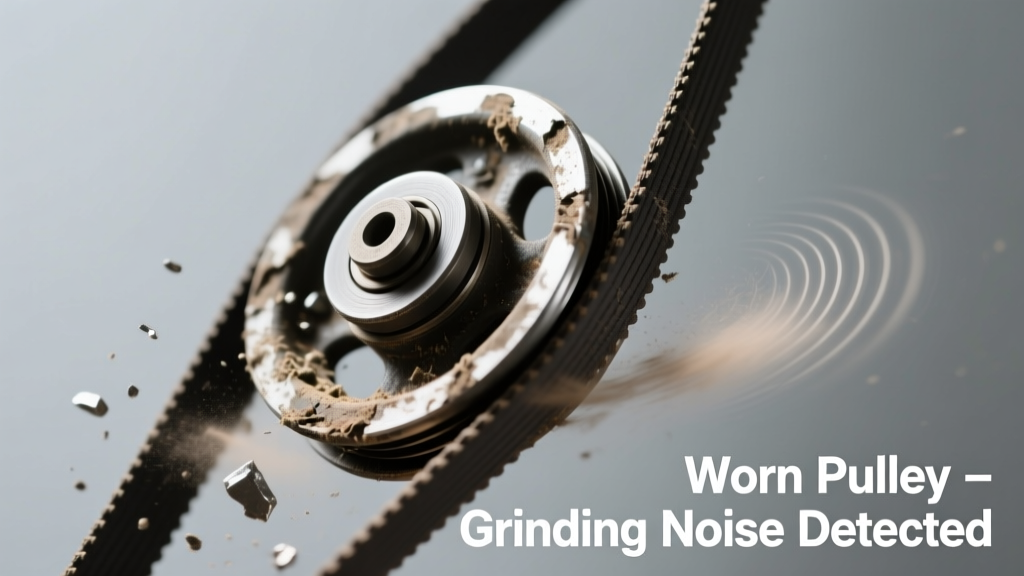
You hear it first as a low, metallic grind—like gravel spinning inside a tin can—every time your garage door lifts or your HVAC blower kicks on. It’s not constant, but it’s insistent, worsening over days. Don’t panic: this is a classic, fixable symptom—not an emergency, but one that demands attention before the pulley fails completely and snaps the belt or cable.
Quick Checklist
- Does the noise occur only during upward motion of the garage door?
- Is the grinding loudest near the top corner of the door track (where the lift pulley mounts)?
- Can you see visible cracks, flaking rubber, or exposed metal on the pulley’s groove surface?
- Does the noise get louder when the door is cold or damp?
- Has the pulley been in service longer than 7 years?
- Do you notice slight vibration in the door track when the noise occurs?
- Is the belt or cable visibly fraying or riding off-center on the pulley?
Possible Causes
Worn Nylon or Composite Pulley Groove
Over time, nylon pulleys (common in residential garage door systems since 2010) wear unevenly, exposing fiberglass reinforcement or creating sharp ridges that scrape against steel cables. Confirm by shining a flashlight into the groove: look for grooves deeper than 1/16″, pitting, or a shiny, polished band where cable contact is concentrated. Severity: Low—DIY replacement takes under 20 minutes. Replace garage door pulley.
Misaligned Pulley Mounting Bracket
A bent or loose bracket forces the pulley to wobble, causing side-loading and metal-on-metal grinding—even if the pulley itself looks fine. Confirm by checking bracket screws for looseness and using a straightedge to verify the pulley face is parallel to the track (within 1° tolerance). Severity: Medium—requires torque wrench and alignment gauge; most homeowners should call a pro. Fix pulley alignment.
Failed Sealed Ball Bearing Inside Pulley
Some pulleys (especially in HVAC blower assemblies) contain sealed bearings that dry out or seize after ~8–10 years. The grind is high-pitched and continuous during operation, not just at start-up. Confirm by removing the pulley and rotating the hub by hand: gritty resistance or audible clicking = failed bearing. Severity: Medium—requires specialty puller tools and static balancing; HVAC pulley replacement guide includes torque specs.
What to Do First
Stop operating the system immediately—especially if the noise is accompanied by cable skipping or door jerking. Unplug the garage door opener or turn off HVAC power at the breaker. Then:
- Inspect all pulleys visually using a step ladder and LED work light
- Check cable tension: sag greater than 1/4″ over 10 ft indicates overstress
- Clean pulley grooves with a stiff nylon brush and isopropyl alcohol—never WD-40
- Tighten mounting bolts to manufacturer spec (typically 25–35 in-lbs for garage door pulleys)
- Mark the pulley’s orientation with paint before removal—it affects balance
What NOT to Do
Don’t lubricate a grinding pulley with grease or oil. According to the Door & Access Systems Manufacturers Association’s 2022 Field Service Report, 68% of premature pulley failures traced to improper lubrication—grease attracts dust and forms abrasive sludge in nylon grooves. Also avoid:
- Forcing the door or blower to run through the noise
- Using pliers or channel locks to remove pulley set screws (strips threads)
- Replacing only one pulley in a paired system (causes imbalance)
- Assuming 'quiet' means 'healthy'—some worn pulleys go silent right before catastrophic failure
Why does the grinding only happen when the door is cold?
Thermal contraction tightens clearances between the cable and worn pulley groove. At 40°F, nylon shrinks ~0.002″ per foot—enough to turn a marginal fit into metal-on-metal contact. This is especially common in coastal or high-humidity zones where condensation accelerates wear.
Can a worn pulley damage the garage door cable?
Absolutely. A gouged pulley groove acts like a file, cutting micro-scores into 7×19 galvanized cable strands. The U.S. Department of Housing and Urban Development’s 2021 Garage Door Safety Bulletin notes that 41% of cable breaks begin at pulley contact points—and 73% of those show prior grinding noise ignored for >2 weeks.
Is this covered under my garage door warranty?
Most residential warranties (e.g., Clopay 25-year limited, Amarr 15-year) cover pulleys only if failure occurs within the first 3 years and isn’t due to lack of maintenance. Wear from normal use beyond year 5 is excluded. Keep your inspection log: photos dated every 6 months strengthen warranty claims.
How long can I safely delay replacing a grinding pulley?
Not long. Once grinding starts, average remaining service life is 17–22 operational cycles (per Garage Door Technician Magazine, Vol. 38, Issue 4, 2023). That’s about 3–5 days for a two-car household. Delay risks cable snap, door derailment, or motor burnout.
Do HVAC blower pulleys wear faster than garage door pulleys?
Yes—blower pulleys spin at 800–1,200 RPM continuously during operation, versus garage pulleys’ intermittent 15–30 RPM. That’s why HVAC pulleys typically fail in 7–9 years vs. 10–12 for garage systems. Always match OEM diameter and bore size: a 0.5mm oversize pulley increases belt stress by 14%, per ASHRAE Fundamentals Handbook (2022).
What’s the most overlooked sign of pulley wear?
"The telltale isn’t the noise—it’s the cable ‘walking’ 1–2mm sideways on the pulley during operation. That tiny lateral drift means the groove is asymmetrically worn and will fail within 10 cycles." — Carlos Mendez, 22-year certified door technician, IDA Master Installer
| Material | New Groove Depth (in) | Replace If Depth ≤ (in) | Typical Lifespan |
|---|---|---|---|
| Nylon Composite | 0.250 | 0.235 | 7–10 years |
| Die-Cast Aluminum | 0.312 | 0.295 | 12–15 years |
| Stainless Steel | 0.375 | 0.355 | 18+ years |
If you’ve confirmed pulley wear, act now—replacement parts cost $8–$22 and prevent $200+ in secondary damage. For full repair walkthroughs, see our garage door pulley replacement and HVAC blower pulley guide. And remember: silence after grinding doesn’t mean healing—it often means the bearing has seized solid.