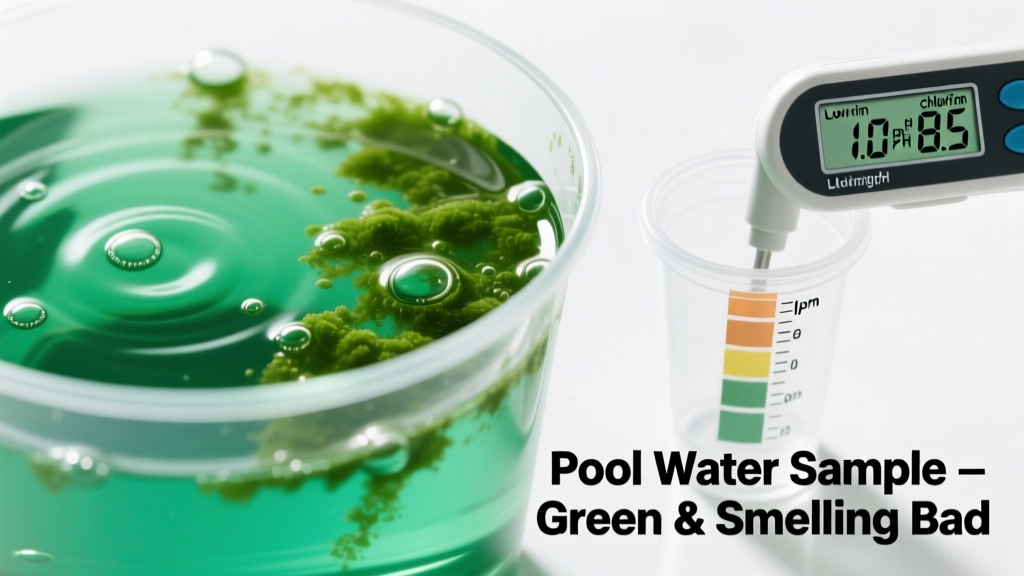
Your pool water looks like pea soup, smells like rotten eggs or wet dog, and maybe even coats your swimsuit with slime — it’s alarming, but not hopeless. Most green, smelly pools can be diagnosed and treated in under 48 hours if you act methodically.
Quick Checklist
- Is the water cloudy green (not just slightly hazy) with visible floating particles?
- Does the smell intensify near the skimmer or return jets?
- Has your chlorine level tested at or near zero for more than 24 hours?
- Are there slimy patches on steps, walls, or ladder rails?
- Did you recently skip shocking, backwash, or run the pump for >12 hours straight?
- Is your cyanuric acid (CYA) level above 80 ppm?
- Do you notice a strong ammonia or chloramine odor—not fresh chlorine?
Possible Causes
Algae Bloom (Most Common)
Confirm by swabbing a green wall patch with a white cloth—if it leaves green residue, it’s algae. Also check for pH >7.8 and free chlorine <1 ppm. Severity: DIY fixable in 2–3 days with proper shock and brushing. Fix green algae now.
Chlorine Lock (High CYA)
Test cyanuric acid—levels >100 ppm bind chlorine so tightly it can’t sanitize. Water may test as having ‘chlorine present’ but still smell swampy and harbor algae. Severity: Moderate DIY—requires partial drain (25–50%) and rebalancing. Break chlorine lock.
Black Algae or Sulfur Bacteria
Look for dark, speckled spots that resist brushing (black algae) or a distinct rotten-egg stench (sulfur-reducing bacteria). Test for hydrogen sulfide using a dedicated kit. Severity: Pro recommended—requires aggressive brushing, copper-based algaecide, and possible filter media replacement. Treat black algae.
What to Do First
Stop using the pool immediately. Run the pump continuously (24/7) for the next 48 hours—no exceptions. Test and record full water chemistry: free chlorine, total chlorine, pH, alkalinity, calcium hardness, and cyanuric acid. Skim all visible debris and brush walls and floor vigorously with a stainless-steel brush (avoid nylon on plaster).
- Shut off automatic chlorinators or salt cells until levels stabilize
- Clean or replace skimmer and pump baskets now
- Backwash or clean your filter (DE, cartridge, or sand) before shocking
What NOT to Do
Don’t double-shock without testing first—overchlorination can bleach liners and corrode metal fixtures. Don’t add clarifiers or flocculants yet; they’ll trap live algae and make filtration harder. And never ignore the smell: according to the CDC, foul odors often signal combined chlorine levels >0.5 ppm, which increases risk of recreational water illnesses.
"A persistent sulfur or musty odor in green pool water isn’t just unpleasant—it’s a red flag for anaerobic bacteria colonies thriving in dead zones. Brushing and circulation are non-negotiable before any chemical treatment." — Pool & Hot Tub Alliance Water Quality Manual, 2022
Why does my green pool smell like wet dog?
This odor usually means Pseudomonas aeruginosa or other biofilm-forming bacteria feeding on organic waste in low-chlorine conditions. It’s not just algae—it’s microbial decay. Confirm with a total plate count test (available at most pool supply labs). Fix requires superchlorination + enzyme treatment.
Can rain cause green water and bad smell?
Yes—especially after heavy storms. Rain dilutes sanitizer, washes nitrogen-rich organics (leaves, pollen, fertilizer) into the pool, and lowers pH. The U.S. EPA estimates storm runoff contributes to 30% of seasonal algae outbreaks in residential pools (National Stormwater Database, 2021). Test within 6 hours of rainfall.
Is it safe to swim in green, smelly water?
No. The CDC reports swimmers in poorly sanitized green pools face up to 4× higher risk of skin rashes, ear infections, and gastrointestinal illness. Even if no one feels sick yet, the presence of combined chlorine and heterotrophic bacteria exceeds public health thresholds.
Why did my saltwater pool turn green and smell like ammonia?
Salt systems produce chlorine slowly—and when demand spikes (e.g., after heatwave or party), they fall behind. Ammonia odor signals chloramine buildup from sweat and urine reacting with insufficient free chlorine. Your salt cell may be scaled or undersized; test output with an ORP meter.
How long before green, smelly water damages my pool surface?
Within 72 hours, acidic byproducts from decaying algae can etch plaster and corrode stainless steel ladders. Vinyl liners may stain permanently after 5 days. According to the National Plasterers Council, 68% of acid-etched plaster repairs stem from untreated green water episodes lasting >3 days.
| Free Chlorine | CYA (ppm) | pH | Smell Profile | Most Likely Cause |
|---|---|---|---|---|
| <0.5 ppm | <50 | 7.2–7.6 | Grassy/musty | Early-stage green algae |
| 1–3 ppm | >100 | 7.8–8.2 | Chlorine-like but stale | Chlorine lock |
| <0.2 ppm | Any | <7.0 | Rotten eggs | Sulfur bacteria |
| 0.5–1.5 ppm | 30–60 | 7.0–7.4 | Ammonia/wet dog | Chloramine buildup |
If your water turned green and foul-smelling overnight, don’t panic—start with the checklist, then match your numbers to the table above. Most cases resolve with targeted shock, circulation, and filtration. For persistent issues, consider a certified lab water analysis to rule out metals or phosphates. And remember: green + stink is never ‘just cosmetic’—it’s your pool’s distress signal.