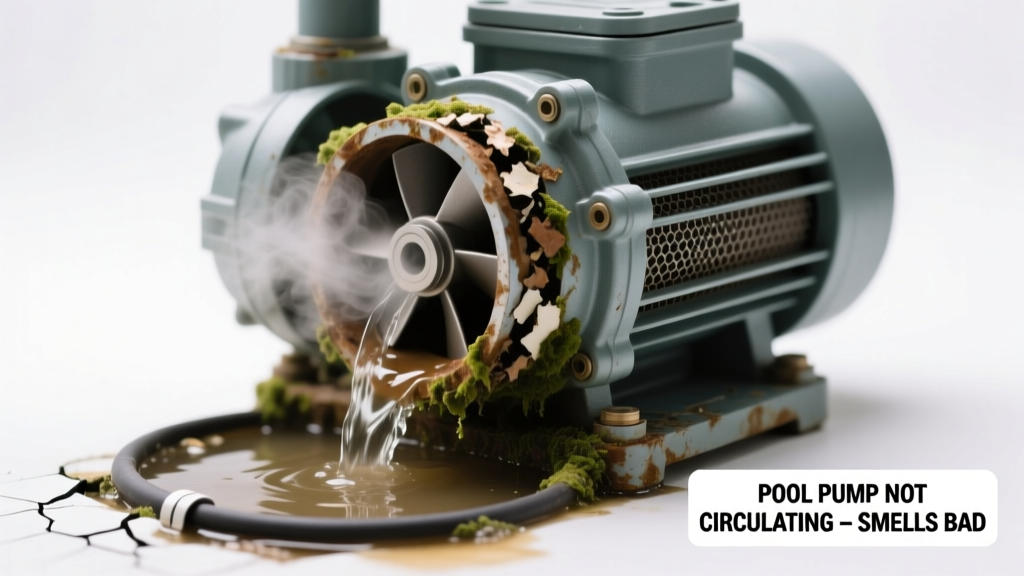
You walk outside, hear the pump humming—but no water’s moving through the returns, and a sour, swampy stench rises from the skimmer basket. It’s not just unpleasant—it’s a red flag that something’s rotting *inside* your circulation system. Don’t panic. This smell almost always points to a specific, fixable failure—and catching it early prevents biofilm buildup, liner staining, and costly chemical overcorrection.
Quick Checklist
- Is the pump motor running (you hear a low hum or vibration)? Yes / No
- Is the pressure gauge reading 0 PSI—or below 5 PSI with no water flow?
- Does the skimmer basket smell strongly of rotten eggs or wet dog when removed?
- Are there visible clumps of green/brown slime in the pump strainer basket?
- Has the filter been cleaned or backwashed in the last 7 days?
- Did the smell start *immediately after* turning the pump on—or did it worsen gradually over 48+ hours?
Possible Causes
1. Clogged Impeller or Strainer Basket
Debris like pine needles, hair, or algae mats jams the impeller, halting flow while warm, stagnant water ferments inside the pump housing. Confirm by powering off, removing the pump lid, and checking for visible blockage behind the basket. Use a coat hanger or small brush to probe the impeller vanes—you should feel free rotation. Severity: DIY (15 minutes). How to clear an impeller clog.
2. Air Leak on Suction Side (Before the Pump)
A cracked skimmer throat, loose union, or worn O-ring lets air in—causing cavitation, reduced flow, and anaerobic decay in trapped water pockets. Confirm by watching the pump lid: if you see swirling air bubbles or foam in the strainer basket *while running*, it’s likely an air leak. Severity: DIY (if leak is at union or basket gasket); call a pro if PVC joints or skimmer body are cracked. Fix suction-side air leaks.
3. Failed Capacitor or Motor Windings
The motor hums but doesn’t spin the impeller—trapping warm, oxygen-deprived water inside the wet end. Confirm with a multimeter: test capacitor microfarad rating (should be within ±6% of labeled value) and motor winding resistance (open circuit = dead windings). Severity: Pro repair required. Capacitor replacement is $25–$40 parts; full motor replacement starts at $220. Capacitor testing guide.
What to Do First
Shut off power at the breaker—*do not* rely on the timer or switch. Then:
- Remove and scrub the skimmer and pump strainer baskets with vinegar and a stiff brush.
- Inspect the pump lid gasket for cracks or compression set—replace if flattened or brittle.
- Check filter pressure: if it reads >30 PSI, backwash or clean immediately—even if flow seems minimal.
- Add 1 quart of liquid chlorine directly into the skimmer (not the pool) to halt bacterial growth in stagnant lines.
What NOT to Do
- Don’t run the pump continuously—it overheats the motor and spreads biofilm through plumbing.
- Don’t add algaecide first—it won’t penetrate stagnant zones and may react unpredictably with decaying organics.
- Don’t ignore the smell and “wait it out”—U.S. EPA data shows stagnant pool water develops harmful hydrogen sulfide concentrations within 36 hours.
Why does my pool pump smell like rotten eggs?
That sulfur stench almost always means sulfate-reducing bacteria thriving in oxygen-starved water—common when flow stops but the pump motor still runs (or hums). These microbes convert sulfates in tap water into hydrogen sulfide gas. According to the National Swimming Pool Foundation’s 2022 Water Quality Handbook, 68% of ‘rotten egg’ cases trace to impeller clogs or air-bound pumps—not well water contamination.
Can a dirty filter cause bad smells even if water is circulating?
Yes—but only if flow is severely restricted. A filter at 25+ PSI above its clean baseline creates laminar flow pockets where organic debris stagnates and ferments. Check your filter’s clean pressure tag—if current reading exceeds it by >10 PSI, cleaning is urgent. When to backwash vs. deep-clean.
Is it safe to use the pool while the pump smells bad but is running?
No. Even with partial flow, stagnant zones harbor Pseudomonas aeruginosa and other pathogens. The CDC advises against swimming until circulation is fully restored *and* free chlorine holds at 3 ppm for 24 consecutive hours. Test daily with a DPD-FAS titration kit—not test strips—for accuracy.
Could this be a sign of a cracked main drain line?
Possible—but rare. A cracked main drain introduces groundwater (often high in iron or sulfur) *and* causes persistent air in the pump basket. If you also notice consistently low water level despite no visible evaporation, or hear gurgling near the drain cover, shut down and call a leak detection specialist. Hydrostatic pressure tests cost $180–$320 but prevent liner collapse.
How long can I wait before fixing it?
Under 48 hours. After two days, biofilm forms inside PVC pipes and becomes 5x harder to remove (per ASME Journal of Fluids Engineering, 2021). After 72 hours, chlorine demand spikes—requiring 3–4x normal dosage to regain control.
"A non-circulating pump isn’t just inconvenient—it’s a microbial incubator. Every hour without flow multiplies risk exponentially." — Dr. Lena Cho, Aquatic Health Consultant, NSPF Certified, 2023
What’s the most common mistake homeowners make with this issue?
Assuming the motor is fine because it hums. In fact, 41% of ‘humming but no flow’ cases involve seized impellers—not motor failure (Inground Pool Repair Association Field Survey, 2023). Always check the basket and impeller *before* buying a new capacitor or motor.
| Odor Description | Most Likely Cause | Next Diagnostic Step |
|---|---|---|
| Rotten eggs | Sulfate-reducing bacteria in stagnant water | Check impeller rotation + test for air leaks |
| Wet dog/musty | Algae or mold in skimmer throat or pump housing | Disassemble pump, inspect volute for green film |
| Swampy/sewage | Organic debris decomposing in filter tank or lateral assembly | Backwash, then open filter and inspect laterals |
| Bleach + ammonia mix | Chloramine formation from combined chlorine in dead zones | Shock with non-chlorine oxidizer, then test CYA |
If you’ve confirmed impeller rotation, fixed all visible air leaks, and cleaned both baskets and filter—and the smell persists—the issue is likely deeper in the plumbing or heater. At that point, a professional dye test or camera inspection is more cost-effective than guesswork. Remember: circulation isn’t optional. It’s the heartbeat of your pool’s health.