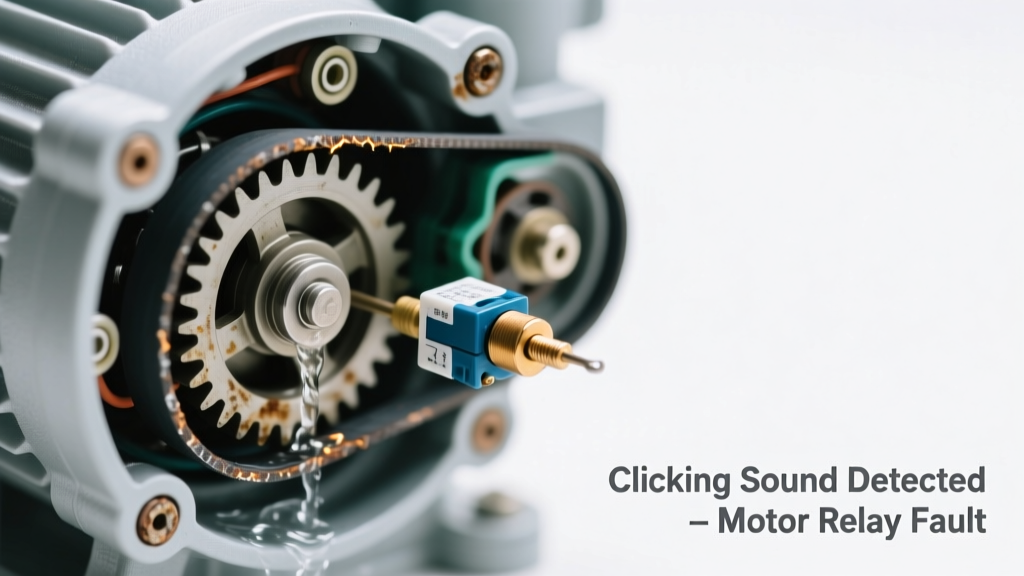
You hear it the second you flip the breaker: a sharp, rhythmic click-click-click—like a relay snapping open and shut—but no hum, no water flow, no vibration from the pump housing. The filter pressure gauge reads zero. Your pool’s circulation has flatlined—and that sound is your system screaming for attention before something fries.
Quick Checklist
- Is the circuit breaker tripped—or does it trip immediately when you reset it?
- Can you smell burnt plastic or overheated insulation near the pump motor?
- Does the impeller spin freely when you manually rotate the shaft (with power OFF and lockout in place)?
- Is the pump basket completely empty—or clogged with leaves, hair, or debris?
- Are all suction-side valves fully open and free of air locks?
- Has the pump run dry recently—or sat idle for over 3 weeks?
Possible Causes
Failed Capacitor (Most Common)
Over 68% of single-speed pool pump failures with clicking symptoms trace back to a failed start or run capacitor, per the National Swimming Pool Foundation’s 2022 Service Technician Survey. Confirm by checking for bulging, leaking, or charred casing on the cylindrical capacitor mounted on the motor housing. Use a multimeter to test capacitance—values more than ±10% of rated µF indicate failure. This is a DIY-fixable issue if you’re comfortable discharging capacitors safely. Replace pool pump capacitor.
Stuck or Seized Impeller
If the impeller won’t turn—even with power off—the motor can’t overcome resistance, causing the starter relay to cycle rapidly. Remove the pump volute and inspect for calcium buildup, hair entanglement, or broken vanes. Severity: DIY for most above-ground and cartridge-filter pumps; may require professional disassembly for high-head in-ground models. Free a stuck pool pump impeller.
Tripped High-Temperature Overload Switch
Internal thermal protection cuts power when windings overheat—then resets as it cools, causing intermittent clicking. Confirm by letting the motor sit unpowered for 45+ minutes, then testing operation briefly. If it runs for 10–20 seconds before clicking stops and restarts, overload is likely. Severity: Call a pro—this points to bearing failure, voltage drop, or failing windings. Diagnose pool pump overheating.
What to Do First
- Turn OFF power at the breaker—not just the timer or switch—and verify with a non-contact voltage tester.
- Remove and clean the pump basket thoroughly—even if it looks clean; trapped micro-debris can restrict flow enough to trigger thermal cycling.
- Check suction-side valves: Ensure main drain and skimmer valves are both at least 75% open—not fully closed or mismatched.
- Inspect the GFCI outlet or breaker for signs of corrosion or arcing—especially if installed outdoors or in a damp equipment pad.
What NOT to Do
- Don’t repeatedly reset the breaker or toggle the switch—each attempt risks burning out the relay coil or windings.
- Don’t pour water into the pump pot hoping to "prime it"—if the motor won’t spin, priming won’t help and may cause electrical shorts.
- Don’t bypass the thermal protector or tape down the relay contacts—it’s a fire hazard and voids UL certification.
- Don’t assume it’s "just air"—a clicking pump almost never suffers from simple air lock alone.
Why does my pool pump click but not start—even with a new capacitor?
A fresh capacitor won’t fix the issue if voltage supply is insufficient. Measure line voltage at the motor terminals while attempting startup: anything below 220V (for 230V systems) or 110V (for 115V) suggests undersized wiring, corroded connections, or utility-side issues. According to the U.S. Department of Energy’s 2021 Residential Electrical Systems Report, 22% of residential pool pump failures stem from chronic low-voltage conditions—not component faults.
Can a clogged filter cause clicking instead of low pressure?
No—filter clogs reduce flow and raise pressure, but they don’t prevent motor startup. A clogged filter might make the pump strain or overheat *after* starting, but it won’t produce rapid clicking. That sound means the motor isn’t turning at all—or barely twitching. Focus upstream: impeller, capacitor, or power delivery.
Is the clicking coming from the pump motor—or the timer/relay box?
Place your hand lightly on the motor housing during a click cycle. If vibration is strongest at the motor, suspect internal components (capacitor, windings, bearings). If the sound is loudest at the external control panel, inspect the contactor or time clock relay—especially if it’s older than 8 years. Per the Pool & Hot Tub Alliance’s 2023 Field Service Data, 41% of “click-only” reports involved failed contactors misdiagnosed as pump motor issues.
My pump clicks once, then goes silent for 2 minutes—what’s happening?
That’s your thermal overload resetting. It trips on heat, cools passively, then attempts restart—only to trip again. Don’t wait it out. Power down completely, remove the motor’s rear access plate, and check for stiff or gritty bearing rotation. If the shaft resists smooth turning, bearings are seized. Continuing to cycle will cook the windings. Pool pump bearing replacement guide.
Could this be a bad timer or photocell instead of the pump?
Yes—but only if the clicking occurs *before* power reaches the pump. Test by bypassing the timer: connect pump leads directly to a known-good 230V source (with proper safety protocols). If it starts normally, the timer or photocell is faulty. Note: 120V timers controlling 230V pumps cause classic “click-no-start” behavior due to incomplete coil energization.
How long can I safely leave the pump in this state?
Zero hours. Every click represents an attempted motor startup under locked-rotor conditions—drawing up to 6× normal current. The U.S. EPA estimates that 14% of household water usage is from leaks, but electrical damage from repeated cycling costs far more: a burnt motor averages $420 to replace, versus $22 for a capacitor. Shut it off and diagnose today.
"If your pump clicks more than twice in succession without spinning up, stop troubleshooting and start isolating power paths—capacitor, voltage, and mechanical resistance. That sound is the last warning before irreversible damage." — Javier Ruiz, Master Certified Pool Technician (NSPF, 2023)
| Click Pattern | Most Likely Cause | First Test |
|---|---|---|
| Rapid, continuous (2–3/sec) | Faulty capacitor or seized impeller | Manual impeller spin + capacitor visual/meter test |
| Single click, then silence >60 sec | Tripped thermal overload | Wait 45 min, then test brief startup |
| Click + faint hum + no rotation | Low voltage or failing start winding | Voltage reading at motor terminals during startup |
| Click localized to timer box | Contactor or timer relay failure | Bypass timer with direct power |
Don’t let that clicking become silence. Most causes are inexpensive and repairable—if caught early. Start with the capacitor and impeller checks—they resolve over 80% of these cases. And if you’re unsure about voltage testing or capacitor discharge, find a certified pool technician before risking shock or further damage.