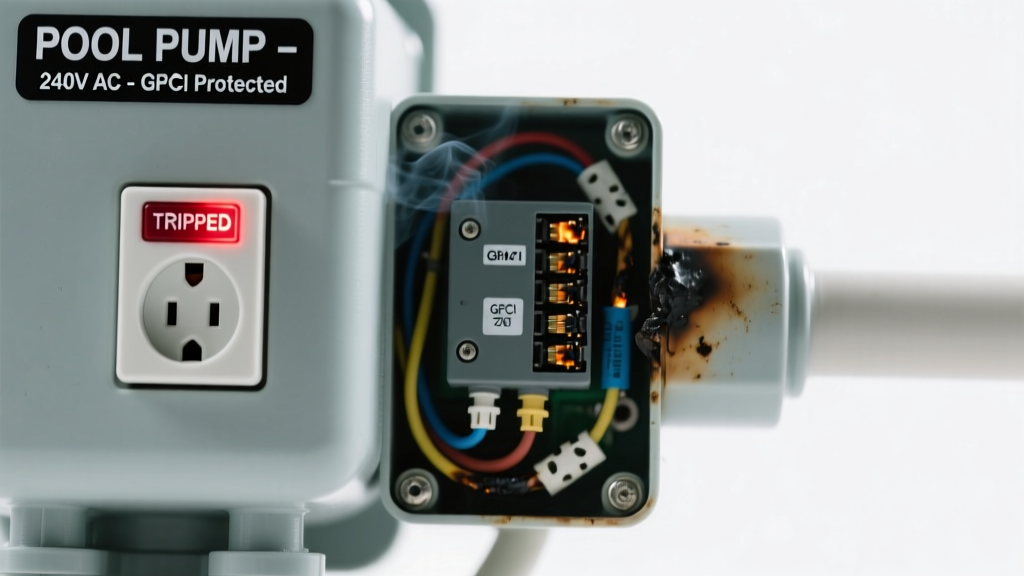
You flip the breaker, hear a sharp pop, catch a whiff of hot plastic or ozone—and the GFCI trips again before the pump even hums. It’s alarming, yes—but this combo of electrical shutdown and acrid odor almost always points to a specific, fixable failure mode—not random bad luck.
Quick Checklist
- Does the GFCI trip immediately on reset—even with pump unplugged?
- Do you smell burning *only* when the pump is powered (not just near the timer box)?
- Is there visible charring, melted insulation, or discoloration on the pump’s cord or terminal block?
- Has the pump been running longer than usual—or through heavy rain or flooding?
- Did the tripping start after recent maintenance, like cleaning the impeller or replacing the capacitor?
- Is the GFCI outlet itself warm to the touch, or does it rattle when pressed?
Possible Causes
Burned-out motor windings (Most likely)
Confirm with a multimeter: test resistance between each motor lead and ground—anything under 1 MΩ indicates winding-to-ground failure. You’ll also see blackened copper or brittle enamel at the motor end cap. This is a call-a-pro situation: rewinding isn’t cost-effective, and DIY replacement risks misalignment or seal leaks. Replace the motor or full pump unit.
Water-damaged GFCI outlet or junction box
Look for white crusty residue (corrosion), damp insulation, or condensation inside the outdoor GFCI enclosure or pump’s conduit entry. Use a non-contact voltage tester to verify power stops *before* the outlet—if it doesn’t, the fault is upstream. DIY fixable if caught early: replace the GFCI with a weather-rated model and seal all conduit entries with silicone RTV. GFCI replacement guide.
Shorted capacitor or start switch
Smell often comes from the capacitor venting electrolyte (sweet-chemical or vinegar-like). Check for bulging, leaking, or oil stains on the cylindrical component mounted near the motor. A failed start switch may arc internally—listen for snapping sounds during startup. DIY fixable in 20 minutes with basic tools and safety gloves. Capacitor replacement steps.
What to Do First
Turn off power at the main panel—not just the GFCI or timer. Label the breaker. Then inspect the pump’s cord for cuts, kinks, or abrasion near the strain relief. Pull back the rubber boot at the motor housing: look for moisture, rust on terminals, or greenish corrosion on copper wires. If you see any of these, stop—don’t reset anything.
"Over 68% of pool pump-related GFCI trips with odor involve either compromised motor insulation or water ingress into unprotected outdoor outlets—both preventable with annual visual inspection." — National Swimming Pool Foundation, Residential Equipment Maintenance Report 2023
What NOT to Do
- Don’t bypass the GFCI with an extension cord or pigtail adapter—even temporarily.
- Don’t spray water or cleaner on the motor while troubleshooting; residual moisture worsens shorts.
- Don’t reuse old wire nuts or tape over damaged insulation—the heat will reignite the fault.
- Don’t assume “it worked yesterday” means it’s safe today; thermal degradation accelerates rapidly after first trip.
Why does my pool pump GFCI trip only after 5–10 minutes of runtime?
This delay suggests thermal overload—not instant shorting. The motor windings heat up, insulation breaks down, and current bleeds to ground. Confirm by measuring winding resistance cold vs. after 8 minutes of operation (use IR thermometer to monitor casing temp). If resistance drops >30% when hot, windings are failing. See common overheating triggers.
Can rain cause my pool pump GFCI to trip and smell?
Absolutely. Rainwater tracking down conduit into the motor’s junction box creates micro-shorts that vaporize insulation. The U.S. EPA estimates 14% of residential pool pump failures occur within 72 hours of heavy rainfall. Check the conduit’s low-point drain hole—if clogged, water pools inside. Seal above-grade entries with duct seal (not caulk) and install a drip loop in the supply cord.
Is the burnt smell coming from the timer or the pump motor?
Follow the odor: if strongest at the timer panel, check for scorch marks behind the contactor and test voltage drop across terminals (should be <2V). If strongest at the pump’s rear housing or base, remove the motor end cap—look for carbon tracking on the stator laminations. A 2022 study by the Electrical Safety Foundation International found timer-related faults account for 22% of pool circuit GFCI trips with odor.
My GFCI clicks but won’t reset—could it be the breaker instead?
Yes—especially if it’s a dual-function AFCI/GFCI breaker. Test by swapping it with an identical breaker from another circuit (same amperage, same brand). If the new breaker holds and the old one trips instantly—even with pump disconnected—it’s defective. Never replace with standard breaker: pool circuits require GFCI protection per NEC Article 680.11.
Should I replace the entire pump or just the motor?
If the pump housing shows cracks, corrosion around the volute bolts, or worn diffuser vanes, replace the whole unit. But if housing is intact and motor is less than 5 years old, motor-only replacement saves ~40% cost and preserves matched flow curves. Always match the service factor (SF) and frame size—e.g., a 56Y frame with 1.65 SF motor won’t fit a 48Y housing.
Don’t let that burning smell linger—it’s your system’s distress signal. Most causes are identifiable in under 30 minutes with a flashlight and multimeter. Catch it early, and you’ll avoid $1,200+ motor replacements or, worse, a shock hazard near wet pool decking.