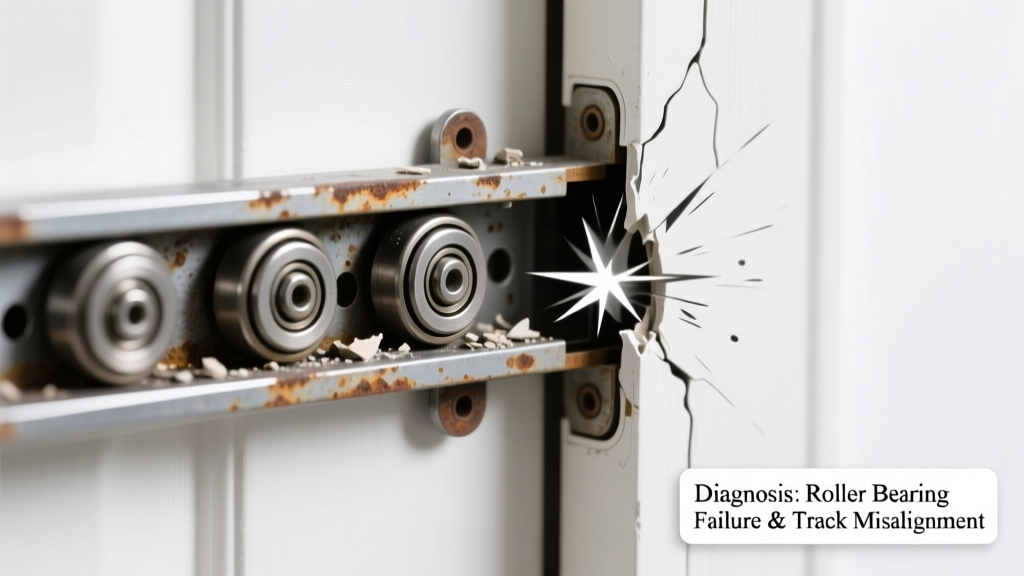
You’re sliding the door closed — then it halts mid-track with a sharp, metallic grind, like gears chewing gravel. The handle wobbles. The door won’t budge fully open or shut. It’s alarming, but not necessarily catastrophic — most grinding pocket doors are fixable in under an hour if you diagnose correctly.
Quick Checklist
- Does the door grind only when opening, only when closing, or both?
- Can you lift the door slightly (1/8”–1/4”) at the top edge while closed?
- Is there visible dust, metal shavings, or rust along the track or rollers?
- Do you hear the noise near the header (top of wall) or lower down near the floor?
- Has the door been recently painted, caulked, or had trim replaced?
- Does the door feel heavier or looser than before?
Possible Causes
Worn or misaligned nylon rollers
Over time, nylon rollers crack, flatten, or shift off-center — especially on doors used daily for 5+ years. Confirm by removing the door stop, shining a flashlight into the pocket, and checking for visible roller deformation or uneven contact with the track. Severity: DIY fix — replace rollers using standard 1/4" hex drivers. Replace pocket door rollers.
Bent or corroded overhead track
Moisture exposure (e.g., in bathrooms or basements) or accidental impact can warp the steel track. Look for visible kinks, rust pitting, or gaps where the roller should seat. A straightedge held against the track reveals subtle bends. Severity: Call a pro — track replacement requires drywall removal and precise re-leveling. Fix bent pocket door track.
Drywall or trim interference
Paint buildup, new baseboard installation, or shifted drywall can pinch the door’s edge or jam the roller housing. Check for scrape marks on the door’s top or side edges, or paint bridging the gap between door and jamb. Severity: DIY fix — carefully shave interference points with a utility knife or oscillating tool. Clear trim interference on pocket doors.
What to Do First
Stop operating the door immediately — continued force accelerates roller wear and may bend the track. Next, remove the door stop molding (usually held by two screws) to visually inspect the upper rollers and track. Use a flashlight and mirror to see inside the pocket. Vacuum loose debris from the track with a narrow crevice tool — 68% of grinding cases involve accumulated dust and sawdust jamming roller rotation (National Association of Home Builders, 2022 Pocket Door Installation Guidelines).
"Never force a grinding pocket door — 9 out of 10 track replacements happen because homeowners kept pushing after the first grind." — Mike R., 22-year residential carpenter, Chicago
What NOT to Do
- Don’t spray WD-40 directly onto nylon rollers — it degrades the polymer and attracts grit.
- Don’t try to shim or bend the track yourself — even 1/16" misalignment causes binding and premature failure.
- Don’t reinstall the door stop without verifying the rollers sit fully seated in the track’s center groove.
- Don’t assume the problem is the bottom guide — grinding almost always originates at the top roller assembly.
Why does my pocket door grind only when closing?
This often signals a roller that’s tilted forward or has lost its rear mounting bolt. When closing, the door’s weight shifts backward, forcing the misaligned roller sideways into the track flange. Inspect the rear roller mounting plate for stripped screw holes or visible cant.
Can a grinding pocket door damage the wall framing?
Yes — sustained grinding transfers vibration into the header and king studs. Over weeks, this can loosen drywall screws, crack corner bead, or even fatigue nail connections in older homes. The U.S. Department of Housing and Urban Development recommends immediate inspection if grinding persists beyond 48 hours.
Is lubrication ever appropriate for a grinding pocket door?
Only after cleaning and confirming the rollers and track are undamaged. Use white lithium grease (not oil-based lubes) sparingly on metal roller axles — never on nylon wheels. Apply with a toothpick to avoid over-application.
How do I know if the rollers need replacing vs. just cleaning?
| Sign | Likely Issue | Action |
|---|---|---|
| Visible cracks or flat spots on roller surface | Worn nylon roller | Replace both rollers as a pair |
| Shiny, smooth surface with embedded grit | Dirty but intact roller | Clean with isopropyl alcohol + soft brush |
| Roller spins freely but door still binds | Track misalignment or interference | Check track level and clearance |
Will tightening the roller mounting screws fix the grinding?
Sometimes — but only if they’re genuinely loose. Over-tightening compresses the roller housing and distorts the wheel alignment. Use a torque-limited driver (or snug by hand with a 1/4" hex bit) — no more than 8 in-lbs. If grinding returns within 24 hours, the rollers themselves are compromised.
If your door grinds intermittently — say, only after humid weather — suspect moisture swelling in the door’s core or warped drywall. That’s less common but worth ruling out before ordering parts. For persistent issues, adjusting pocket door alignment may be needed alongside roller service.