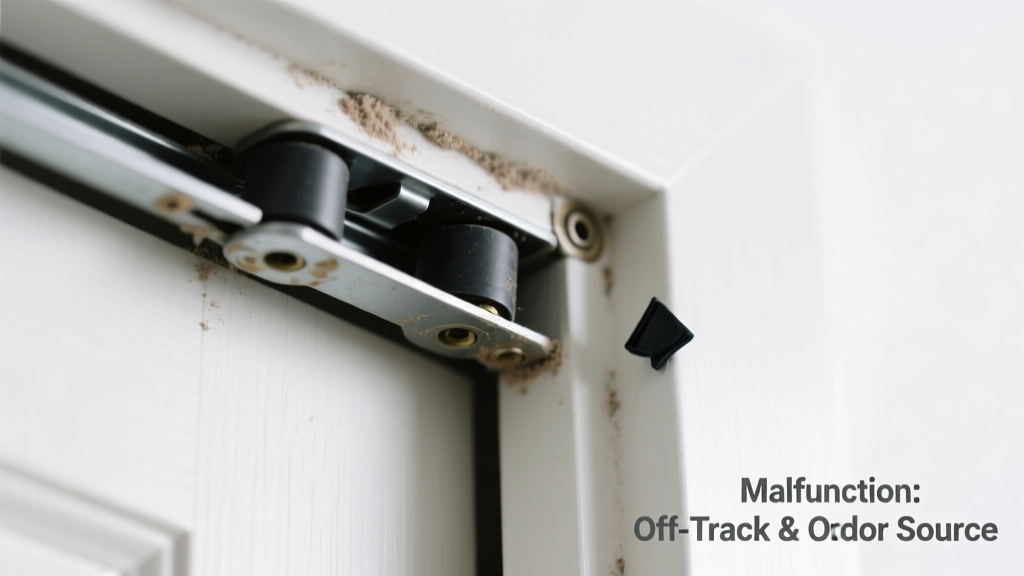
You’re walking past the bedroom closet and catch a whiff—damp, sour, almost like wet dog and mildew mixed with something vaguely rotten. Then you notice the pocket door sticks, scrapes, or won’t close fully. That’s not just a jammed mechanism; it’s a red flag that something’s decomposing inside the wall cavity.
Quick Checklist
- Does the smell intensify when the door is opened or closed?
- Can you hear scratching, scraping, or grinding when moving the door?
- Is there visible discoloration or warping on the door edge or frame?
- Do you feel cool, damp air leaking from the track opening or baseboard near the door?
- Has there been recent plumbing work, roof leaks, or basement flooding nearby?
- Have you spotted insects (silverfish, cockroaches) or mouse droppings near the door casing?
Possible Causes
Mold & Mildew in Wall Cavity
Moisture has pooled in the pocket door’s hollow stud bay—often due to a failed vapor barrier, leaky HVAC duct, or condensation from uninsulated cold-water pipes. Confirm by removing the door’s trim plate and shining a flashlight into the track; look for fuzzy black/green growth or water stains on drywall backing. Severity: Moderate—DIY inspection is safe, but remediation requires mold removal protocols. Call a pro if surface area exceeds 10 sq ft or insulation is saturated.
Rodent Nest or Carcass
Field mice and rats love the warm, dark void behind pocket doors—and they often die there. Confirm by sniffing closely at the bottom track gap (especially early morning), checking for nesting material (shredded insulation, paper), or using a borescope. Severity: High—removal requires PPE and sanitation; never attempt without gloves, N95 mask, and disinfectant. DIY only for fresh, accessible finds; otherwise, hire pest control.
Decaying Wood or Drywall
Long-term moisture exposure has rotted the track’s wooden header or bottom plate. Confirm by tapping the door frame with a screwdriver handle—if it sounds hollow or crumbles under light pressure, wood decay is likely. Severity: High—structural compromise possible. Requires framing repair and moisture source correction before reinstallation.
What to Do First
Stop operating the door immediately. Unplug any nearby outlets (if smell is electrical-adjacent) and shut off HVAC supply to that room. Next, remove the door’s faceplate or trim cover to inspect the top track—look for standing water, mold, or debris. Use a flashlight and mirror; don’t force anything. If you see active mold or rodent evidence, wear an N95 mask and gloves before proceeding.
- Turn off power to adjacent circuits if odor includes ozone or burning plastic notes
- Open windows in the room for cross-ventilation—but avoid fans that could aerosolize spores
- Photograph all findings for contractor or inspector reference
What NOT to Do
Don’t spray bleach or deodorizers into the track—they mask symptoms and can corrode metal rollers or degrade drywall paper. Don’t force the door open or closed; misaligned rollers under load can snap or gouge framing. And never ignore a musty smell that coincides with sticking—it’s rarely ‘just humidity.’
- Avoid using compressed air to blow out the track—it spreads mold spores deeper into wall cavities
- Don’t seal the track opening with caulk or foam to ‘trap’ the smell—it traps moisture and accelerates decay
- Never assume the source is the door itself—the problem is almost always behind or beneath it
Why does my pocket door smell only when I open it?
Opening the door disrupts stagnant air in the sealed wall cavity, releasing trapped volatile organic compounds (VOCs) from mold, rot, or decomposition. According to the U.S. EPA’s 2022 Indoor Air Quality Guide, enclosed cavities with poor ventilation can concentrate airborne contaminants up to 5× higher than room air.
Can a clogged drain line cause this smell?
Yes—if your pocket door is near a bathroom or laundry closet, a cracked or disconnected P-trap or vent stack can allow sewer gas to infiltrate wall cavities. Check floor drains and sink overflows first. A sulfur or rotten-egg odor that pulses with plumbing use points strongly to this source.
Is the smell dangerous to breathe?
It depends on the source. Mold spores (especially Stachybotrys) and endotoxins from rodent urine can trigger asthma, allergic rhinitis, and neurological symptoms with chronic exposure. The CDC reports 1 in 4 homes with documented water damage shows elevated indoor mold levels linked to respiratory hospitalizations.
How long until this becomes a structural issue?
If caused by moisture, significant wood decay can develop in as little as 6–12 months under sustained high humidity (>70% RH). The Insurance Institute for Business & Home Safety’s 2023 report found that 68% of pocket door failures with odor involved undetected moisture intrusion exceeding 90 days.
Will replacing the door fix the smell?
No—unless you also replace or treat the contaminated substrate. In fact, installing a new door over moldy framing or rodent-laden insulation guarantees recurrence. As licensed home inspector Maria Chen told Journal of Residential Construction (2022): “The door is the symptom—not the disease. Treat the cavity, not the hardware.”
“The door is the symptom—not the disease. Treat the cavity, not the hardware.” — Maria Chen, Journal of Residential Construction, 2022
| Odor Type | Most Likely Cause | Urgency Level |
|---|---|---|
| Damp, earthy, musty | Mold in wall cavity or wet insulation | High |
| Rotten meat or ammonia | Rodent carcass or urine-soaked drywall | Critical |
| Sulfur or rotten eggs | Sewer gas infiltration | High |
| Burning plastic or ozone | Faulty wiring near track motor or switch | Immediate |
Once you’ve confirmed the source, act deliberately—not hastily. Most pocket door odor issues are solvable, but only when addressed at the root. Delaying inspection risks health impacts, structural weakening, and costlier repairs down the line. Start with visual access, document everything, and match your findings to the right repair path.