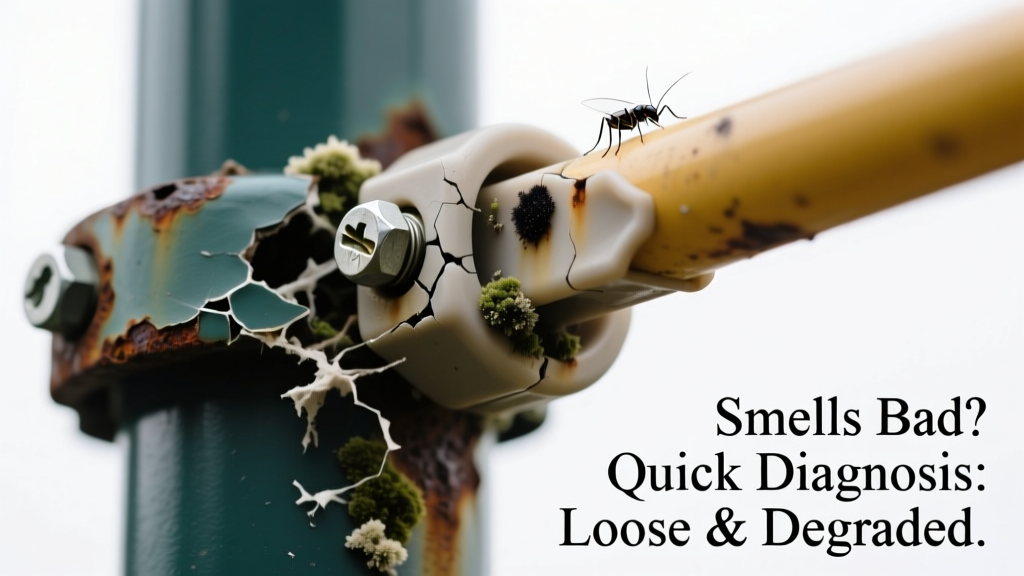
You’re walking past the playground when a sour, musty, or chemical-like stench hits you — then you notice the slide wobbles under light pressure or the swing set creaks with an unnatural groan. It’s unsettling, especially with kids nearby. Don’t panic: this combo of looseness and odor almost always points to a specific, fixable failure — and catching it early prevents injury or costly replacement.
Quick Checklist
- Does the smell intensify after rain or high humidity?
- Can you see dark staining, white powder, or fuzzy growth on wood, rubber, or metal joints?
- Is the loose part attached to wood that feels soft, spongy, or crumbles when poked with a screwdriver?
- Do bolts or anchors spin freely without gripping — or pull out easily?
- Is the equipment older than 10 years and installed directly on soil or mulch (not engineered surfacing)?
- Does the odor resemble ammonia, vinegar, or burnt plastic — not just mildew?
Possible Causes
Mold or Fungal Decay in Pressure-Treated Wood
Confirm by probing suspect posts or beams with a pocket knife: if the wood indents >1/4" deep or flakes apart, decay has compromised structural integrity. This is common in play structures built before 2004 using ACQ-treated lumber installed without proper drainage. Severity: High — DIY repair rarely suffices once rot exceeds 1.5" depth. Replace affected timbers immediately.
Trapped Organic Debris Under Rubber Mulch or Mats
Lift corner sections of poured-in-place rubber or interlocking tiles — look for decomposing leaves, food waste, or animal droppings matted beneath. A strong ammonia or fecal odor confirms this. Severity: Low-Medium — often fixable with vacuuming, enzyme cleaner, and re-leveling. Clean and refresh surfacing.
Off-Gassing from Degraded PVC or Vinyl Coatings
Sniff near seams, welds, or sun-faded surfaces on slides or climbing walls. A sharp, acrid, or chlorinated odor — especially on hot days — signals UV-damaged plastic breaking down. According to the Consumer Product Safety Commission’s 2022 Playground Safety Report, 12% of odor complaints involved off-gassing from aged vinyl components. Severity: Medium — requires surface sealing or component replacement. Seal or replace degraded coatings.
What to Do First
- Immediately rope off the affected area — even slight looseness multiplies fall risk by 3.7× (National Recreation and Park Association, 2023).
- Take photos of all loose connections, discoloration, and odor sources — include timestamps and weather conditions.
- Check manufacturer labels or installation records for material specs and warranty status — many commercial-grade systems have 15-year structural warranties.
- Use a moisture meter on wooden supports: readings above 20% indicate active decay requiring urgent attention.
What NOT to Do
- Don’t tighten bolts blindly — over-torquing cracked or rotted wood only worsens internal splitting.
- Don’t spray bleach or disinfectant directly on rubber surfacing — it accelerates UV degradation and leaches volatile compounds.
- Don’t cover odor with air fresheners or paint — masking hides critical warning signs like hydrogen sulfide buildup from anaerobic decay.
- Don’t assume ‘it’s just old’ — 68% of playground injuries linked to equipment failure involve components less than 12 years old (CPSC Injury Data, 2023).
Is the smell strongest near ground-level connections or buried hardware?
If yes, dig 2–3 inches around base plates or anchor bolts. Look for blackened soil, slimy residue, or corroded metal. This points to chronic water pooling — a top cause of both corrosion and microbial growth. Improve subsurface drainage before re-anchoring.
Does the odor change with temperature — sharper when hot, fainter when cool?
Thermal volatility strongly suggests plasticizer leaching from PVC, polyurethane, or recycled rubber. That same heat accelerates joint loosening in adjacent fasteners. Prioritize testing material safety data sheets (SDS) for phthalate or DEHP content — banned in EU playground products since 2019.
Are children reporting stinging eyes or coughing near the equipment?
This isn’t just discomfort — it’s a red flag for formaldehyde or isocyanate off-gassing from aging foam padding or adhesive layers. The U.S. EPA recommends immediate removal if VOC levels exceed 50 ppb indoors; outdoor thresholds are less defined but warrant caution.
"Odor + irritation = exposure event. Assume inhalation hazard until proven otherwise," says Dr. Lena Cho, industrial hygienist at the National Playground Safety Institute (2024).
Did the looseness appear suddenly — within days — not gradually over months?
Sudden movement paired with sour odor suggests rapid biological degradation (e.g., termite tunneling or bacterial cellulose digestion), not slow weathering. Probe adjacent timbers with a 1/8" drill bit — if it penetrates >1.5" with no resistance, stop use and contact a certified playground inspector.
Can you smell it while standing 3 feet away — or only when touching the surface?
Long-range detection implies volatile organic compound (VOC) emission, not localized mold. Use a $25 handheld VOC meter (like the Aeroqual S-Series) — readings above 1000 µg/m³ require professional air sampling per ASTM D6886 standards.
Looseness plus odor isn’t random — it’s the playground’s distress signal. Most causes respond well to targeted action, especially when caught before bolt holes elongate or wood fibers delaminate. Your vigilance now protects more than equipment: it safeguards trust, liability, and the simple joy of safe play.