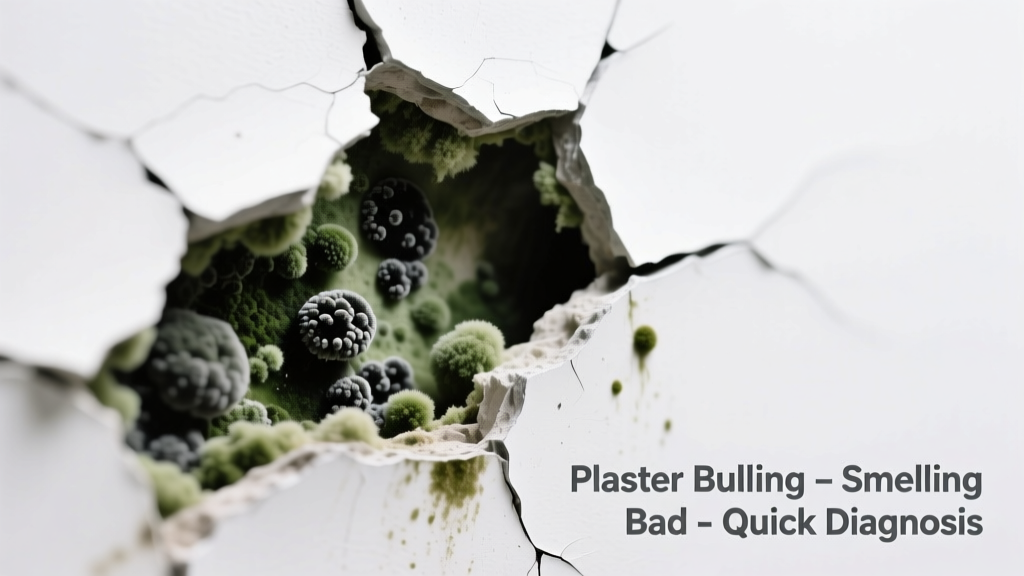
You walk into the hallway and catch it—a damp, sour, sometimes sweet-rotten odor clinging to the air, followed by a soft, spongy bulge in the ceiling or wall where plaster should be firm and smooth. It’s unsettling, but not hopeless: this combo of visual distortion and odor almost always points to a specific, fixable problem beneath the surface.
Quick Checklist
- Does the bulge feel soft or springy when gently pressed with fingertips?
- Is the odor strongest after rain or high humidity?
- Do you see discoloration (yellow, brown, or black streaks) around or under the bulge?
- Has there been recent plumbing work, roof damage, or a known leak nearby?
- Can you hear a faint hollow sound when tapping the area with a coin?
- Is the bulge located near an exterior wall, window, or chimney breast?
- Have occupants reported allergy flare-ups, headaches, or respiratory irritation in that room?
Possible Causes
Mold Behind Plaster (Most Likely)
Confirm by checking for musty odor intensifying in humid conditions and visible black/green speckling at cracks or nail holes. Use a moisture meter—if readings exceed 18% MC on the substrate, mold is highly probable. Severity: Call a pro—mold remediation requires containment, PPE, and lab testing per EPA guidelines. How to safely remove mold behind plaster.
Active Water Leak Behind Wall or Ceiling
Confirm by shutting off water to adjacent fixtures (sink, shower, toilet) for 12 hours—does the bulge stop expanding or the smell lessen? Also check for dripping sounds or cold spots on the surface. Severity: Call a plumber immediately if confirmed; untreated leaks cause rot and electrical hazards. Steps to locate and repair hidden leaks.
Plaster Detachment Due to Failed Lath or Moisture Damage
Confirm by tapping: a consistent hollow echo across the bulge (not just at edges) suggests full detachment. No odor? Likely just aging. But combined with odor? Moisture has compromised both lath and plaster. Severity: Diy fix possible for small areas (<5 sq ft), but large sections require replastering or drywall overlay. Reattaching or replacing loose plaster.
What to Do First
Turn off HVAC systems in the affected zone to prevent spore circulation. Open windows for cross-ventilation—but only if outdoor humidity is below 60%. Place a dehumidifier set to 45–50% RH in the room, running 24/7. Document everything: take timestamped photos of the bulge, odor notes, and any visible staining. Then shut off water to the nearest supply line—even if you’re unsure of the source.
According to the Insurance Institute for Business & Home Safety's 2023 report, 72% of homes with undetected moisture behind plaster developed significant structural decay within 9 months of first visible bulging.
What NOT to Do
- Don’t puncture or peel the bulge—it spreads spores and worsens water infiltration.
- Don’t paint over it with sealant or primer—this traps moisture and accelerates decay.
- Don’t ignore it for more than 48 hours—microbial growth doubles every 24–48 hours in damp plaster.
- Don’t use bleach on visible mold—EPA states it’s ineffective on porous surfaces like plaster and can produce toxic fumes when mixed with ammonia-based cleaners.
Is the smell worse at night or early morning?
This often signals condensation buildup inside wall cavities due to poor insulation or thermal bridging—especially common in older homes with solid masonry walls. Nighttime cooling causes warm, moist indoor air to deposit moisture on cold surfaces behind plaster. Check for cold spots with an infrared thermometer; readings below 55°F on interior surfaces indicate risk.
Does the bulge appear only on one side of a shared wall?
If yes—and the other side is a bathroom, kitchen, or laundry room—the source is likely on that adjacent side. Inspect grout lines, caulk around tubs/showers, and vent duct seals. The U.S. EPA estimates that 14% of household water usage is from leaks, many hidden behind walls.
Did the bulge appear suddenly—or has it grown gradually over weeks?
Sudden onset (within 24–72 hours) strongly indicates active water intrusion—like a burst pipe or failed shingle. Gradual growth (over 2+ weeks) points to chronic issues: slow roof leaks, condensation, or long-term plumbing weeping. Track growth with masking tape markers and weekly photos.
Can you smell it even when the room is empty and doors closed?
Yes? That means the source is likely embedded in the building assembly—not surface mold or trash. Air pressure differentials pull odor through gaps in baseboards, outlets, or light switches. Turn off the furnace fan and test again: if odor fades, your ductwork may be pulling contaminated air from wall cavities.
Are there musty odors in other rooms on the same floor?
Widespread odor suggests a systemic issue—like a failed roof valley, clogged gutters overflowing onto fascia, or foundation drainage problems. Check downspouts for blockages and grade slope away from the house (minimum 6 inches drop over 10 feet). A certified home inspector can perform thermal imaging to map moisture migration paths.
Is the plaster cracking in a spiderweb pattern around the bulge?
Spiderweb cracking + bulge + odor = classic sign of hydrostatic pressure pushing plaster outward from behind. This commonly occurs where basements leak or slab-on-grade foundations wick moisture upward. Use a digital hygrometer to measure subfloor relative humidity—if >75%, capillary rise is likely the culprit.
| Odor Type | Bulge Texture | Most Likely Cause |
|---|---|---|
| Musty, earthy, like wet cardboard | Soft, cool, slightly damp to touch | Mold colonization (Stachybotrys or Chaetomium) |
| Sweet-rotten, like spoiled fruit | Warm, spongy, emits faint vapor when pressed | Active bacterial decomposition in saturated lath |
| Sharp, acrid, chemical-like | Firm but discolored, blistered surface | Off-gassing from degraded adhesive or fire-retardant additives |
Don’t wait for the bulge to pop or the odor to fade on its own—by then, framing may be compromised and health risks elevated. Start with the checklist, isolate the source using the clues above, and act before weekend plans get derailed by emergency repairs.