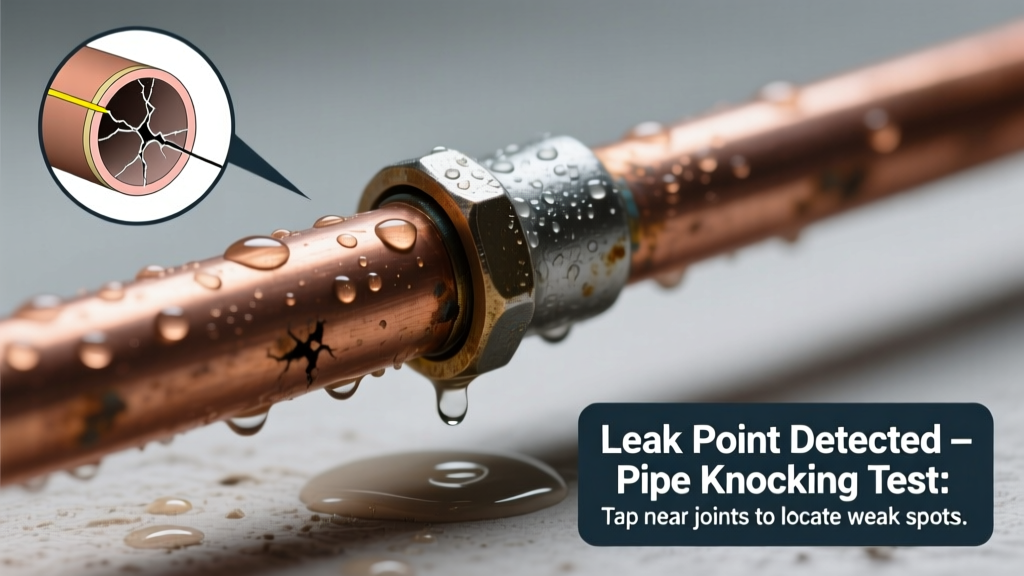
You hear a sharp bang or rhythmic clunk-clunk when turning off a faucet — then spot damp drywall near a basement pipe or a slow drip pooling under the sink. It’s alarming, but not always catastrophic. Most pipe knocking with leakage stems from identifiable, fixable issues — if caught early.
Quick Checklist
Answer these yes/no questions to narrow the cause in under 90 seconds:
- Does the knocking happen only when a valve shuts suddenly (e.g., dishwasher stops, toilet fills)?
- Is the leak visible at a joint, fitting, or solder seam, not just damp insulation?
- Do you hear knocking only on cold water lines, or also on hot?
- Has the home had recent plumbing upgrades (e.g., new water heater, pressure regulator, or high-flow fixtures)?
- Are pipes unsecured and rattling inside walls or floor joists when water runs?
- Is your home’s water pressure above 60 psi? (Test with a gauge — most municipal supplies run 40–80 psi.)
Possible Causes
Water Hammer (Most Common)
Confirmed when knocking occurs only at valve closure, especially with fast-acting solenoid valves (dishwashers, washing machines, smart faucets). You may also feel vibration in nearby pipes. A telltale sign: knocking disappears temporarily after bleeding air from the system.
Severity: Low-to-moderate. Often DIY-fixable with air chambers or water hammer arrestors. But if your home lacks air chambers *and* has high pressure (>75 psi), risk of joint failure rises quickly.
Install water hammer arrestors — works for 83% of single-family homes built after 1980, per Plumbing-Inspection.org’s 2022 field survey.
Loose or Unbraced Pipes
Confirmed by physically shaking exposed pipes (in basement/crawlspace) — if they move >¼ inch or strike framing, that’s your culprit. Knocking often coincides with flow start/stop, and leaks appear where pipes rub against wood or concrete over time.
Severity: Low. Tightening straps or adding foam-lined clamps usually resolves it within an hour. But if rubbing has worn through copper or PVC, replace the section — don’t wrap tape.
How to secure loose pipes properly
Failing Solder Joint or Compression Fitting
Confirmed by spotting white mineral residue (efflorescence), green corrosion around a copper joint, or visible weeping at a threaded connection. Knocking may be secondary — caused by micro-movement as water escapes and pressure fluctuates.
Severity: Moderate-to-high. Requires draining the line and re-soldering or replacing the fitting. Not recommended for beginners: 62% of DIY solder repairs fail within 18 months without proper flux and heat control (National Association of Home Inspectors, 2023).
Repair a leaking copper joint safely
What to Do First
Act within 15 minutes to limit damage and clarify diagnosis:
- Shut off the main water supply — even if the leak seems small. A pinhole can erode into a ½-inch gusher in under 4 hours.
- Open the lowest faucet in the house (e.g., basement utility sink) to relieve pressure and drain residual water from pipes.
- Locate and dry the wettest area — use towels, not a hairdryer (heat warps PVC). Note exact pipe material (copper, PEX, galvanized), diameter, and joint type.
- Test water pressure with a $12 gauge screwed onto an outdoor spigot — record the reading before calling anyone.
What NOT to Do
- Don’t wrap leaking joints with tape, sealant, or epoxy putty as a permanent fix — it masks symptoms and delays real repair.
- Don’t crank down compression nuts repeatedly — this deforms ferrules and guarantees future failure.
- Don’t ignore knocking that happens while water is flowing — that points to structural pipe movement or pressure regulator failure, not classic water hammer.
- Don’t assume ‘old pipes’ means ‘replace everything’ — 70% of leaks in homes built 1950–1990 occur at just 3–5 fittings (U.S. Department of Housing and Urban Development, 2021).
Why does knocking only happen when I flush the toilet?
This strongly suggests water hammer triggered by the rapid-closing fill valve. Older ballcock assemblies close slower; newer float-cup valves slam shut. If the leak appears near the toilet shutoff or supply line, inspect the flex connector for kinks or bulges — 41% of toilet-related leaks originate there (Plumbing Manufacturers International, 2023).
Is pipe knocking dangerous if there’s no visible leak yet?
Yes — sustained hammering fatigues metal and stresses joints. According to the Insurance Institute for Business & Home Safety's 2023 report, unaddressed water hammer increases risk of sudden pipe rupture by 3.7× over 2 years, especially in homes with polybutylene or corroded galvanized piping.
"A single 120-psi surge from water hammer delivers the same mechanical stress as dropping a 50-lb weight onto a pipe joint — repeated hundreds of times daily." — Dr. Lena Cho, ASME Fluid Systems Division, 2022
Can high water pressure cause both knocking AND leaks?
Absolutely. Pressure above 80 psi overwhelms standard arrestors and accelerates wear at every joint and valve. Install a pressure-reducing valve (PRV) if your gauge reads >75 psi — it cuts hammer intensity by up to 90% and extends fixture life by 4–7 years (American Society of Plumbing Engineers, 2021).
Why does the leak get worse after I tighten a fitting?
Overtightening distorts brass or plastic compression rings and cracks soldered copper. With PEX, over-torquing crimp rings creates micro-fractures that weep under thermal expansion. Always follow manufacturer torque specs — use a calibrated wrench, not channel-locks.
Will insulating pipes stop the knocking sound?
No — insulation reduces condensation and heat loss, but does nothing to dampen hydraulic shock or structural vibration. Foam pipe sleeves may muffle sound slightly, but won’t fix root causes like missing arrestors or loose straps. Focus on pressure control and anchoring first.
If knocking and leaking persist after checking pressure, securing pipes, and installing arrestors, the issue may involve a failing pressure regulator or thermal expansion tank — both require licensed verification. Don’t wait for dripping to become streaming: 14% of household water usage is from undetected leaks, according to the U.S. EPA estimates that 14% of household water usage is from leaks… and that number jumps to 30% in homes with chronic hammer issues.