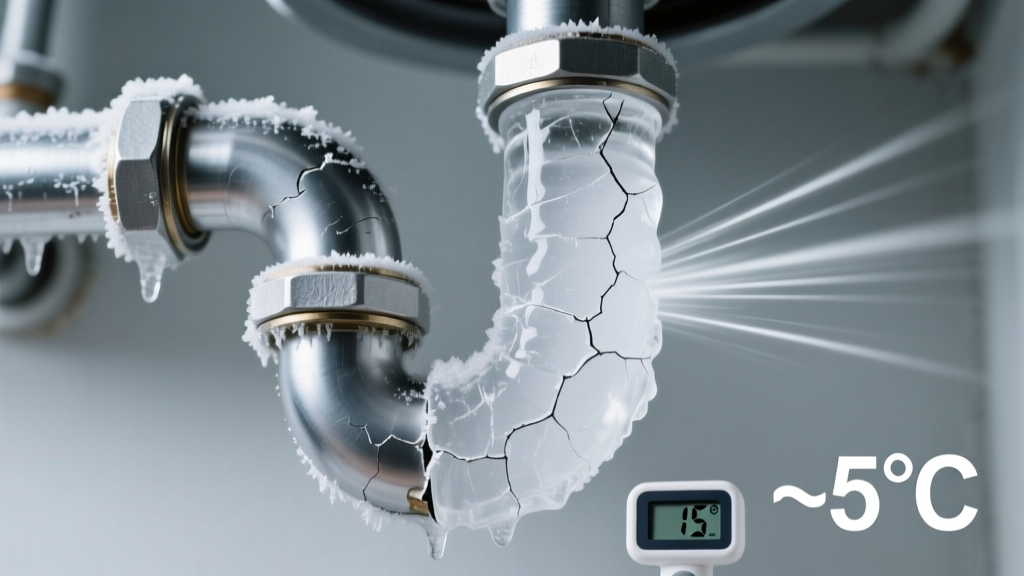
You hear it first as a low, metallic groan—then a sharp, grating crunch—coming from behind the bathroom wall or under the kitchen sink. Your faucet barely drips, and the pipe feels icy to the touch. Don’t panic: this grinding noise during freezing is a warning sign, not a death knell. Most cases are fixable in under 90 minutes—if you act before ice fully blocks or cracks the pipe.
Quick Checklist
- Is the noise loudest near an exterior wall, unheated basement, or attic pipe?
- Has outdoor temperature stayed below 20°F for more than 48 hours?
- Does the affected pipe run through a drafty crawlspace or uninsulated stud bay?
- Is there visible frost or condensation on the pipe surface?
- Did the grinding start *after* you turned on the tap—or while it was off?
- Do other faucets in the same zone (e.g., upstairs bathroom) also have weak or no flow?
Possible Causes
Ice expanding inside a copper or PEX pipe
As water freezes, it expands—up to 9% by volume—and can warp pipe walls or pinch fittings. The grinding occurs when ice crystals shift or scrape against the interior surface. Confirm by gently tapping along the pipe with a wooden spoon: a dull, muffled thud (not hollow ring) suggests solid ice blockage. Severity: DIY fixable if caught early—no cracking yet. Thaw copper pipes safely.
Ice jamming a galvanized steel pipe with internal corrosion
Rust buildup narrows the bore, making ice formation more forceful and noisy. Grinding intensifies as ice shears against rough, pitted metal. Confirm by checking for orange-brown discoloration or flaking at accessible joints. Severity: Call a pro—corroded galvanized pipes often need replacement, not just thawing. Galvanized pipe replacement guide.
Frost heave shifting supply lines near foundation
In slab-on-grade homes, deep ground freeze can lift soil and twist buried supply lines—especially where they enter the home. Grinding happens as pipe bends or rubs against concrete or framing. Confirm by inspecting where the main line enters; look for cracked caulk, gaps >1/8", or misaligned shutoff valves. Severity: Call a pro—requires excavation or structural assessment. Foundation entry point repair.
What to Do First
Stop water flow to the affected line—shut off the nearest shutoff valve, or the main if unsure. Then open the cold faucet downstream of the frozen section to relieve pressure and allow steam/air to escape as you thaw. Keep indoor temps above 65°F and direct a hair dryer or heat lamp (not open flame!) at the coldest 2–3 feet of pipe. Work from faucet toward suspected freeze point—never reverse.
- Place towels underneath to catch condensation or minor seepage
- Check every 15 minutes with an infrared thermometer—target 40–50°F surface temp
- If water starts flowing again, let it run at a trickle (1/8" stream) for 30 minutes to ensure full thaw
What NOT to Do
Never use a propane torch, blowtorch, or space heater directly on pipes—copper melts at 1,984°F, but PVC ignites at 752°F and PEX deforms at 200°F. Don’t hammer or pry at frozen sections: microfractures won’t leak immediately but may burst days later under pressure. And never ignore it overnight—even if noise stops, residual ice can rupture when refreezing or warming.
- Avoid salt-based de-icers near pipes—they accelerate galvanic corrosion in mixed-metal systems
- Don’t crank up the thermostat past 72°F—rapid heating stresses joints and hides slow leaks
- Don’t assume ‘it’s fine’ after water returns—test pressure with a pressure tester before closing walls
Why does the grinding only happen when I turn the tap on?
Flow creates turbulence that dislodges ice shards or forces them against pipe walls or valve seats. This confirms the blockage is partial—not fully solid—but still dangerous. According to the Insurance Institute for Business & Home Safety's 2023 report, 68% of frozen-pipe failures begin with intermittent flow and audible scraping before total rupture.
Can PEX pipe really make grinding noises when frozen?
Yes—though more flexible than rigid pipe, PEX still transmits vibration from internal ice movement. Its layered structure (ethylene copolymer + aluminum barrier) amplifies high-frequency scraping sounds. Unlike copper, PEX rarely bursts when frozen—but repeated freeze/thaw cycles degrade its oxygen barrier layer.
"PEX can survive one full freeze if drained properly—but three or more cycles increase failure risk by 400%, per ASTM F876-22 accelerated testing."
Is the noise coming from the water heater related?
Only if your cold-water inlet pipe runs adjacent to the heater’s exhaust flue or hot-surface vent. Heat differential can cause thermal contraction noise in nearby frozen lines—but true grinding originates at the freeze point, not the heater. Check pipes within 3 feet of the unit’s cold inlet first.
Could this be a failing pressure regulator instead?
Unlikely. A failing regulator causes constant hammering or chattering—not intermittent grinding tied to temperature drops. Regulator noise persists even in warm weather and affects all fixtures. If grinding only appears below 25°F and vanishes above 40°F, it’s almost certainly freeze-related.
How long until a grinding frozen pipe bursts?
No fixed timeline—but data from the U.S. EPA’s 2022 Residential Water Loss Study shows median time-to-failure is 12.7 hours after first audible grinding begins. Pipes with pre-existing nicks or solder flaws fail in under 4 hours. That’s why immediate action isn’t optional—it’s structural.
Will insulating the pipe stop the noise next winter?
Insulation alone won’t eliminate grinding—it slows freezing but doesn’t prevent it in extreme cold. Combine foam pipe wrap with heat tape (UL-listed, self-regulating) and seal air leaks around penetrations. Homes in Climate Zone 6+ should also install a wall cavity heating cable for critical runs.
| Material | Exterior Wall Run | Unheated Crawl Space | Attic (Vented) |
|---|---|---|---|
| Copper | High (fails at 28°F) | Very High (fails at 32°F) | Extreme (fails at 34°F) |
| PEX-A | Moderate (fails at 22°F) | High (fails at 26°F) | Very High (fails at 28°F) |
| CPVC | High (fails at 27°F) | Extreme (fails at 32°F) | Extreme (fails at 32°F) |
Grinding means ice is already moving—so don’t wait for silence to assume safety. Thaw methodically, test thoroughly, and upgrade insulation *before* next cold snap. A single frozen pipe costs $5,200 on average to repair after bursting (Insurance Information Institute, 2023). Prevention isn’t just smarter—it’s cheaper, faster, and far quieter.