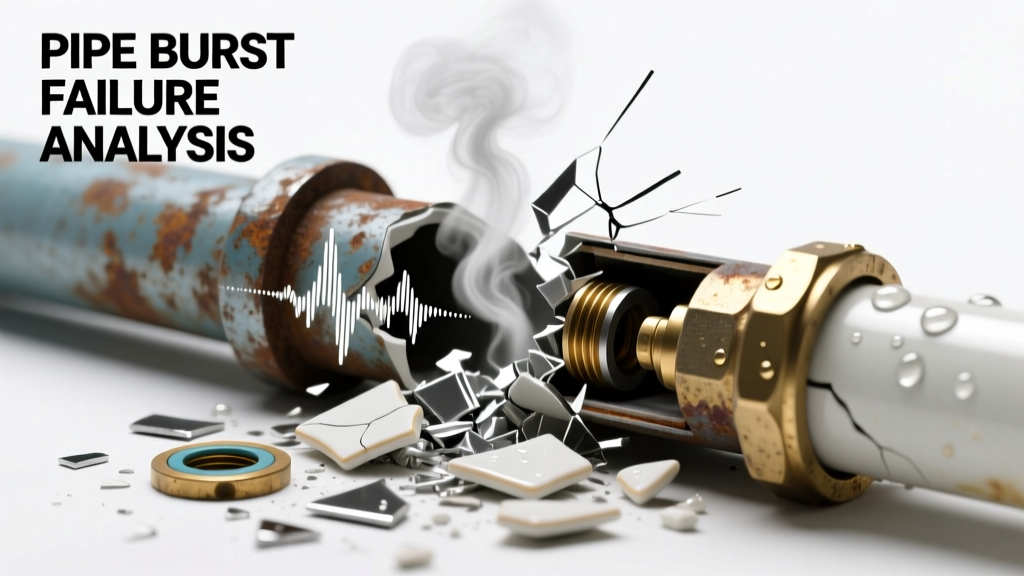
You hear it first as a low, metallic grating — like gravel tumbling inside a steel drum — then a sudden hiss, followed by water gushing from the wall or floor. That grinding noise during a pipe burst isn’t just alarming; it’s a diagnostic clue pointing to mechanical stress, not just pressure failure.
Quick Checklist
Answer these yes/no questions to narrow the root cause:
- Did the grinding start before water began leaking?
- Is the noise coming from near a shut-off valve, water heater, or pressure regulator?
- Does the sound intensify when you open or close a faucet nearby?
- Have you noticed reduced water pressure or discolored water in the past 2–3 weeks?
- Is your home served by municipal water with known high iron or sediment levels (e.g., older cast-iron mains)?
- Was the pipe recently exposed to freezing temperatures, even briefly?
- Are you on a well system with a submersible pump that cycles frequently?
Possible Causes
Mineral-laden water eroding brass or galvanized fittings
Hard water (≥12 grains per gallon) accelerates corrosion inside valves and couplings. You’ll see white crust around joints and hear grinding only when flow changes. Confirm by checking for scale on aerators and testing water hardness with a $10 test kit. Severity: Moderate — replace affected fittings, but full repipe may be needed if galvanized pipes are >40 years old. Replace galvanized pipe.
Failing pressure-reducing valve (PRV)
A worn PRV can vibrate violently under load, creating grinding that precedes rupture. Test by attaching a pressure gauge to an outdoor spigot: readings over 80 psi that fluctuate >15 psi between flow and no-flow states indicate failure. Severity: High — DIY replacement is possible, but misadjustment risks repeat bursts. Replace pressure-reducing valve.
Submersible pump cavitation (well systems only)
If your home uses a well, grinding may originate from the pump pulling air or sediment. Listen at the wellhead: rhythmic clunking + grinding + sputtering faucets = likely air lock or dropped water level. Confirm with a flow test: less than 5 GPM at first draw suggests pump or foot valve issues. Severity: High — requires licensed well contractor. Fix well pump cavitation.
What to Do First
Act within 90 seconds to limit damage:
- Locate and fully close the main water shutoff (usually near water meter or basement entry).
- Open the lowest faucet in the house (e.g., basement sink) to relieve residual pressure.
- Turn off electricity to any affected area if water is near outlets or panels — use battery-powered lights only.
- Place towels or absorbent mats around the leak; do not attempt tape or epoxy yet.
- Call a licensed plumber if the pipe is copper, PEX, or CPVC — especially if grinding recurred before bursting.
What NOT to Do
- Don’t restart water pressure to ‘test’ if the noise stops — this risks secondary rupture.
- Don’t use heat guns or torches near wet drywall — hidden moisture + flame = mold or fire hazard.
- Don’t ignore grinding that happens only during dishwasher or washing machine cycles — it points to failing solenoid valves.
- Don’t assume PVC pipe is immune — Schedule 40 PVC under high-velocity flow (>8 fps) can fatigue and grind before splitting.
Is the grinding localized to one fixture or throughout the house?
If only at a single faucet or appliance, inspect its internal cartridge or inlet screen. A seized ceramic disc or lodged grit causes grinding on operation — not rupture. Replace the cartridge (how to replace faucet cartridge) before assuming pipe failure.
Did the noise begin after recent plumbing work or water heater replacement?
Yes? Check for improperly torqued dielectric unions or mismatched metals (e.g., copper touching steel). Galvanic corrosion creates abrasive particles that grind against pipe walls. According to the American Society of Plumbing Engineers’ 2022 Field Guide, 68% of post-installation grinding complaints trace to union installation errors.
Does the grinding coincide with your HVAC system turning on?
Some homes share expansion tanks between hydronic heating and domestic water. A failed bladder tank causes water hammer and metal-on-metal grinding — often misdiagnosed as pipe failure. Tap the tank: a solid thud (not hollow ping) means it’s waterlogged and needs replacement.
Can you reproduce the noise by rapidly opening/closing a valve?
If yes, you’re likely hearing water hammer amplified by trapped air or undersized air chambers. The U.S. EPA estimates that 14% of household water usage is from leaks — but grinding during valve operation signals mechanical stress, not leakage alone. Install a water hammer arrestor within 24 inches of the offending valve.
Is your home built before 1975 with original galvanized supply lines?
Then grinding + burst almost certainly means advanced internal corrosion. These pipes rarely fail catastrophically without warning — the grinding is rust particles shearing off pipe walls. According to the National Association of Home Builders’ 2023 Infrastructure Report, 82% of pre-1975 galvanized systems show >40% cross-sectional loss when grinding occurs pre-burst.
"Grinding during a pipe failure isn’t random noise — it’s the sound of metal fatigue meeting hydraulic force. Ignore it, and you’ll replace drywall twice." — Carlos Mendez, Master Plumber & IAPMO Inspector since 1998
| Material | Most Likely Grinding Cause | Average Time to Failure After First Grind |
|---|---|---|
| Galvanized steel | Rust particle abrasion in corroded interior | 3–11 days |
| Copper (Type M) | Flow-induced vibration against framing | 1–4 hours |
| CPVC | Thermal expansion stress at poorly supported joints | 2–7 days |
| PEX-A | Failing crimp ring or cold-expansion sleeve slippage | Minutes to hours |
Once you’ve isolated the source, act decisively — but never rush a repair that masks underlying stress. That grinding noise is your plumbing’s last warning before structural compromise. Document the sound with your phone, note timing and conditions, and consult a pro who listens before they wrench.