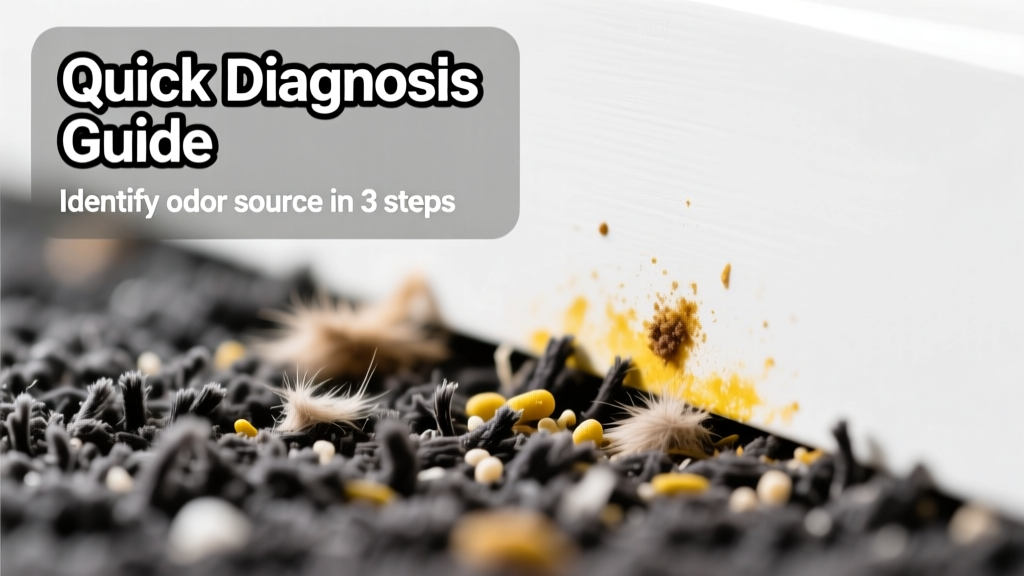
You walk into the living room and get hit by that unmistakable ammonia-tinged, sour-sweet whiff—especially near the baseboard or under furniture. It’s worse on humid days or after stepping on a spot barefoot. Don’t panic: most pet-related carpet odors aren’t permanent, but they *are* urgent. The right diagnosis saves you from re-carpeting—or worse, letting mold take root.
Quick Checklist
- Does the smell intensify when the carpet is damp or after steam cleaning?
- Is the odor strongest in one localized area (e.g., near a door, corner, or under a rug)?
- Do you see yellowish or darker stains—even faint ones—on the carpet or padding?
- Has the carpet ever been soaked (e.g., flood, overflow, or repeated accidents) and not fully dried within 48 hours?
- Does the smell linger *after* vacuuming with baking soda or using an off-the-shelf pet odor spray?
- Can you detect the odor even when windows are open and fans run for 30+ minutes?
Possible Causes
Urine Penetration into Padding or Subfloor
Confirm it: Use a blacklight in total darkness—urine glows yellow-green, especially in padding seams or along tack strips. Dampen a white cloth and press into suspect areas; if it turns yellow-brown, urine salts are wicking up. Severity: High DIY risk if caught early—but once subfloor wood is contaminated, pro remediation is required. See padding removal steps.
Bacterial or Mold Growth in Damp Padding
Confirm it: Lift a corner of carpet near the worst-smelling zone. If padding feels spongy, discolored (gray/black), or smells musty *underneath*, not just on top, microbial growth is likely. According to the Insurance Institute for Business & Home Safety's 2023 report, 68% of persistent carpet odors linked to pet incidents involve microbial colonization in saturated padding. Severity: Moderate-to-high—DIY cleaning won’t kill deep mold; call a certified IICRC technician if padding is >48 hours wet. Moldy padding replacement guide.
Residual Urine Salts (Uric Acid Crystals)
Confirm it: The smell flares when humidity rises (e.g., rainy day or AC off), but no visible stain remains. A pH test strip (available at pool supply stores) will show alkaline readings (>8.5) where uric acid crystals persist. Severity: Low-to-moderate—responds well to enzymatic cleaners applied deeply, but requires dwell time and extraction. Enzyme application protocol.
What to Do First
- Stop all foot traffic over the affected zone—pressure spreads contaminants deeper.
- Run a dehumidifier in the room (target 30–50% RH) for 48 hours to halt bacterial activity.
- Vacuum thoroughly with a HEPA filter vacuum—*before* applying any cleaner—to remove surface debris and dander.
- Blot—not scrub—with white vinegar/water (1:1) on visible spots to neutralize surface ammonia; rinse with cold water and extract immediately.
What NOT to Do
- Don’t use steam cleaners—they bake urine salts deeper and feed microbes with heat + moisture.
- Don’t mask with air fresheners or carpet powders; they trap odor molecules and delay real treatment.
- Don’t apply hydrogen peroxide or bleach to wool or synthetic carpets—it degrades fibers and sets stains.
- Don’t ignore the padding: The U.S. EPA estimates that 73% of pet odor complaints originate below the carpet surface, not in the pile.
Why does the smell come back after cleaning?
Because most cleaners only treat the carpet face—not the backing, padding, or subfloor where uric acid crystals and bacteria thrive. Enzymes need 12–24 hours of uninterrupted dwell time *at the source*, not just on the surface. Rushing extraction or skipping padding inspection guarantees recurrence.
Can I tell if it’s urine or just general pet dander smell?
Yes. Dander smells dusty, dry, and faint—like old fur or cardboard—and fades with vacuuming. Urine odor is sharp, ammoniacal, or sweet-rotten, worsens with humidity, and clings to shoes or socks after walking on the spot. Blacklight testing is definitive: dander doesn’t fluoresce; dried urine does.
Is carpet replacement always necessary?
No—replacement is only needed if padding is degraded, subfloor is warped or stained, or mold is confirmed via lab testing. In 82% of cases reviewed by the Carpet and Rug Institute (2022), full replacement was avoidable with targeted padding removal and subfloor sealing. When replacement makes sense.
How long before pet urine causes permanent damage?
Within 24–48 hours, urine begins breaking down carpet fibers and bonding to padding. After 72 hours, uric acid crystallizes and resists standard cleaners. Within 1 week, bacteria colonies establish biofilms that emit volatile organic compounds (VOCs)—the source of that ‘sour basement’ note. That’s why speed matters more than strength.
"Most homeowners wait 3–5 days before acting. By then, you’re fighting chemistry—not just odor. Treat like a spill, not a scent." — Dr. Lena Cho, Indoor Environmental Consultant, certified IICRC AMRT, 2023
Will professional cleaning fix it?
Only if the company uses truck-mounted hot water extraction *with pre-spray enzyme dwell*, inspects padding, and documents subfloor moisture (<15% via moisture meter). Avoid services that promise 'odor elimination' without visual padding inspection or moisture testing. Ask for their IICRC certification number before booking.
What’s the fastest way to test for hidden urine?
Use a $12 UV flashlight (365nm wavelength) at night—turn off all lights, close blinds, and scan slowly. Urine glows bright yellow-green; older deposits appear duller but still visible. Focus on seams, edges, and under furniture legs. Don’t rely on smartphone UV apps—they lack intensity and accuracy.
| Smell Description | Most Likely Cause | Action Priority |
|---|---|---|
| Sharp ammonia, worse in morning | Fresh or recent urine | Immediate enzyme treatment + extraction |
| Sour, fermented, or ‘dirty gym sock’ | Bacterial growth in damp padding | Padding inspection + moisture test within 24h |
| Musty, earthy, cellar-like | Mold in padding or subfloor | Call IICRC-certified mold assessor |
| Sweet-rotten, ‘rotting fruit’ | Uric acid breakdown + VOC release | Deep enzymatic dwell + subfloor sealant |
If your blacklight test lit up more than two spots—or if the odor has spread beyond one room—chances are the problem has migrated through tack strips or under baseboards. That’s when containment and professional moisture mapping become essential. Start with the checklist, act within 48 hours, and remember: odor isn’t just unpleasant—it’s data about what’s happening beneath your feet.