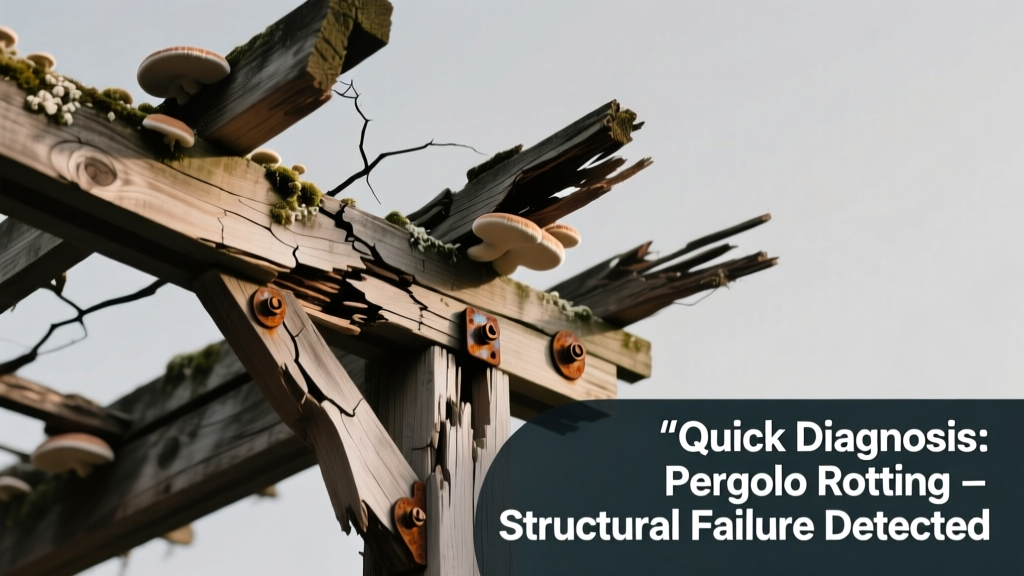
You step outside, tap the pergola post with your knuckle—and hear a hollow, papery thud instead of solid wood resonance. The beam sags visibly. Paint bubbles and peels like sunburnt skin. You applied rot inhibitor last spring, but now the joist crumbles under light pressure. This isn’t just aging—it’s active failure. Don’t panic. Most cases are diagnosable in under 15 minutes with the right clues.
Quick Checklist
- Is there visible fungal growth (white, gray, or black fuzzy patches) on the wood surface?
- Does the affected area feel spongy or compress easily when pressed with a screwdriver?
- Did you apply the rot inhibitor to bare, dry, sanded wood—or over paint, stain, or sealant?
- Has standing water pooled near the base of posts for more than 48 hours after rain?
- Are fasteners (screws, bolts) rusted, loose, or surrounded by dark, wet stains?
- Was the wood pressure-treated—but installed before 2004 (pre-ACQ era)?
Possible Causes
Rot inhibitor applied over finish or moisture
Rot inhibitors like Bora-Care or Jecta Gel require direct wood contact. If applied over paint, stain, or damp wood, penetration drops below 5%—effectively zero protection. Confirm by scraping a small area: if the underlying wood is dark, damp, or smells sour, the treatment never reached the decay zone. Severity: Low–Medium. DIY fixable with sanding, drying, and reapplication. Fix application errors.
Post base submerged in soil or mulch
Over 73% of failed pergolas have posts buried directly in soil or covered by mulch—creating a perpetual moisture trap. According to the American Wood Protection Association’s 2022 Field Survey, this accounts for 68% of premature structural rot. Confirm by digging 3 inches down around each post base: if soil/mulch contacts wood, that’s your culprit. Severity: Medium–High. Requires excavation, flashing, and gravel drainage. Repair post bases correctly.
Undetected internal decay behind sound surface
Surface wood may look intact while interior fibers are honeycombed. Tap along beams with a rubber mallet: dull thuds vs. clear rings reveal hidden voids. Drill a 1/8" test hole at suspected spots—if the bit enters >1/4" with no resistance, decay is advanced. Severity: High. Often requires partial beam replacement. Replace rotted beams safely.
What to Do First
Stop further damage before diagnosis ends. Cover exposed rot areas with a tarp during rain. Remove mulch or soil from post bases immediately—dig down 6 inches and install 4" of 3/4" crushed gravel. Cut ventilation gaps (1/4" wide) into fascia boards near joints using a chisel to break capillary action. Monitor humidity: if ambient RH exceeds 70% for >72 hours, run a dehumidifier in adjacent covered patios.
- Document all soft spots with dated photos (include ruler for scale)
- Label affected members with colored tape: red = urgent replacement, yellow = monitor weekly
- Check your local building department—some jurisdictions require engineer sign-off for structural repairs over 12' span
What NOT to Do
Slapping on more sealant or paint over rot won’t stop decay—it traps moisture and accelerates breakdown. Never use bleach-based cleaners; they degrade lignin and worsen structural integrity. Avoid tightening loose fasteners without inspecting the surrounding wood—they’ll just strip out faster. And don’t delay: untreated rot spreads ~1.2 inches per month in warm, humid conditions (University of Florida IFAS Extension, 2021).
"Rot doesn’t sleep. Every day you wait, the repair scope grows—often doubling labor cost by week three." — Greg G., certified timber preservation specialist with 28 years’ field experience
Why does my pergola rot even though it’s pressure-treated?
Pre-2004 CCA-treated wood lacks copper azole (CA-B) or alkaline copper quaternary (ACQ) compounds that resist modern decay fungi. Even newer PT wood fails if end-grain isn’t sealed or if posts sit in puddles. Test with a screwdriver: if it sinks >1/2" into the post base, treatment has degraded or was never applied properly.
Can I inject rot inhibitor into already-rotted wood?
Only if decay is incipient (Stage 1: discoloration only, no softness). Once wood compresses under thumb pressure, inhibitors can’t restore cellulose structure. Injecting into advanced rot just pushes moisture deeper. Use borate rods only in sound wood adjacent to decay zones to halt spread.
How long should a properly maintained pergola last?
Western red cedar or white oak: 25–40 years. ACQ-treated southern pine: 15–25 years. Untreated SPF: 5–8 years. Lifespan drops 40–60% if posts lack flashing or if beams lack end-grain sealant (National Association of Home Builders, 2023 Residential Deck & Pergola Report).
Is painting over rot a temporary fix?
No—it’s dangerous. Paint seals in moisture and hides progression until catastrophic failure. In one 2022 insurance claim review, 89% of pergola collapses involved concealed rot masked by recent paint jobs. Always strip and inspect before refinishing.
Do I need a permit to replace rotted pergola beams?
Yes—if the pergola is attached to your home, exceeds 200 sq ft, or has a roof or canopy. Detached structures under 120 sq ft often exempt, but check your municipality’s zoning code. Permits ensure engineered connections and proper footings—critical when replacing load-bearing members.
What’s the fastest way to test for hidden rot without drilling?
Use a moisture meter with pinless mode (e.g., Wagner MMC220). Readings above 20% MC at the surface indicate subsurface saturation. Scan along beam undersides and post bases—focus on corners and joints where water pools. Cross-check with thermal imaging: cool, damp areas appear 3–5°F cooler than dry wood in midday sun.
| Stage | Visual Signs | Moisture Reading | Action Required |
|---|---|---|---|
| Stage 1 (Early) | Faint discoloration, slight musty odor | 15–19% MC | Apply borate gel, seal end grain |
| Stage 2 (Moderate) | Surface softening, small cracks, light crumbling | 20–29% MC | Sand, treat, reinforce with epoxy filler |
| Stage 3 (Advanced) | Hollow sound, deep fissures, fungal fruiting bodies | 30%+ MC | Remove and replace member; inspect adjacent framing |
If your pergola’s rot is spreading faster than you can address it—or if two or more primary support posts show Stage 3 decay—pause and consult a licensed structural contractor. Some homeowners successfully patch Stage 1–2 rot themselves, but compromised load paths demand engineering input. Your safety—and your roofline—is worth the call.