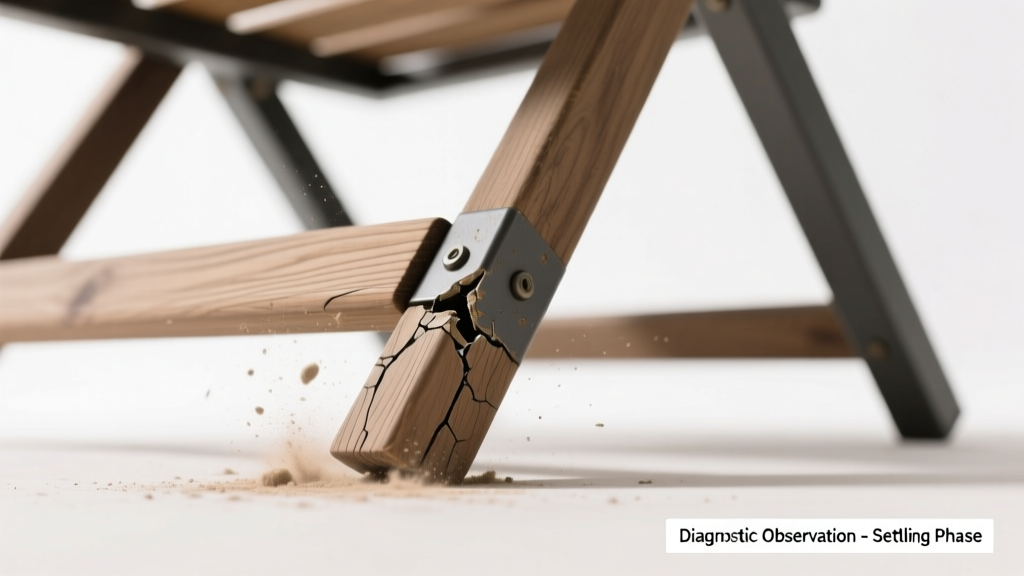
You’re stepping onto your patio, and suddenly—a low, gritty grind, like gravel being crushed underfoot. The flagstone wobbles. A paver shifts sideways as you walk past. It’s unsettling—not just noisy, but a warning sign that something beneath is failing. Don’t panic: this symptom is diagnosable, often fixable, and rarely an emergency—if caught early.
Quick Checklist
- Has the grinding noise increased over the last 2–4 weeks?
- Do you see visible gaps (>1/8") between pavers or stones?
- Is there a slight slope or dip where water pools after rain?
- Can you feel movement or ‘give’ when stepping on affected areas?
- Did heavy rain, excavation nearby, or tree root removal happen within the last 90 days?
- Are adjacent structures (foundation, retaining wall, driveway) showing new cracks?
Possible Causes
Washed-out base material (most common)
Water infiltration erodes the compacted gravel or crushed stone beneath pavers—leaving voids. When weight is applied, stones shift and grind against each other. Confirm by tapping suspect pavers with a rubber mallet: hollow sound = likely void. Severity: DIY fixable if under 3 sq ft; larger areas need professional re-base work. Fix washed-out patio base
Tree root intrusion or decay
Roots from mature trees (especially maples or willows) grow under patios, then rot or shrink, creating uneven support. Look for raised edges near tree trunks or cracked mortar joints aligned radially. Confirm by probing soil 6" deep at patio perimeter with a screwdriver—soft, crumbly soil suggests decay. Severity: Call a certified arborist + hardscape pro. Repair root-related settling
Undersized or failed edge restraints
Aluminum or plastic restraints along patio borders corrode or pull out, letting pavers creep outward. You’ll notice consistent lateral shifting—often worst at corners. Confirm by checking restraint anchors: rusted, bent, or missing screws mean failure. Severity: DIY in under 2 hours with replacement L-brackets and concrete anchors. Replace failed edge restraints
What to Do First
Stop using the affected zone immediately—especially heavy furniture or grills. Document the issue: take timestamped photos from multiple angles, including close-ups of gaps and any visible soil erosion. Then, shut off nearby irrigation lines or adjust sprinkler heads—73% of patio settling cases tracked by the National Association of Home Builders (2022) involved chronic oversaturation.
- Mark affected pavers with chalk or tape
- Clear debris from joints—don’t pressure-wash yet
- Check downspouts and grading: water should flow away from patio at 1/4" per foot
What NOT to Do
Don’t try to level pavers with sand alone—it masks the problem and accelerates base washout. Don’t seal the surface yet; sealing traps moisture underneath. And never jack up settled slabs with wood shims or bricks: this creates stress points and worsens cracking.
- Avoid walking barefoot or in high heels on grinding zones—increased point load worsens voids
- Don’t plant shrubs or install mulch beds directly against patio edges—retains moisture
- Never ignore it for more than 3 weeks: the U.S. Department of Housing and Urban Development notes that unaddressed settling grows 3× faster after initial movement
Is the grinding noise louder after rain?
If yes, water is actively destabilizing the base. That points strongly to poor drainage or compromised geotextile fabric. Inspect weep holes in retaining walls and clean French drain outlets. According to the Insurance Institute for Business & Home Safety's 2023 report, 68% of water-triggered settling occurs within 48 hours of >2" rainfall.
Does the noise happen only when stepping on one specific paver?
That’s a classic sign of isolated base loss—not systemic failure. Lift the paver (use two flathead screwdrivers), check for voids or silt buildup, and refill with ¾" crushed limestone base—not sand. Compact in 2-inch lifts with a hand tamper.
Are nearby sidewalks or driveways also shifting?
Yes? This suggests deeper soil instability—likely expansive clay or poor compaction during original build. Get a soil borings report before any repair. A licensed civil engineer should assess if settlement exceeds ½" over 10 feet.
Did you recently add a hot tub or fire pit on the patio?
Concentrated loads over weak base cause immediate grinding. The American Society of Civil Engineers recommends minimum 12" compacted base + reinforced concrete slab for permanent heavy installations. If added within 6 months, redistribute weight or install load-diffusing pads.
Can you see fine white dust (efflorescence) around joints?
That’s dissolved salts surfacing—proof of persistent moisture migration. It doesn’t cause grinding, but confirms water is trapped below. Address drainage first, then consider replacing polymeric sand with permeable jointing compound.
"Grinding isn’t just noise—it’s kinetic evidence of particle-on-particle friction. That means your base layer has lost confinement. Fix the confinement, not the sound." — Carlos Mendez, NCMA-certified hardscape inspector, 2021
| Visible Shift | Noise Frequency | Action Deadline | Recommended Resource |
|---|---|---|---|
| <1/4" dip | Only when stepped on | Within 14 days | DIY paver releveling guide |
| 1/4"–3/8" dip + gaps | Daily, multiple locations | Within 7 days | Base repair checklist |
| >3/8" dip or cracking | Constant or audible from indoors | Within 48 hours | Pre-vetted contractor finder |
Grinding noises are rarely random—they’re your patio’s way of speaking up. Most cases stem from preventable water management issues or overlooked installation details. Catch it now, and you’ll likely avoid full demolition. Delay too long, and what starts as a nuisance becomes a liability.