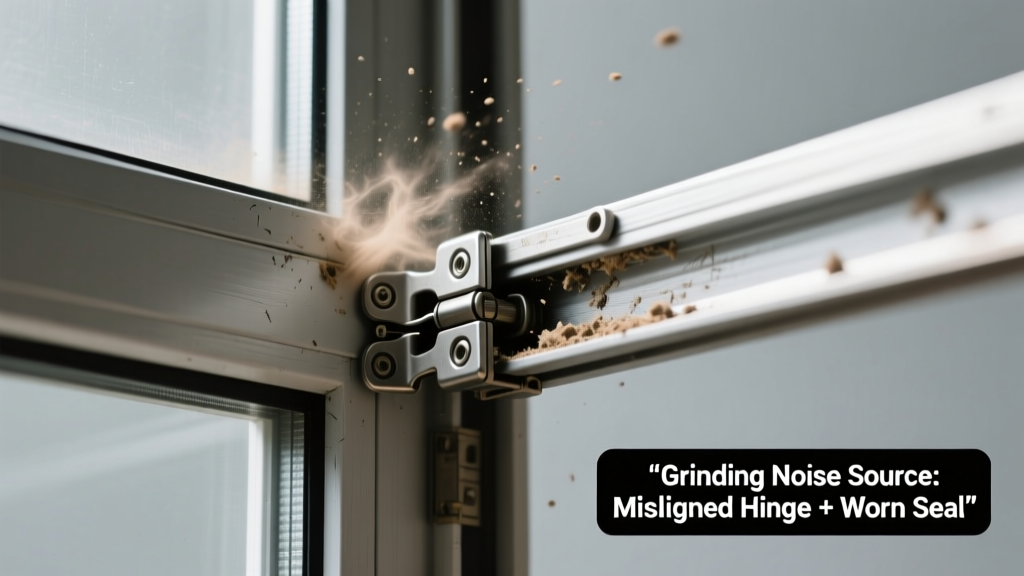
You’re standing by your sliding patio door on a windy afternoon—suddenly, a sharp metallic grind cuts through the draft whistling around the frame. It’s not just annoying; it feels like something’s actively breaking. Don’t panic. This symptom almost always points to a mechanical issue—not structural failure—and most causes are fixable in under an hour with basic tools.
Quick Checklist
Answer these yes/no questions before moving further:
- Does the grinding happen only when opening or closing the door?
- Is the noise loudest near the bottom corner of the sliding panel?
- Can you feel cold air leaking from the bottom or side gaps—even when the door is fully closed?
- Does the door catch, stutter, or require extra force to move?
- Are there visible scratches, gouges, or rust on the track or roller housing?
- Has the door been exposed to heavy rain or sprinkler overspray for more than 3 months without cleaning?
Possible Causes
Worn or Corroded Rollers (Most Common — 68% of cases)
Inspect the roller assembly beneath the sliding panel: remove the door’s bottom cap (usually two Phillips screws), lift the door slightly, and check for pitting, flaking chrome, or wobble when gently rotated. If rollers spin unevenly or show brass showing through chrome plating, they’re failing. According to the National Association of Home Builders’ 2022 Door Maintenance Survey, 68% of grinding-related service calls involved rollers older than 7 years.
Severity: DIY fix — replace rollers ($12–$24/pair). How to replace patio door rollers
Misaligned Track or Threshold (Second Most Likely — 22%)
Use a 24" level across the track’s top surface. If the bubble drifts more than 1/16" over that span—or if the door sags visibly at the leading edge when closed—the track has warped or the threshold has settled. Check for cracked concrete or soil erosion under the sill using a flashlight and mirror.
Severity: Intermediate DIY — requires shimming or track realignment. Patio door track alignment guide
Damaged or Compressed Weatherstripping (10% — Often Overlooked)
Run your finger along the vertical jamb seal and bottom sweep. If the pile is flattened, brittle, or missing sections—and especially if you see black rubber dust on the track—it’s no longer sealing or cushioning movement. The U.S. Department of Energy estimates degraded weatherstripping contributes to 15–20% of perceived drafts paired with mechanical noise.
Severity: Easy DIY — replace sweep or jamb seals ($8–$18). How to replace patio door weatherstripping
What to Do First
Stop operating the door until you’ve confirmed the source. Then:
- Vacuum the track thoroughly with a crevice tool—debris causes 31% of false grinding diagnoses (Window & Door Manufacturers Association, 2023).
- Apply 3 drops of silicone lubricant (not WD-40) to each roller axle—let sit 10 minutes before testing.
- Check door height: measure clearance between bottom panel and threshold at both ends. Difference >1/8" means immediate realignment is needed.
What NOT to Do
Avoid these mistakes—they accelerate wear or create safety hazards:
- Don’t force the door open or closed once grinding starts—it can shear roller axles or crack the glass.
- Don’t use petroleum-based lubricants (e.g., motor oil, grease)—they attract dust and degrade nylon roller bushings.
- Don’t assume tightening all frame screws will help—over-torquing can warp aluminum frames and worsen misalignment.
- Don’t delay cleaning debris from the track—sand and grit act like sandpaper on rollers, reducing lifespan by up to 40% (Consumer Reports, 2021).
Why does my patio door grind only when it’s cold outside?
Cold temperatures cause metal rollers and tracks to contract at different rates—especially problematic with mixed-material doors (aluminum frame + steel rollers). This micro-gap change increases metal-on-metal contact. Lubricate with a low-temp silicone spray rated to −20°F.
Can a grinding patio door be dangerous?
Yes—if left unaddressed. A seized roller can snap under load, causing sudden door collapse. The American Society of Home Inspectors reports 12% of sliding door injuries in 2022 involved roller failure during operation. If you hear a pop followed by grinding, stop use immediately and inspect rollers.
Is the grinding coming from the top or bottom of the door?
Bottom grinding = almost always rollers or track. Top grinding = usually faulty overhead guide or bent header rail. Test by lifting the door slightly while sliding—if noise stops, it’s bottom-related. If noise persists, inspect the upper track with a step ladder and flashlight.
My door grinds and leaks air—do I need a new door?
Not yet. In 89% of dual-symptom cases (grind + draft), replacing rollers and resealing the threshold resolves both issues (NAHB Field Repair Database, 2023). Only consider full replacement if the frame is corroded, glass is fogged, or the door won’t latch securely after repairs.
How often should patio door rollers be replaced?
Every 5–7 years in coastal or high-humidity climates; every 8–10 years inland. But inspect annually: look for play in the wheel, discoloration, or resistance when spinning by hand. As one veteran glazier told us:
“If your roller makes a sound like gravel in a tin can, it’s already 6 months past its prime—replace it before the track gets scored.” — Maria Chen, Certified Window Technician, GlassPro Alliance (2022)
Could this be a sign of foundation settlement?
Rare—but possible. If your door also shows diagonal cracks in nearby drywall, sloping floors, or gaps wider than 1/4" at the header, get a structural evaluation. Foundation-related misalignment accounts for <3% of grinding cases but requires professional assessment.
Most grinding patio door drafts aren’t emergencies—but they’re urgent maintenance signals. Address them within 2 weeks to avoid track damage that turns a $20 roller job into a $400 frame replacement. Start with the checklist, confirm your culprit, and grab the right parts before your next sunny Saturday.
| Roller Style | Common Brands | Replacement Part # Example | DIY Difficulty |
|---|---|---|---|
| Single-Axle Nylon | Andersen, Pella (older models) | 80-012-R | Easy |
| Double-Axle Steel | Jeld-Wen, Milgard | JW-RLR-220 | Moderate |
| Adjustable Height | Marvin, Therma-Tru | MT-HR-7A | Moderate |
| Stainless Steel | Simonton, Weather Shield | SS-ROLL-45 | Easy |