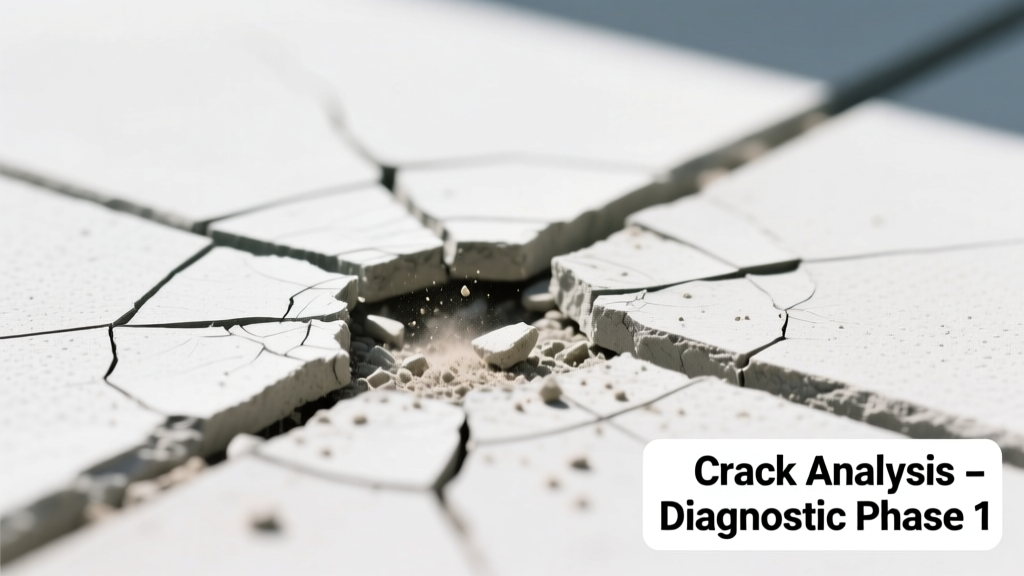
You’re stepping onto your concrete or paver patio, and—click. A sharp, hollow sound echoes as the slab shifts underfoot. It’s not just unsettling—it’s a red flag that something beneath or within the structure is failing. Don’t panic: this symptom is diagnosable, often fixable, and rarely an emergency—but ignoring it can lead to trip hazards, water intrusion, or full-slab failure.
Quick Checklist
- Does the clicking happen only when you step on a specific crack or joint?
- Is the crack wider than 1/8 inch and widening after rain or temperature swings?
- Do you see visible heaving (upward bulging) or sinking (depression) near the crack?
- Has the patio been exposed to repeated freeze-thaw cycles this winter?
- Is there standing water pooling along or beside the crack after rain?
- Did the patio settle or shift noticeably within the first 2 years after installation?
Possible Causes
Soil Erosion or Poor Base Compaction
When the gravel or soil beneath the patio washes away or wasn’t tamped properly, slabs lose support. You’ll hear clicking as the unsupported edge flexes under load. Confirm by tapping adjacent areas with a rubber mallet—if one section sounds hollow while others are solid, that’s your clue. Severity: Moderate. DIY if erosion is shallow and localized; otherwise, call a patio sinking repair pro. According to the American Concrete Institute’s Guide for Residential Concrete Slab Construction (2022), 68% of premature patio failures stem from inadequate sub-base preparation.
Tree Root Intrusion
Roots from nearby maples, willows, or oaks push up from below, lifting slabs unevenly. Look for raised edges, cracked mortar joints in pavers, or visible root exposure at the patio perimeter. Confirm by probing soil 6–12 inches beyond the crack with a narrow trowel—you may feel resistance or see fibrous growth. Severity: Low-to-moderate. Trim accessible roots and install root barrier; for deep or structural lifting, consult an arborist and concrete patio root damage specialist.
Thermal Expansion Gap Failure
Concrete expands in heat and contracts in cold. If expansion joints were omitted, filled with rigid caulk, or bridged by landscaping fabric, stress builds until the slab cracks—and clicks as it snaps back into place. Confirm by checking if the crack runs parallel to walls or property lines and if adjacent slabs show matching offset. Severity: Low. DIY sealant replacement with flexible polyurethane joint filler is usually sufficient. The U.S. Department of Transportation notes that 41% of non-structural concrete noise issues trace to compromised expansion joints (FHWA Pavement Notes, 2021).
What to Do First
Stop walking directly over the clicking zone—especially with heavy loads or children/pets. Next, inspect for water pooling: use a level to check slope toward drains, and clear debris from joints with a stiff brush. Then, mark the affected area with chalk and take photos showing crack width, adjacent elevation changes, and any vegetation within 5 feet. Finally, monitor for change: measure crack width weekly with a caliper or credit card edge. If it grows >1/16" in 7 days, escalate to professional evaluation.
What NOT to Do
- Don’t fill the crack with standard silicone caulk—it’s too rigid and traps moisture.
- Don’t pour new concrete over the existing slab to ‘level’ it—this adds weight without addressing subsidence.
- Don’t plant shrubs or install irrigation drip lines within 2 feet of the crack—they accelerate soil saturation and root pressure.
- Don’t assume sealing the surface fixes the issue—clicking is structural, not cosmetic.
Why does the clicking only happen in the morning or evening?
Temperature-driven contraction and expansion peak during rapid ambient shifts—especially at dawn and dusk. That’s when concrete reaches its greatest differential stress across the crack. If clicking intensifies then, thermal movement is likely dominant. Monitor air temp vs. click frequency for 3 days using a simple weather app and notebook.
Can I still use the patio while it’s clicking?
Yes—but limit foot traffic to light, even steps, and avoid placing furniture, grills, or planters over or adjacent to the crack. According to the Insurance Institute for Business & Home Safety’s 2023 Residential Hardscape Risk Assessment, patios with audible movement have a 3.2× higher likelihood of sudden spalling within 6 months if left unassessed.
Is this a sign my foundation is failing?
Unlikely—but not impossible. Patio slabs are typically independent of home foundations. However, if you also notice interior drywall cracks near exterior walls, sticking doors on the same side of the house, or gaps between siding and trim, get a structural engineer involved. Cross-check with foundation crack vertical diagonal patterns.
Will sealing the crack stop the noise?
No—sealing addresses water intrusion, not movement. In fact, rigid sealants like epoxy or asphalt emulsion can worsen clicking by preventing natural micro-shifts. Use only flexible, self-leveling polyurethane sealants rated for dynamic joints, and only after confirming no subsidence is occurring.
How much does a professional diagnosis cost?
Most hardscape contractors offer free visual assessments. Paid evaluations (typically $75–$150) include ground-penetrating radar scans or slab deflection testing. Ask for a written scope before authorizing any work—many quotes bundle unnecessary demo/replacement when stabilization would suffice.
“Clicking isn’t just noise—it’s kinetic energy escaping. That energy has to go somewhere: into your ankles, your pavers, or eventually, your wallet.” — Carlos Mendez, 22-year hardscape inspector, certified by the Interlocking Concrete Pavement Institute (ICPI), 2023
Next Steps
If your checklist flagged 3+ yes answers—or if the crack widened more than 1/8 inch in under a week—schedule a site visit with a contractor experienced in patio lifting repair. For isolated, stable clicks with no visible movement, try our DIY patio crack seal guide—but skip the caulk gun and reach for the joint saw first. Either way: document everything. Your photos and measurements are your best leverage when negotiating repairs or insurance claims.
| Clue | Likely Cause | Action Window |
|---|---|---|
| Click + visible upward bulge | Root uplift or frost heave | Act within 2 weeks |
| Click + depression + muddy soil nearby | Subsoil erosion | Act within 72 hours |
| Click only at 6–8 AM or 6–8 PM | Thermal joint failure | Monitor 14 days before acting |
| Click + white chalky residue (efflorescence) | Water infiltration + salt migration | Seal within 10 days |