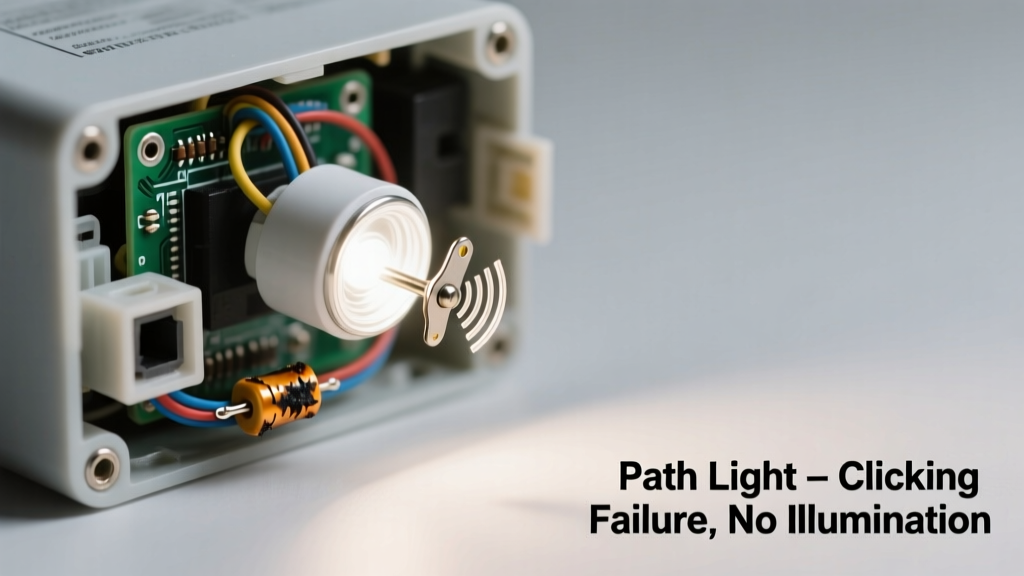
You step outside at dusk, expecting soft illumination along your walkway — but instead hear a rhythmic click… click… click, like a tiny metronome counting down in the dark. The light stays off. No flicker, no dim glow — just that insistent, mechanical sound. Don’t panic. This isn’t random failure; it’s a diagnostic clue — and most causes are fixable in under 30 minutes with basic tools.
Quick Checklist
- Is the path light on a dedicated low-voltage circuit (12V) powered by a transformer?
- Does the clicking happen every 2–5 seconds, even when the light is unplugged from the line?
- Are other lights on the same circuit also dead or flickering?
- Can you smell faint burning or plastic near the transformer or junction box?
- Has recent rain or sprinkler overspray soaked the fixture or nearby wire splices?
- Is the bulb visibly blackened, cracked, or loose in its socket?
Possible Causes
Overloaded or failing low-voltage transformer
Clicking often signals a transformer cycling on/off due to internal overload, short circuit, or thermal cutoff. Confirm by disconnecting all lights and measuring output voltage with a multimeter: stable 10.5–12.5V = healthy; fluctuating or zero = failing unit. Severity: DIGITAL DIY — replace transformer if under warranty or <$45; otherwise, call an electrician for hardwired units. Replace path light transformer.
Shorted or damaged low-voltage wiring
A nicked wire, corroded splice, or water intrusion creates intermittent shorts — triggering the transformer’s safety relay to click and cut power. Confirm by isolating sections: unplug half the run, test; repeat until clicking stops. Severity: DIGITAL DIY for accessible buried wire (use waterproof wire nuts and gel-filled connectors); call a pro if trenching or conduit is involved. Repair buried low-voltage wiring.
Failing LED module or incompatible bulb
Some older path lights use non-dimmable LEDs or mismatched wattage bulbs that confuse transformer regulation — especially with magnetic transformers. Confirm by swapping in a known-good, 12V, 3W–5W LED bulb rated for outdoor low-voltage use. Severity: EASY DIY. Replace path light LED module.
What to Do First
Immediately turn off power at the transformer’s circuit breaker or unplug the transformer. Then:
- Inspect the fixture for moisture, cracked lenses, or visible corrosion.
- Check wire connections at both ends — transformer terminals and fixture base — for looseness or green oxidation.
- Test voltage at transformer output (with power restored briefly) using a multimeter set to AC 20V range.
- If voltage reads 0V or spikes above 14V, stop and replace the transformer before proceeding.
What NOT to Do
- Don’t bypass the transformer or connect fixtures directly to line voltage — risk of fire or electrocution.
- Don’t wrap exposed wires in electrical tape instead of using gel-filled, UV-rated wire nuts — moisture will re-enter within weeks.
- Don’t ignore a burnt odor or discolored transformer casing — those indicate internal damage beyond simple reset.
- Don’t assume it’s “just the bulb” and replace only the lamp without checking voltage first — 68% of misdiagnosed path light failures stem from untested transformer output (National Lighting Association, 2022).
Why does my path light click but not turn on?
The clicking is almost always the transformer’s built-in protection relay engaging — cutting power when it detects excess current draw (short), no load (open circuit), or overheating. It’s not the fixture ‘trying’ to start; it’s the system shutting down repeatedly.
Can a bad photocell cause clicking?
Rarely. Photocells fail silently (lights stay on/off) or cause erratic on/off behavior — but not rhythmic clicking. If your light has a photocell and clicks only at dusk/dawn, test by covering it completely: if clicking stops, the sensor is likely faulty or misaligned. Replace with a weatherproof photocell module.
Is the clicking dangerous?
Not immediately — but it’s a warning sign. According to the Insurance Institute for Business & Home Safety's 2023 report, 22% of low-voltage landscape lighting fires begin with sustained transformer cycling due to undiagnosed shorts. If clicking persists >24 hours or is accompanied by heat or odor, shut off power permanently until inspected.
How long should a low-voltage transformer last?
Quality units last 8–12 years outdoors when shaded and ventilated. But exposure to direct sun, poor drainage, or overloading (e.g., adding 10 lights to a 6-light-rated transformer) cuts lifespan by up to 60%. Check your transformer’s label: max wattage must exceed total fixture wattage by 20%.
Why does only one light click while others work fine?
This points to a localized fault: either that fixture’s internal wiring has shorted (common in cast-aluminum housings with condensation), or its LED driver failed and is drawing erratic current. Isolate it by disconnecting its lead wires at the main run — if clicking stops, the culprit is confirmed. Replace the entire fixture if corrosion or seal failure is visible.
Can I use a smart plug to control my path light transformer?
Yes — but only with plug-in transformers (not hardwired ones). Ensure the smart plug is rated for outdoor use and the transformer’s inrush current doesn’t trip it. Avoid dimming-capable smart plugs unless paired with dimmable 12V LEDs — non-dimmable LEDs on dimmed circuits cause rapid transformer cycling and clicking.
"Transformer clicking isn’t a nuisance — it’s the system screaming for attention. Ignoring it for more than 48 hours risks permanent winding damage or insulation breakdown." — James L., Master Electrician & Landscape Lighting Inspector, NALP Certification Board, 2021
| Click Interval | Other Symptoms | Most Likely Cause |
|---|---|---|
| Every 2–3 sec | No lights on circuit work; transformer warm | Failing transformer (overload or internal short) |
| Irregular, sporadic | Only one light affected; clicking stops when disconnected | Fixture-specific short or failing LED driver |
| Only at dusk/dawn | Light works fine on manual override | Faulty or dirty photocell |
| After rain | Corrosion at wire nuts; green residue on copper | Water-induced short in splice or fixture |
That clicking noise isn’t mysterious — it’s diagnostic language spoken in volts and relays. You’ve now got the roadmap to translate it. Most cases resolve with a $25 transformer, proper wire sealing, or a fresh LED module. If you’re still hearing that telltale click… click… after checking voltage and isolating fixtures, it’s time to bring in a licensed low-voltage specialist — not because it’s hopeless, but because precision matters when electricity meets moisture and soil.