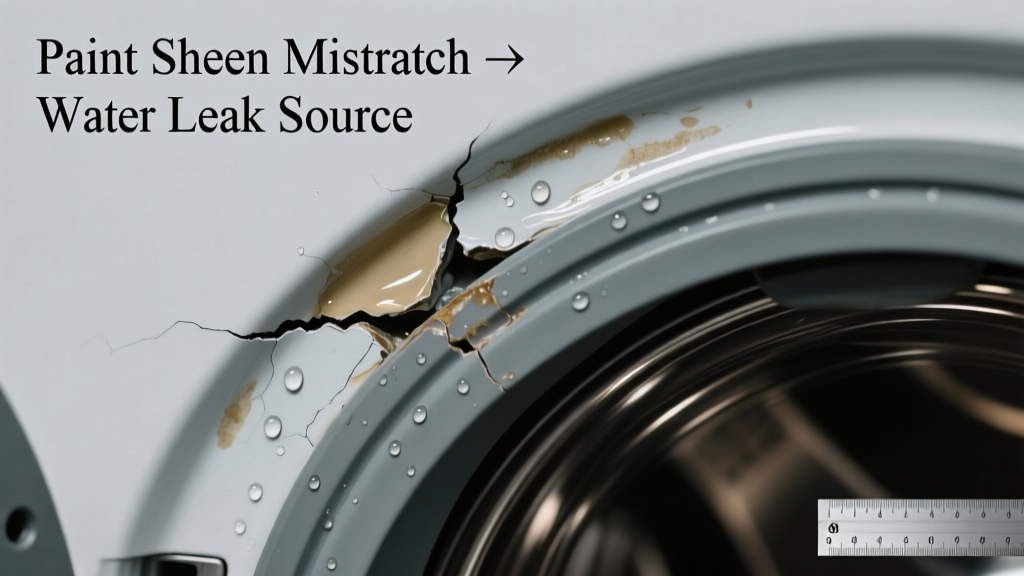
You notice a dull, chalky patch next to glossy paint on your bathroom ceiling—then a drip hits the shower floor. That sheen mismatch isn’t just ugly; it’s your wall or ceiling screaming that moisture is trapped behind the finish. Don’t assume it’s ‘just condensation’—this symptom almost always points to active water movement.
Quick Checklist
- Is the sheen mismatch located directly above or beside a plumbing fixture (shower valve, tub overflow, sink drain)?
- Does the dull area feel cool or slightly damp to the touch—even when the room is dry?
- Has the affected area expanded in size over the past 7–10 days?
- Do you hear faint dripping or running water behind the wall when no fixtures are in use?
- Is there visible efflorescence (white, powdery mineral deposits) near baseboards or grout lines below the mismatch?
- Was the wall repainted within the last 18 months—without addressing prior moisture damage?
Possible Causes
Failed Grout or Caulk at Shower Enclosure
Water wicks through hairline cracks in silicone or sanded grout, saturating drywall behind tile. Confirm by spraying the shower walls with a mist bottle for 90 seconds while watching for new darkening or beading on the painted surface. Low severity—DIY fixable in under 2 hours. Replace shower caulk.
Leaking Supply Line Behind Vanity or Toilet
A corroded flex line or loose compression nut drips steadily into wall cavities, causing uneven moisture absorption and paint failure. Confirm using a moisture meter: readings >18% on drywall indicate active saturation. Medium severity—requires shut-off and replacement; most homeowners can handle it. Fix leaking toilet supply line.
Roof Flashing Failure Above Bathroom Fan Duct
Rainwater enters where the exhaust duct penetrates the roof deck, travels down framing, and pools inside top plates—eventually bleeding through ceiling paint. Confirm by inspecting attic insulation above the fan for dark, matted, or mold-flecked areas. High severity—call a roofing pro. Roof flashing repair.
What to Do First
Shut off water to the bathroom at the local shutoff valve (not the main)—even if you don’t see an obvious leak source. Then, place a bucket under active drips and run a dehumidifier at 45% RH for 48 hours. According to the Insurance Institute for Business & Home Safety's 2023 report, delaying mitigation beyond 48 hours increases mold risk by 63%.
"Sheen variation is the earliest visual clue of moisture migration—not the last. By the time you see it, water has likely been moving for 10–14 days." — Certified Moisture Inspector, IICRC Water Restoration Certification Handbook (2022)
What NOT to Do
- Don’t sand and repaint the mismatched area—it hides the evidence and traps moisture.
- Don’t use a heat gun or hair dryer to ‘dry out’ the spot—this accelerates drywall disintegration and spreads mold spores.
- Don’t ignore it because the drip stopped—intermittent leaks often worsen during seasonal humidity spikes or after heavy rain.
Is the sheen mismatch only on one wall—or does it appear on adjacent surfaces like door trim or ceiling corners?
If it spans multiple planes, moisture is migrating laterally through framing or insulation—not localized to one fixture. This strongly suggests a roof or gutter issue rather than plumbing. Check for clogged gutters or missing drip edge flashing.
Did the mismatch appear within 3 days of a heavy rainstorm—even if no plumbing was used?
Yes? Prioritize roof and exterior envelope inspection. The U.S. EPA estimates that 14% of household water intrusion originates from roof or siding failures—not internal pipes.
Can you smell mildew or mustiness near the affected area—even without visible mold?
That odor confirms microbial growth behind the surface. Stop all painting activity immediately. Mold colonies can colonize wet drywall in as few as 48 hours.
Does the dull area flake or powder when lightly rubbed with your thumb?
Chalking indicates prolonged alkalinity exposure—common when water carries lime from concrete backer board or mortar. This means the leak has been active for weeks, not days.
Are there corresponding stains or soft spots on the floor below the mismatched wall?
If yes, water has migrated downward through framing or subfloor. Inspect the crawl space or basement ceiling for sagging insulation or rust on joist hangers.
Did the original paint job use flat paint over patched drywall—but satin elsewhere?
This is a red herring—sheen differences from patching alone won’t cause water leakage. If no moisture is present, this is purely aesthetic. Use a moisture meter before assuming it’s related.
| Reading (%) | Interpretation | Action |
|---|---|---|
| <12% | Dry, normal substrate | No moisture issue detected |
| 12–17% | Acceptable ambient moisture | Monitor daily for change |
| 18–25% | Active water intrusion | Locate source within 24 hrs |
| >25% | Severe saturation—structural risk | Call water restoration pro immediately |
Sheen mismatch isn’t the problem—it’s the messenger. Once you identify whether it’s coming from above, behind, or below, you’ll know exactly where to open the wall—or call for help. Start with the checklist, grab a moisture meter, and trust what the paint is showing you.