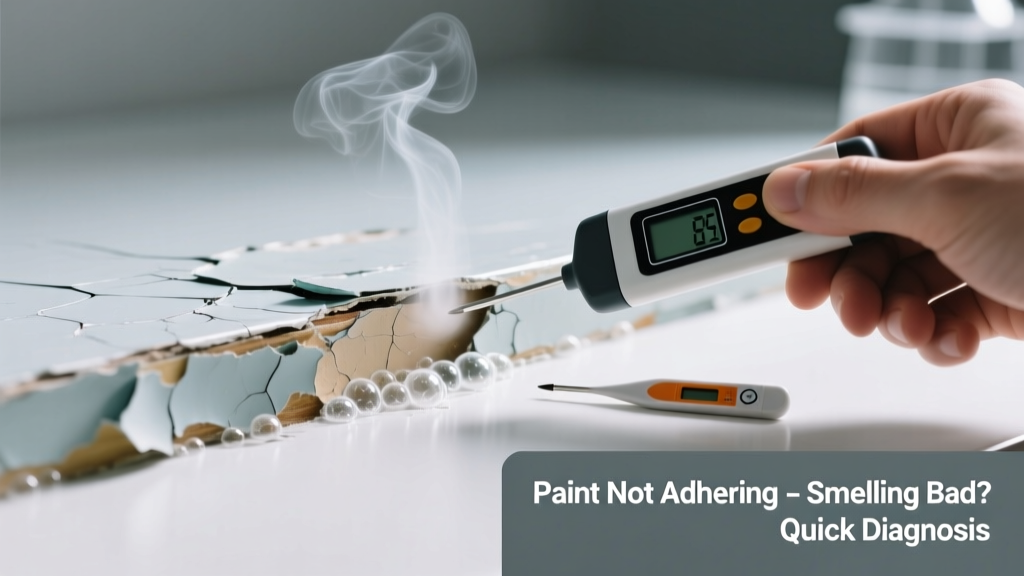
You’re rolling on fresh paint—and instead of that clean, crisp finish, you get a sticky, peeling mess with a sour, musty, or ammonia-like stench. Don’t panic. This isn’t just ‘bad paint’—it’s your wall shouting about an underlying problem. Most causes are fixable, but only if you diagnose correctly first.
Quick Checklist
- Did the surface feel damp or cool to the touch before painting?
- Is the odor strongest near baseboards, corners, or behind furniture?
- Does the paint bubble, wrinkle, or lift like plastic film when scraped gently?
- Was the area previously flooded, leaked, or exposed to high humidity for >48 hours?
- Did you skip primer—or use a water-based primer over oil-based paint?
- Is there visible discoloration (green, black, or yellow staining) under or around the failed paint?
- Does the smell worsen after rain or during humid weather?
Possible Causes
Mold or Mildew Under the Paint
Confirm by swabbing a small area with diluted bleach (1 part bleach : 10 parts water). If stain lightens within 2 minutes, it’s likely biological growth. Use a moisture meter: readings above 16% in drywall indicate active moisture intrusion. Severity: Call a pro—mold remediation requires containment and HEPA filtration. Fix mold under paint.
Trapped Moisture in Substrate
Tap the wall: a hollow, drum-like sound plus spongy texture indicates waterlogged drywall. Check behind outlets with a non-contact voltage tester and moisture meter. According to the Insurance Institute for Business & Home Safety's 2023 report, 68% of premature paint failures in humid climates trace to undetected substrate moisture. Severity: DIY fix possible if caught early and limited to one stud bay. Dry out damp drywall.
Chemical Incompatibility or Solvent Trapping
Scrape a small section: if the paint lifts in thick, rubbery sheets and smells sharply like nail polish remover or vinegar, solvents never fully evaporated. This often happens when applying latex over uncured oil-based primer or sealing damp concrete with epoxy. Severity: DIY fix—full removal and recoat with compatible products. Fix solvent-trapped paint.
What to Do First
Stop all painting activity immediately. Open windows and run a dehumidifier set to 35–45% RH for 72 hours—even if the room feels dry. Cut a 2" × 2" inspection notch in an inconspicuous corner (e.g., inside a closet) using a utility knife; look for dark staining, soft gypsum, or fuzzy growth behind the paint layer. Seal off the area with plastic sheeting if mold is suspected—don’t let spores circulate.
- Label and bag any peeled paint chips for lab testing if health symptoms (coughing, headaches) accompany the odor
- Photograph all affected areas—including adjacent walls and ceilings—for contractor quotes
- Log humidity and temperature readings twice daily for 3 days using a thermo-hygrometer
What NOT to Do
Don’t sand or scrape aggressively—the odor may mean volatile organic compounds (VOCs) or microbial volatile organic compounds (mVOCs) are airborne. Don’t apply another coat of paint to cover it up: the U.S. EPA estimates that 14% of household water usage is from leaks that go unnoticed for >90 days, and sealing over them guarantees blistering and odor recurrence. Don’t assume ‘low-VOC’ means ‘no VOC’—some zero-VOC paints still emit mVOCs when applied over biologically active substrates.
- Avoid using ozone generators—they mask odors but don’t eliminate mold roots and can degrade rubber seals and wiring insulation
- Never mix brands of primer and topcoat without verifying compatibility in the manufacturer’s technical data sheet (TDS)
- Don’t ignore HVAC ducts: a 2022 study in Indoor Air found 41% of persistent paint-related odors originated from mold in return air plenums
Is the smell strongest in the basement or crawlspace?
That points to rising damp or groundwater wicking through foundation walls. Test with a calcium carbide moisture meter: readings above 3.5% moisture content by weight signal active capillary action. Install a vapor barrier and perimeter drain if confirmed.
Does the odor appear only after turning on the heat or AC?
This suggests microbial growth inside ductwork or on evaporator coils. Turn off the system and inspect the air handler access panel for slimy residue or black specks. A certified HVAC technician should perform ATP testing—not just visual inspection.
Did you use painter’s tape that left a gummy residue before painting?
Old or low-quality tape can leave adhesive that reacts with certain paints—especially alkyds—causing amine blush and fishy odors. Wipe the surface with mineral spirits before priming. Never use blue tape rated for short-term use on surfaces meant for long-term paint exposure.
Is the paint failing only on patched areas or drywall seams?
Joint compound often contains starch or cellulose—food sources for mold if not sealed properly. Unprimed patches absorb paint unevenly and trap moisture. Always seal repairs with a stain-blocking primer like Zinsser Bulls Eye 1-2-3 before topcoating.
Are pets or recent renovations involved?
Cats urinating on baseboards or contractors using solvent-heavy cleaners (e.g., methylene chloride strippers) can embed odors deep into porous substrates. Use a blacklight to check for urine fluorescence; for chemical residues, wash with TSP substitute and rinse with distilled water before testing pH with litmus paper.
Can you smell it even after cleaning with vinegar or baking soda?
That’s a red flag: household cleaners neutralize surface odors but won’t penetrate biofilm or off-gassing substrates. As home restoration specialist Lena Torres notes in Practical Building Science (2021): “If the smell returns within 48 hours of cleaning, the source is embedded—not superficial.”
“If the smell returns within 48 hours of cleaning, the source is embedded—not superficial.” — Lena Torres, Practical Building Science, 2021
| Smell Type | Visual Clue | Most Likely Cause | Action Priority |
|---|---|---|---|
| Musty, wet cardboard | Black spotting under lifted paint | Active mold growth | Stop work; call IICRC-certified remediator |
| Sharp ammonia or urine | Yellowish halo around baseboard | Pet urine in substrate | Enzyme treatment + encapsulation |
| Sour vinegar or sour milk | Wrinkling, alligatoring, tacky film | Solvent entrapment | Full mechanical removal + ventilation |
| Bleach or chlorine | White powdery residue (efflorescence) | Alkaline substrate (new concrete/mortar) | Acid wash + pH test before priming |
Once you’ve ruled out health hazards and documented the pattern, you’ll know whether this is a 2-hour prep fix—or a structural moisture issue needing expert eyes. Either way, skipping diagnosis leads to repeat failure. Your walls aren’t broken—they’re communicating. Listen closely, test deliberately, and act precisely.