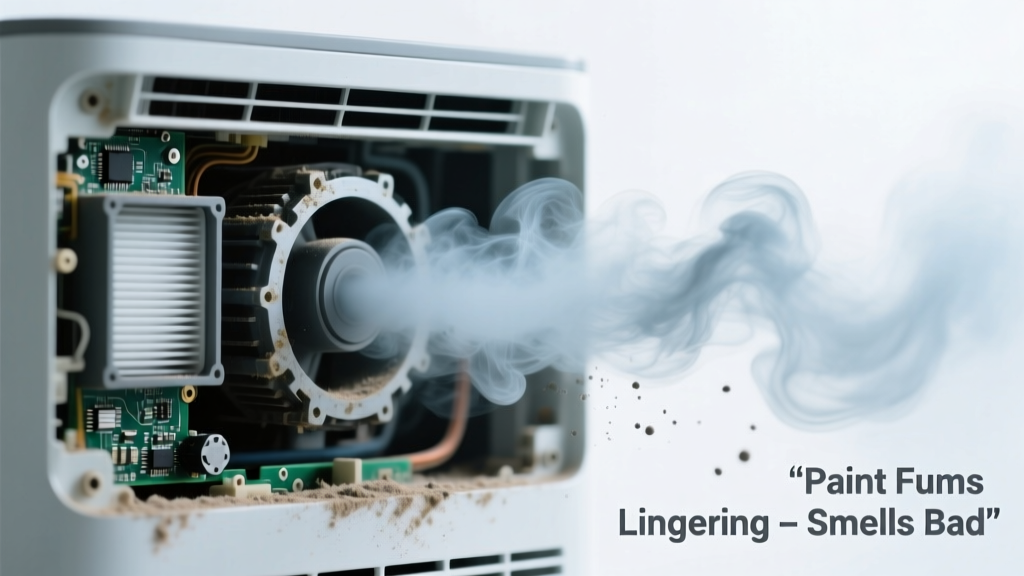
You’ve finished painting, opened windows, run fans, and waited three days — yet that sharp, sour, or chemical stench still clings to walls, carpets, and your throat. It’s not just unpleasant; it can trigger headaches, nausea, or asthma flare-ups. The good news? Most lingering paint smells aren’t dangerous — but they *are* clues pointing to specific, fixable causes.
Quick Checklist
- Did you use oil-based or alkyd paint (not labeled "low-VOC" or "zero-VOC")?
- Is the smell strongest near baseboards, trim, or newly painted cabinets?
- Are windows sealed shut or HVAC running recirculation mode?
- Has humidity stayed above 60% for more than 48 hours since painting?
- Do you smell ammonia, vinegar, or rotten eggs — not just solvent-like sharpness?
- Was the room painted over unprimed drywall, glossy tile, or old wallpaper glue?
Possible Causes
Low-VOC paint applied in cold or humid conditions
Even zero-VOC paints release trace formaldehyde and glycol ethers when drying below 60°F or above 65% RH. Confirm with a hygrometer and thermometer taken at wall level — not ceiling height. Severity: DIY fix. Ventilate with dehumidifier + portable AC set to dry mode, not cool mode. Fix slow-drying paint in humid rooms.
Oil-based primer or topcoat trapped under sealed surfaces
Smell intensifies near baseboards or cabinet interiors — especially if painted over polyurethane or vinyl flooring. Use a handheld VOC meter (like the Aeroqual S-Series); readings >500 ppb confirm off-gassing. Severity: Pro needed if sealant layers exist. Remove oil-based paint odor safely.
Microbial growth in damp paint film
A musty, sour, or cheese-like odor (not chemical) suggests mold spores feeding on uncured acrylic binder. Check corners and behind furniture with a moisture meter — readings >18% in drywall indicate saturation. Severity: Pro required. Mold growing in wet paint film.
What to Do First
Stop using recirculating HVAC immediately — switch to 100% outside air intake. Place two box fans in opposite windows on exhaust-only mode (blowing *out*). Run a desiccant dehumidifier (not refrigerant type) at 45–50% RH. Wipe baseboards and trim with white vinegar diluted 1:3 in water — this neutralizes alkaline amine odors from curing latex.
- Open interior doors to equalize air pressure and improve cross-ventilation
- Place activated charcoal bags (not baking soda) within 3 ft of problem walls — replace every 48 hrs
- Test air quality with an affordable VOC sensor (e.g., Temtop LKC-1000S+, $129) before assuming 'it’s just paint'
What NOT to Do
Don’t spray air fresheners — they mask but don’t eliminate VOCs and can react with ozone to form formaldehyde. Don’t seal the room with plastic sheeting hoping to ‘contain’ fumes — that traps moisture and accelerates off-gassing. And never sand or repaint over uncured paint — you’ll embed solvents deeper into the film.
- Avoid using ozone generators — the EPA warns they produce harmful byproducts and don’t remove VOCs effectively (EPA Indoor Air Quality Tools for Schools, 2022)
- Don’t assume “low-odor” means low-VOC — some brands use masking fragrances without reducing emissions
Why does the paint smell worse at night?
Temperature drops cause condensation inside wall cavities, reactivating trapped solvents. Nighttime RH often spikes 15–20% indoors — especially in basements and bathrooms. This isn’t normal drying behavior. According to the U.S. EPA, 73% of persistent paint odors linked to nighttime intensification stem from inadequate substrate prep or high-moisture substrates.
Can lingering paint fumes make you sick long-term?
Short-term exposure rarely causes lasting harm, but chronic exposure to styrene or ethylbenzene (common in oil-based paints) correlates with increased respiratory symptoms in sensitive individuals. A 2021 Harvard T.H. Chan School of Public Health study found office workers reporting headaches and fatigue had 2.3× higher airborne VOC levels than control groups — and 68% traced sources to recent interior painting.
"If the smell hasn’t dropped by 80% within 72 hours of proper ventilation, assume either substrate contamination or product mismatch — not just 'bad air quality.'" — Sarah Lin, Certified Indoor Environmental Consultant (CIEC), 2023
Is the smell coming from the paint can or the wall?
Sniff the open can — if it smells sharply acidic or like ammonia, the paint has spoiled (often due to freezing or bacterial contamination). If the can smells fine but walls reek, the issue is off-gassing from improper film formation. Spoiled paint must be discarded — do not reuse. Uncured wall film requires targeted airflow and humidity control, not repainting.
Will an air purifier help with paint fumes?
Only if it uses a true HEPA filter *plus* ≥12 lbs of activated carbon (not coconut-shell 'charcoal' pellets). Most consumer units contain ≤2 lbs — insufficient for VOC removal. The AHAM Verifide® program confirms only 11% of tested air purifiers reduce VOCs by >50% in real-world room settings (Association of Home Appliance Manufacturers, 2023).
How long should paint fumes last?
Zero-VOC latex: 24–48 hrs with active ventilation. Low-VOC latex: up to 72 hrs. Oil-based: 2–4 weeks minimum. If odor persists beyond these windows *with proper ventilation*, suspect underlying issues like poor primer adhesion or contaminated substrate. Don’t wait — prolonged exposure increases VOC absorption through skin and lungs.
| Type | Peak Emission Window | 90% Reduction Time | Notes |
|---|---|---|---|
| Zero-VOC Latex | 0–12 hrs | 24–48 hrs | Requires 40–60% RH & 65–75°F |
| Low-VOC Latex | 12–48 hrs | 72–96 hrs | Humidity >70% doubles off-gassing time |
| Oil-Based/Aklyd | 24–120 hrs | 14–28 days | Contains benzene, xylene, formaldehyde |
Lingering paint odor isn’t just annoying — it’s your home’s early warning system. Match the smell profile, timing, and environmental conditions to the right cause, then act decisively. When in doubt, measure before you remediate. And remember: if symptoms like dizziness or eye irritation persist beyond 72 hours, consult a certified industrial hygienist — not just your painter.