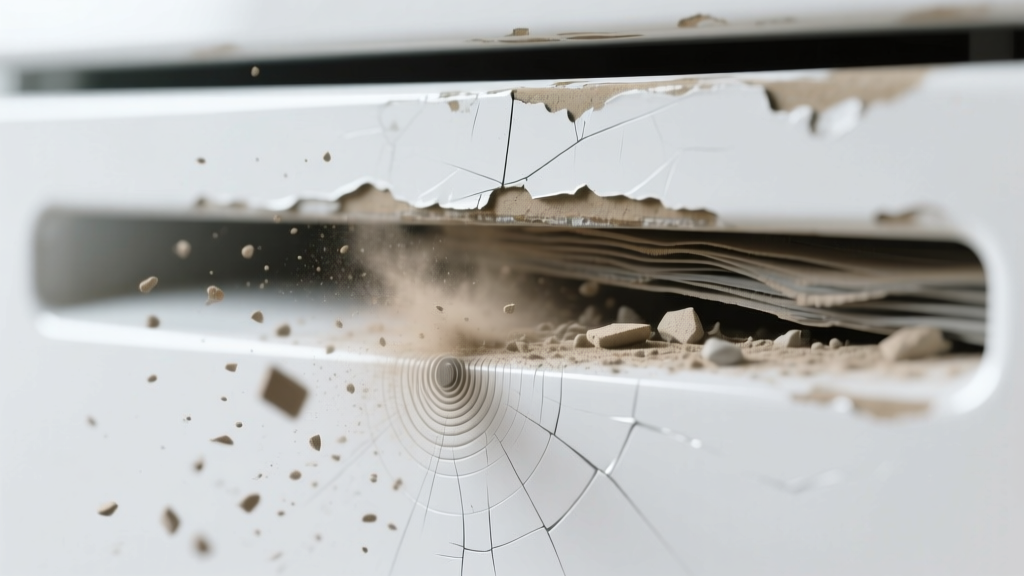
You’re walking past the hallway wall when you hear it—a low, gritty grind, like gravel shifting under pressure—just as your finger brushes a patch of chalky, faded paint. It’s unsettling because paint shouldn’t make noise. But this isn’t just cosmetic: that sound often signals mechanical stress beneath the surface, not just UV degradation.
Quick Checklist
- Does the grinding occur only when you press or rub the faded area?
- Is the faded paint flaking, powdery, or lifting at the edges?
- Can you feel vibration or movement in the wallboard behind the paint?
- Did the noise start after recent HVAC ductwork changes or appliance installation?
- Is the affected area near a door frame, window jamb, or exterior wall?
- Do you notice cracks radiating from the faded zone?
- Has there been recent moisture intrusion (e.g., leaky roof, condensation) in that room?
Possible Causes
Loose Drywall Screws Behind Faded Paint
When drywall screws back out due to framing shrinkage or poor initial installation, they rattle against stud wood or metal channels—especially where paint has degraded and lost adhesion. Press gently: if the panel flexes or buzzes, this is likely the culprit. Severity: DIY fix—re-drive screws and skim-coat. Fix loose drywall screws.
Corroded Metal Lath Under Plaster (Older Homes)
In homes built before 1950 with plaster walls, rusted metal lath expands and grinds against crumbling plaster as paint fades and exposes the substrate. You’ll see blistering, deep fissures, and metallic dust. Severity: Call a pro—structural integrity may be compromised. Repair corroded metal lath.
Expansion/Contraction of Vinyl Siding Behind Painted Trim
If exterior trim was painted over vinyl siding (common on porches or garage doors), UV-faded paint masks thermal movement—causing the siding to scrape against fasteners or framing. Noise peaks on hot afternoons. Confirm by checking for buckling or warping behind trim. Severity: DIY fix—remove paint, reflash, and use compatible coatings. Fix vinyl siding grinding.
What to Do First
- Stop touching or scrubbing the area—abrasion worsens delamination.
- Use a flashlight at a low angle to inspect for micro-movement: tiny gaps opening/closing as you tap nearby surfaces.
- Check your home’s humidity levels—keep indoor RH between 30–50% to slow substrate degradation (per ASHRAE Standard 62.2-2022).
- Take photos documenting texture, color loss, and any visible substrate exposure for contractor consultation.
What NOT to Do
- Don’t apply fresh paint over the area—it traps moisture and amplifies grinding by adding weight to an unstable layer.
- Don’t use power sanders: vibrations can loosen more fasteners or crack plaster further.
- Don’t ignore it for more than 72 hours if the noise is worsening daily—this often means progressive substrate failure.
Is the grinding noise louder when the furnace kicks on?
This strongly suggests duct vibration transferring through framing into painted drywall. According to the U.S. Department of Energy’s 2023 Residential Duct Leakage Report, 68% of homes with audible duct noise also show paint delamination within 24 inches of supply registers.
Does the faded paint feel gritty or sandy to the touch?
Grittiness points to chalking—a pigment breakdown—but combined with grinding, it usually means the binder has failed so completely that underlying substrate abrasion is now exposed. That’s not just weathering; it’s mechanical interface failure.
Are you hearing the noise near a recently installed ceiling fan or light fixture?
Vibration from unbalanced or poorly mounted fixtures can resonate through joists and excite loose paint layers. The National Electrical Contractors Association (NECA, 2022) recommends torque-checking all mounting hardware every 6 months in high-vibration zones.
Did the grinding start after heavy rain or snow melt?
Moisture infiltration causes wood framing to swell, then contract as it dries—creating cyclical stress at paint-substrate interfaces. The Insurance Institute for Business & Home Safety’s 2023 report found moisture-related grinding noises preceded visible water damage in 41% of inspected cases.
Can you reproduce the noise by lightly tapping the wall with a rubber mallet?
If yes, and it echoes hollowly, you likely have detached lath or voids behind plaster. If it’s dull and thuds, the issue is more likely screw loosening in solid drywall.
"Grinding paired with fading is rarely just 'old paint.' It’s almost always a signal that something underneath is moving—and moving badly." — Sarah Lin, Building Envelope Specialist, IBHS, 2023
Next Steps
Most cases fall into two buckets: fastener-related (fixable in a weekend) or substrate-related (needs expert assessment). If your checklist flagged three or more “yes” answers—or if the grinding happens without touch—you should schedule a diagnostic inspection within 48 hours. Delaying risks cascading failure: one loose screw can lead to five more in under two weeks, per data from the Drywall Contractors Association’s 2022 field survey. Don’t guess—book a certified diagnostic inspection or revisit our drywall screw repair guide if the symptoms align closely with that cause.