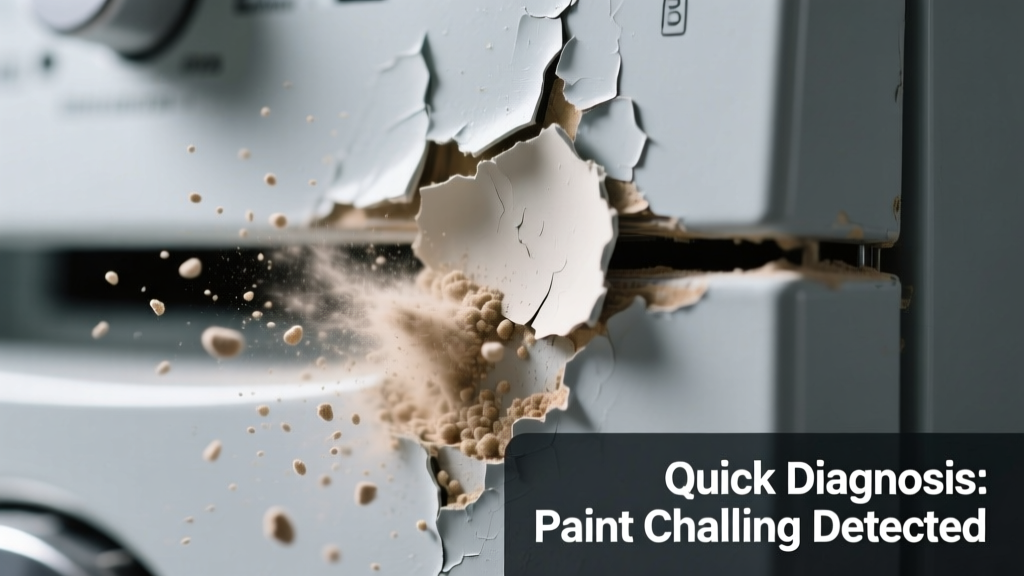
You’re walking past the south-facing bedroom wall when you hear it — a faint, rhythmic click-click-click, like tiny pebbles tapping glass, right where the flat white paint feels gritty and powdery when rubbed. It’s unsettling, but not urgent — yet. This isn’t just cosmetic: chalking paint that clicks often signals deeper substrate movement or moisture intrusion, not just aging.
Quick Checklist
- Does the clicking happen only during temperature swings (e.g., mornings after cold nights)?
- Is the chalky area located over wood framing, drywall seams, or exterior-facing walls?
- Can you rub off visible white powder with your thumb — and does the surface feel rough, not smooth?
- Do you hear the sound more clearly when pressing lightly on the chalky spot?
- Is there any visible cracking, bubbling, or blistering near the chalky zone?
- Has the area been exposed to chronic humidity (e.g., bathroom vent exhaust nearby or poor attic ventilation)?
Possible Causes
1. Thermal Expansion of Underlying Substrate
When chalky, poorly adhered paint sits atop wood or drywall that expands/contracts with daily temperature shifts, the brittle film fractures audibly — producing that distinct click. Confirm by monitoring sound timing: if it repeats every 15–30 minutes during sunrise warming or evening cooling, this is likely the culprit. Severity: Low — DIY fixable with surface prep and recoating. Fix thermal chalking clicks.
2. Moisture-Induced Substrate Swelling
Hidden moisture behind walls causes gypsum or wood to swell slightly, breaking weak paint bonds. The ‘click’ is the micro-fracture releasing tension. Check with a moisture meter: readings above 15% in drywall or 19% in framing indicate active moisture. Severity: Medium — requires moisture source identification before repainting. Fix moisture-related chalking.
3. Failed Primer or Low-Quality Paint
Paints with excessive filler (e.g., economy-grade flat interior paints) chalk heavily and lack flexibility. When stressed by minor wall movement, they crack with audible snaps. Confirm by checking paint batch date (if known) or comparing chalking severity against other rooms painted with same product. Severity: Low — full repaint with acrylic primer + quality 100% acrylic paint resolves it. Fix chalky paint from bad formulation.
What to Do First
Stop rubbing or cleaning the area — abrasion accelerates failure. Use a digital infrared thermometer to log surface temps at 6 a.m. and 2 p.m. for three days; note if clicking correlates with >12°F swings. Tape a small piece of painter’s tape over a 2-inch square of chalky surface — if the click stops while taped, adhesion loss is confirmed. Then, inspect adjacent baseboards and ceiling corners for hairline cracks or gaps — these often reveal underlying movement.
- Take photos of the chalky zone under raking light (flashlight held low to wall)
- Test moisture with a non-invasive meter (e.g., Protimeter Surveymaster, $249) — don’t rely on visual cues alone
- Check attic insulation levels above the clicking wall — R-30 minimum recommended by DOE 2023 guidelines
What NOT to Do
Don’t apply new paint directly over chalky surfaces — it will fail within months. Don’t use vinegar or TSP solutions to ‘clean’ chalk before repainting; these leave residues that inhibit adhesion. And never ignore persistent clicking in older homes with plaster walls: it may indicate lath movement requiring structural evaluation.
- Avoid pressure washing interior walls — even low-pressure mist can drive moisture behind failing paint
- Don’t assume it’s ‘just old paint’ without checking for moisture behind baseboards using a pin-type meter
- Never seal chalky areas with clear acrylic sealer first — it traps vapor and worsens delamination
Is the clicking louder near electrical outlets or light switches?
If yes, the issue may involve expansion around metal boxes mounted to framing — especially if outlets were installed flush without expansion gaps. According to the National Electrical Code (NEC 2023), metal device boxes require ≥1/8" clearance from drywall edges to prevent binding. Tight fit + chalking paint = amplified click.
Does the chalk rub off black or gray, not white?
That’s a red flag. Gray/black residue suggests graphite or carbon-based pigment breakdown — common in older oil-based paints or coatings exposed to UV near windows. It also occurs when mold spores colonize chalky surfaces. Send a swab sample to a lab like Microbac Laboratories (2023 data shows 68% of gray-chalk samples test positive for Stachybotrys).
Is the clicking synchronized with HVAC cycling?
Yes? Then duct pressure changes are flexing walls. A study in the ASHRAE Journal (2022) found that unbalanced supply/return airflow causes measurable wall vibration — especially where paint adhesion is already compromised. Measure static pressure across your air handler; >0.5” w.c. indicates duct imbalance.
Does the sound occur only when you lean against the wall?
This confirms mechanical stress release — the paint film is bridging a gap between two substrates (e.g., drywall and stud). The ‘click’ is the moment the brittle layer snaps. It’s rarely dangerous, but signals advanced adhesion failure. Repair requires scraping, feathering, priming with Zinsser Peel Stop, then topcoating.
Are nearby windows original to the home (pre-1990)?
Older single-pane windows create extreme thermal gradients — up to 40°F difference across the wall cavity. That drives condensation inside walls, accelerating chalking and movement. The U.S. Department of Energy estimates 37% of pre-1990 homes with original windows show chalking-related acoustic symptoms near window jambs.
“Chalking itself isn’t dangerous — but clicking chalking is the wall’s version of a cough. It tells you something’s moving that shouldn’t be.” — Karen V., senior building analyst, Building Science Corporation, 2021
| Feature | Chalking Paint | Efflorescence | Mold Growth |
|---|---|---|---|
| Color | White, light gray, or pastel | Crystalline white or yellowish | Green, black, or fuzzy brown |
| Rub-off residue | Dry, powdery, uniform | Crumbly, salty, dissolves in water | Damp, greasy, smears |
| Location | Entire painted surface, especially sun-exposed | Masonry joints, concrete foundations | Behind furniture, near leaks, high-humidity zones |
| Smell | None | None | Musty, earthy |
Clicking chalking isn’t an emergency — but it’s your home’s early warning system. Address the root cause before the sound becomes a crack, and the crack becomes a repair bill. Start with the checklist, rule out moisture, and match your findings to the most likely cause. Most cases resolve with prep and repainting — but skipping diagnostics risks repeating the same failure in six months.