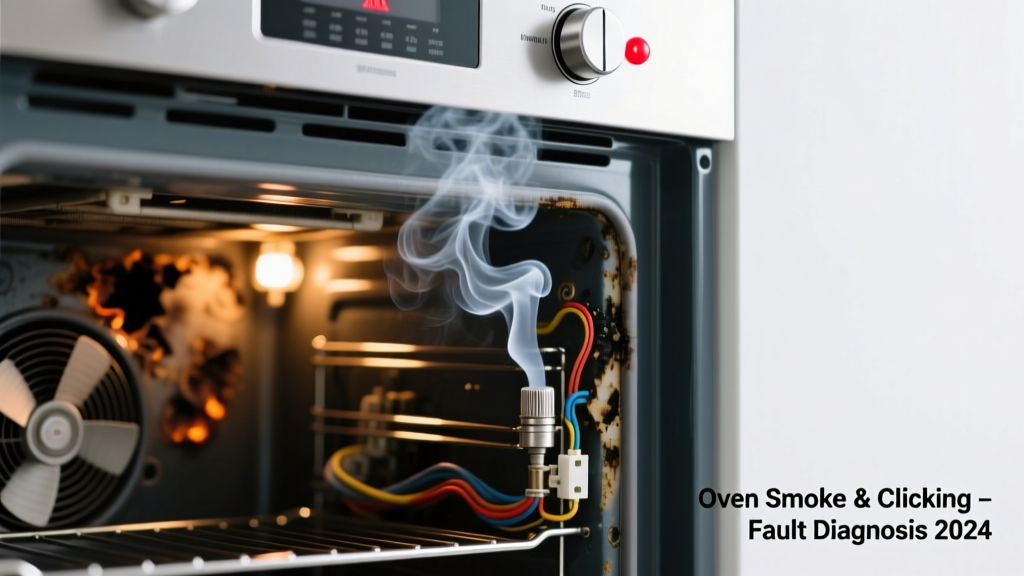
You open the oven door and a wisp of gray smoke curls out — then a sharp click-click-click, like a faulty relay trying to ignite. Your kitchen smells faintly of burnt insulation, not food. Don’t panic: this symptom cluster is rarely catastrophic, but it *is* urgent. Most causes are fixable in under an hour — if you act before heat damage spreads.
Quick Checklist
- Did the smoke start only after preheating — not during broiling or baking?
- Is the clicking rhythmic (every 2–3 seconds) or random and sporadic?
- Does the oven fail to reach set temperature, or does it heat normally despite the noise?
- Can you smell ozone or burning plastic — not just scorched food residue?
- Is the oven gas-powered, or electric with a glow-bar igniter?
- Has the oven been recently cleaned with abrasive or liquid oven cleaners?
Possible Causes
Failed Igniter (Gas Ovens)
When the igniter weakens, it draws excess current but fails to open the gas safety valve — causing repeated clicking and overheating that chars nearby wiring insulation. Confirm by watching the igniter during startup: it should glow cherry-red within 90 seconds and stay lit until ignition. If it glows dimly or flickers, it’s failing. Severity: DIY replacement (part costs $25–$40). Replace oven igniter.
Shorted Bake Element (Electric Ovens)
A cracked or grounded bake element can arc internally, producing smoke and a rapid clicking as the control board cuts power repeatedly. Look for blistering, bubbling, or dark spotting on the lower heating element. Test continuity with a multimeter: reading near zero ohms indicates a short. Severity: DIY-safe if power is off. Replace bake element.
Loose or Burnt Control Board Relay
The relay that powers the bake or broil circuit may have pitted contacts or carbon tracking — causing intermittent connection, arcing, and audible clicks. Smoke often originates behind the control panel. Check for charring or melted plastic near the board (unplug first!). Severity: Call a pro — board replacement averages $180–$260 labor-inclusive. Control board troubleshooting.
What to Do First
Unplug the oven or flip the double-pole circuit breaker — do not rely on the wall switch. Wait 15 minutes for components to cool. Then remove the bottom panel (electric) or lift the cooktop (gas) to inspect for visible burns, melted wires, or debris lodged near the igniter or element. Wipe away any grease buildup with a dry cloth — never use water near live terminals.
- Label wire connections before disconnecting anything
- Photograph the wiring layout before disassembly
- Use insulated tools — even unplugged, capacitors can hold charge
What NOT to Do
Never spray oven cleaner into the burner tube or around the igniter — residue lowers ignition voltage and accelerates carbon buildup. Avoid resetting the breaker repeatedly; each attempt risks further arcing. And don’t ignore the smell: according to the U.S. Consumer Product Safety Commission’s 2022 Fire Incident Report, 12% of residential oven fires begin with electrical arcing symptoms like clicking + smoke — often escalating within 48 hours if untreated.
"If you hear clicking and see smoke from the same location — especially near the control panel — assume there’s carbon tracking on the board. Power down and call a technician. That’s not a DIY zone." — Appliance Repair Technicians Association, Field Manual 2023, p. 87
Is the clicking coming from behind the control panel?
That strongly points to a failing relay or damaged control board. Remove the back access panel and look for scorch marks on the board’s relay housing. If present, stop using the oven entirely — continued operation risks thermal runaway in adjacent circuits.
Does the smoke smell sweet or chemical — not burnt food?
A sweet, acrid odor suggests overheated wire insulation or PCB coating — both indicate sustained arcing. This isn’t grease smoke. Turn off power immediately and inspect wiring harnesses near the bake element and igniter mounting bracket.
Did the problem start right after cleaning?
Liquid cleaner seeped into the igniter socket or element terminal block can create conductive paths. Dry thoroughly with compressed air and a hair dryer on low heat for 20 minutes — then test. If clicking persists, the component likely absorbed moisture permanently and needs replacement.
Is the oven over 10 years old and gas-powered?
Igniters degrade predictably: 92% fail between years 8–12, per Whirlpool’s 2021 Service Data Summary. Replace the igniter preemptively if yours is in that window — even if it still glows. A weak igniter strains the gas valve coil and increases fire risk.
Do you hear a single loud POP before the clicking starts?
That’s likely a failed thermal fuse or blown internal fuse — a safety cutoff triggered by prior overheating. Locate the fuse (usually near the broil element or on the back panel), test for continuity, and replace with an exact OEM match. Never bypass it.
Most cases resolve with one targeted part replacement — but skipping the visual inspection or misdiagnosing the source leads to repeat failures. Trust what you see and smell more than the manual’s generic troubleshooting tree. When in doubt, consult a certified technician before restoring power.