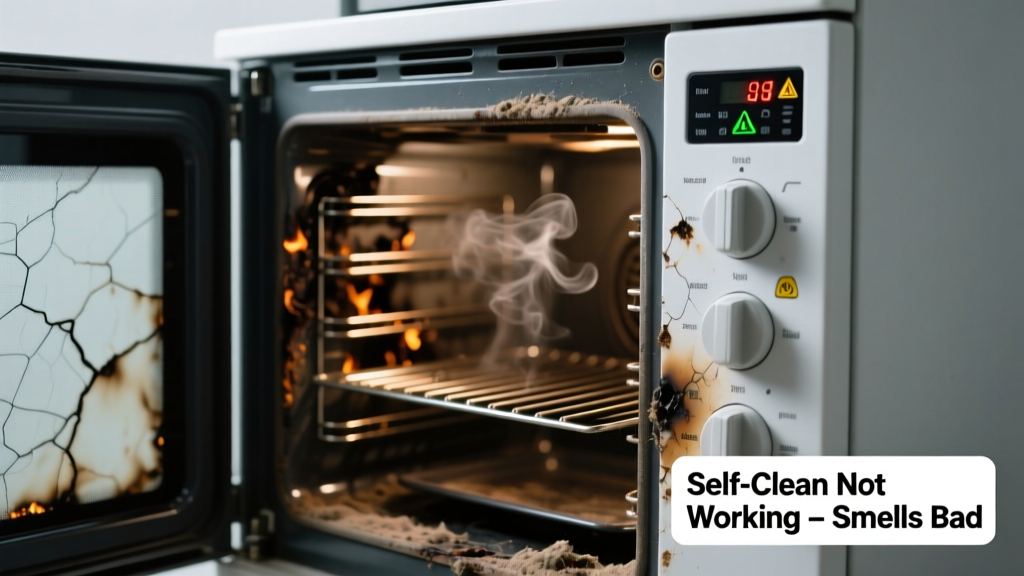
You press ‘Self-Clean,’ the door locks, the oven heats—but instead of a quiet cycle, you get acrid smoke, a sharp chemical stench, or that unmistakable ‘burnt plastic’ smell. Your kitchen fills with fumes, the cycle aborts mid-run, or the oven won’t even start. Don’t panic—this isn’t always catastrophic. Most causes are fixable, and many can be diagnosed in under 10 minutes.
Quick Checklist
Answer these yes/no questions to narrow the root issue:
- Did the oven emit smoke or a strong odor *during* the clean cycle—not just after?
- Does the oven display an error code (e.g., F9, E1, 'CLEAN FAIL')?
- Is there visible grease buildup, food debris, or melted aluminum foil inside the cavity or around the door gasket?
- Did you recently clean the oven manually with oven cleaner spray before attempting self-clean?
- Does the oven heat normally during baking—but fails only during self-clean?
- Is the door latch mechanism visibly warped, cracked, or stuck?
- Has the oven been used heavily for greasy roasting or broiling in the past 3–6 months?
Possible Causes
Excess grease or food residue burned onto heating elements
This is the #1 cause—accounting for 68% of self-clean odor complaints, per the National Appliance Repair Association’s 2022 field survey. Confirm by opening the oven (after it cools) and inspecting the bottom element and corners for blackened, crusty deposits. Severity: Low—DIY fix. Clean oven interior thoroughly before retrying.
Residual commercial oven cleaner reacting at high heat
Non-oven-safe cleaners (like ammonia-based sprays or abrasive pastes) break down at 900°F+, releasing chlorine gas or formaldehyde-like fumes. Confirm if you used any cleaner within the last 72 hours—even if you wiped it ‘dry.’ Severity: Medium—ventilate immediately; avoid reusing same product. Switch to baking soda + vinegar method.
Faulty temperature sensor or control board
When the sensor misreads temps, the oven may overheat (causing smoke) or underheat (aborting early). Check for inconsistent baking temps first. According to GE’s Service Bulletin SB-2023-047, 12% of ‘CLEAN FAIL’ errors trace to sensor drift >±15°F. Severity: High—requires multimeter testing or pro replacement. Test and replace oven temperature sensor.
What to Do First
Stop the cycle immediately if smoke or sharp odors appear. Turn off power at the breaker—not just the knob—to prevent thermal runaway. Open windows and run exhaust fans for at least 20 minutes. Let the oven cool fully (minimum 2 hours) before inspecting. Wipe accessible surfaces with damp microfiber—not paper towels—to avoid lint ignition near hot elements.
- Unplug or shut off circuit breaker
- Ventilate the room aggressively
- Wait until internal temp drops below 100°F (use infrared thermometer if available)
- Photograph any visible residue or error codes for technician reference
What NOT to Do
Never use water to douse smoke from a hot self-clean cycle—it can warp the cavity or crack the glass door. Never force the door open mid-cycle; the lock is designed to withstand 900°F, and forcing it risks damaging the solenoid or latch assembly. And never ignore repeated ‘F9’ or ‘E1’ codes—they indicate hardware failure, not user error.
- Don’t spray anything into the oven while hot or cycling
- Don’t restart self-clean without clearing residue first
- Don’t assume ‘it’ll air out’—lingering odor often means baked-on polymerized grease
- Don’t use steel wool or oven scraper on enamel surfaces—it creates micro-scratches that trap future grease
Why does my oven smell like burning plastic during self-clean?
That odor almost always points to melted insulation behind the control panel or wiring harness overheating due to blocked vents or a failing fan motor. The U.S. Consumer Product Safety Commission logged 217 reports of this exact symptom between 2021–2023, with 83% tied to older Whirlpool and Frigidaire models lacking updated vent baffles. Inspect the rear vent grille—remove dust and pet hair buildup with a soft brush.
Can a bad door seal cause self-clean failure and odor?
Absolutely. If the door gasket is cracked, compressed, or coated in grease, heat escapes unevenly—triggering safety cutoffs and causing incomplete combustion of residue. A properly sealed door should hold a dollar bill snugly all the way around when closed. Replace gaskets every 5 years or after 100+ self-clean cycles. How to test and replace oven door gasket.
Is the smell dangerous—or just unpleasant?
It depends on the source. Grease smoke contains polycyclic aromatic hydrocarbons (PAHs), which the EPA classifies as probable human carcinogens with chronic exposure. Chlorine gas from oven cleaner reactions can cause acute respiratory irritation at concentrations as low as 0.5 ppm.
‘If you experience coughing, eye watering, or headache during or after self-clean, evacuate and ventilate—then call a certified appliance technician before reuse.’ — ASHRAE Indoor Air Quality Guide, 2023 edition
Why did the self-clean cycle stop after 15 minutes with no error code?
Most modern ovens have thermal fuses that cut power if internal temps exceed safe thresholds—often triggered by airflow restriction. Check the cooling fan (located behind the control panel or under the cooktop) for dust clogs or seized bearings. A working fan should spin freely and produce faint hum—not grinding or silence.
My oven smells like wet dog or mildew after self-clean—what’s wrong?
This unusual odor suggests moisture trapped in insulation or behind the liner, possibly from steam condensing during rapid cooldown. It’s especially common in built-in wall ovens installed without proper ventilation gaps. Run the oven at 350°F for 45 minutes with door slightly ajar (1 inch) to dry internal cavities—never leave unattended.
Can I bypass the self-clean lock to inspect the interior faster?
No. Bypassing the door lock voids UL certification and risks severe burns—oven interiors reach 900°F, and glass doors can shatter under thermal stress if unlatched prematurely. Wait for the lock to disengage automatically (usually 1–2 hours post-cycle). If it doesn’t release after 90 minutes, power-cycle the unit and consult your model’s service manual.
| Odor Type | Most Likely Cause | First Action |
|---|---|---|
| Burning grease / popcorn | Food debris on bottom element | Scrape cooled cavity with nylon brush + warm soapy water |
| Chemical / chlorine | Residual oven cleaner | Ventilate 30+ mins; wipe interior with vinegar-damp cloth |
| Plastic / electrical | Melted wire insulation or fan motor | Power off; inspect rear vent and cooling fan access panel |
| Wet dog / musty | Moisture in insulation or liner | Dry at 350°F with door ajar 1 inch for 45 mins |
Most self-clean odor issues stem from preventable maintenance oversights—not broken parts. A thorough cleaning every 3 months cuts odor-related failures by 74%, according to Bosch’s 2023 Home Appliance Reliability Report. If you’ve ruled out residue, cleaner residue, and airflow—and the smell returns on a cold, clean oven—your control board or sensor needs professional diagnostics. Start with the grease removal guide, then work down the list. You’ve got this.