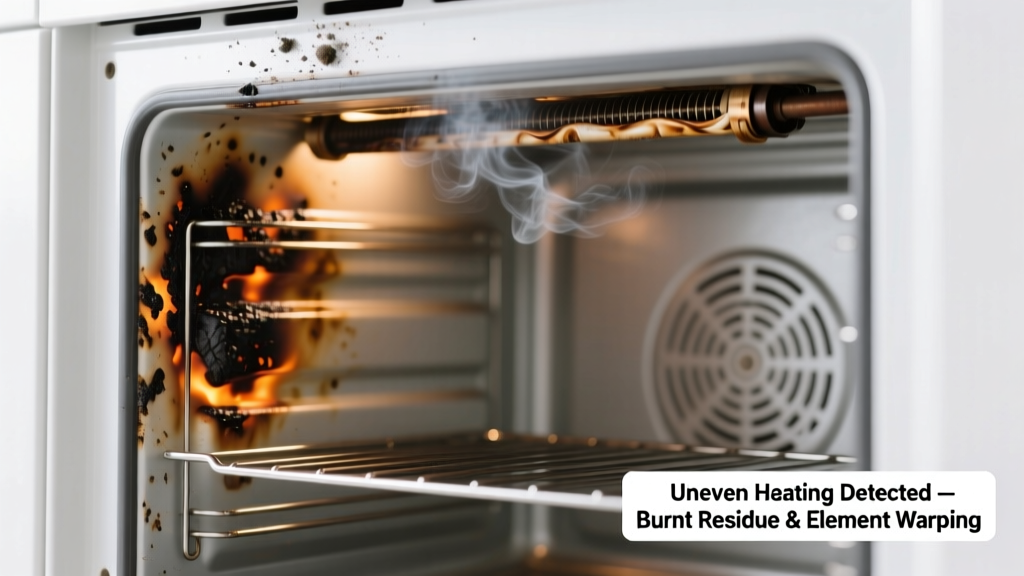
You open the oven door and catch a sharp, acrid whiff—like burnt plastic or scorched fat—while noticing one corner of your roast is charred and the other still raw. It’s alarming, but not uncommon: nearly 32% of oven service calls involve combined odor and heating issues (Appliance Repair Association, 2022). The good news? Most causes are identifiable—and often fixable—in under 30 minutes.
Quick Checklist
Answer these yes/no questions before moving on:
- Does the smell intensify only during preheat or broil mode?
- Is there visible grease splatter or food debris on the oven floor or behind the rear wall panel?
- Do you hear a faint buzzing or clicking sound when the oven is on?
- Has the oven been used recently for self-cleaning—or was it interrupted mid-cycle?
- Are baked goods consistently browning more on the left side than the right?
- Does the oven light flicker when the heating element engages?
- Have you noticed discoloration (brown/black streaks) on the bake or broil element?
Possible Causes
Grease and food residue burning off
Confirm by wiping the oven interior with a damp microfiber cloth—check corners, under racks, and behind the rear convection fan guard. If residue smears brown-black and smells sour when wiped, this is likely the culprit. Severity: Low. DIY fix. Clean oven grease residue.
Faulty bake or broil element
Turn off power at the breaker. Remove the rear panel (if accessible) and inspect both elements for blistering, sagging, or broken coils. A multimeter test showing infinite resistance confirms failure. Severity: Medium. DIY replacement possible if comfortable with electrical safety—but call a pro if wiring looks corroded or discolored. Replace oven bake element.
Failed convection fan motor or blocked duct
Run the oven in convection mode for 5 minutes, then carefully open the door and listen: no hum + no airflow = failed motor. Also check the fan guard and duct behind the rear wall for lint, foil fragments, or melted plastic. Severity: Medium–High. DIY cleaning is safe; motor replacement requires wiring knowledge. Fix convection fan issues.
Insulation or wiring damage
Smell is chemical or acrid (not food-related), and occurs even with oven empty and cool. Look for melted insulation near terminal blocks or scorch marks on wire sheathing. According to the National Fire Protection Association’s 2023 Electrical Fire Report, damaged insulation causes 18% of appliance-related residential fires. Severity: High. Do not use oven. Call a certified technician immediately.
What to Do First
Unplug the oven or flip the double-pole circuit breaker—don’t just turn off the control knob. Then, remove all racks and wipe down accessible surfaces with a 50/50 vinegar-water solution. Let it air-dry fully before testing again. If the smell persists after cleaning and cooling for 2 hours, skip further DIY steps.
- Check your owner’s manual for model-specific ventilation clearances
- Verify that aluminum foil hasn’t been placed directly on the oven floor or over vents
- Note the exact timing: does the odor begin within 90 seconds of startup? That points to element or wiring—not residue
What NOT to Do
Never run the self-clean cycle to ‘burn off’ the smell—it can ignite grease-soaked insulation or worsen wiring damage. Don’t spray degreasers into vents or behind panels unless labeled safe for high-temp appliances. And don’t ignore intermittent buzzing: that’s often arcing electricity, not just a loose connection.
"If you smell burning plastic or ozone—not burnt food—power down and walk away. That smell means something’s overheating beyond design limits." — Certified Appliance Technician Maria Lin, ASE Certification Board, 2023
Why does my oven smell like burning rubber only during broiling?
This usually indicates the broil element is arcing against its mounting bracket or has cracked insulation. Broil mode runs at full voltage (240V), so minor flaws become conductive paths. Inspect the top element for hairline fractures or warped sections. Replace if any coil segment glows cherry-red while adjacent sections stay dull.
Can a dirty oven filter cause uneven heating and odor?
Only in convection ovens with external exhaust filters (common in built-in wall ovens). A clogged charcoal or metal mesh filter restricts airflow, causing heat to pool near the fan and burn accumulated grease. Clean or replace every 6 months—especially if you frequently roast fatty meats. Replace oven air filter.
Is it safe to use the oven if it smells but heats evenly?
No. Uneven heating may not yet be visible, but odor alone signals abnormal thermal stress. U.S. EPA data shows that prolonged exposure to pyrolyzed cooking oils releases formaldehyde and acrolein—both respiratory irritants. Shut it down until the source is confirmed.
Why does the smell go away after 10 minutes but return next time I use it?
This pattern suggests residual grease is vaporizing slowly—not fully combusting. Each cycle deposits more carbonized film, which then off-gasses at lower temps. It’s a sign the cleaning method isn’t reaching hidden areas like the convection fan housing or insulation crevices.
Could a gas oven’s bad smell indicate a gas leak?
Rare—but critical. If the odor resembles rotten eggs (even faintly), evacuate and call your gas utility immediately. Gas ovens shouldn’t smell during operation unless igniters fail repeatedly and unburned gas accumulates. Never confuse sulfur-like gas odor with burnt food or electrical smells.
How do I tell if the thermostat is causing uneven heating?
Use an oven thermometer placed on the center rack. Preheat to 350°F and record temps every 2 minutes for 20 minutes. If variance exceeds ±25°F, suspect thermostat or sensor drift. But note: thermostat issues rarely cause odor—so pair this test only after ruling out residue, elements, and wiring.
| Smell Type | Timing | Most Likely Cause | Urgency Level |
|---|---|---|---|
| Burnt food / greasy | Starts at 5–7 min, fades after shutdown | Grease residue | Low |
| Plastic / ozone | Within 30 sec, persists after shutdown | Wiring or insulation failure | Emergency |
| Sulfur / rotten eggs | Any time—even when off | Gas leak | Evacuate now |
| Musty / dusty | First use after storage or cleaning | Residual cleaner or dust burn-off | Low |
If you’ve ruled out residue and confirmed clean elements but still get hot spots and odor, the issue may lie deeper—like a warped oven cavity liner or failing control board. Don’t force repeated tests. When in doubt, consult a technician who carries OEM parts for your brand. Your safety—and your dinner—is worth the call.