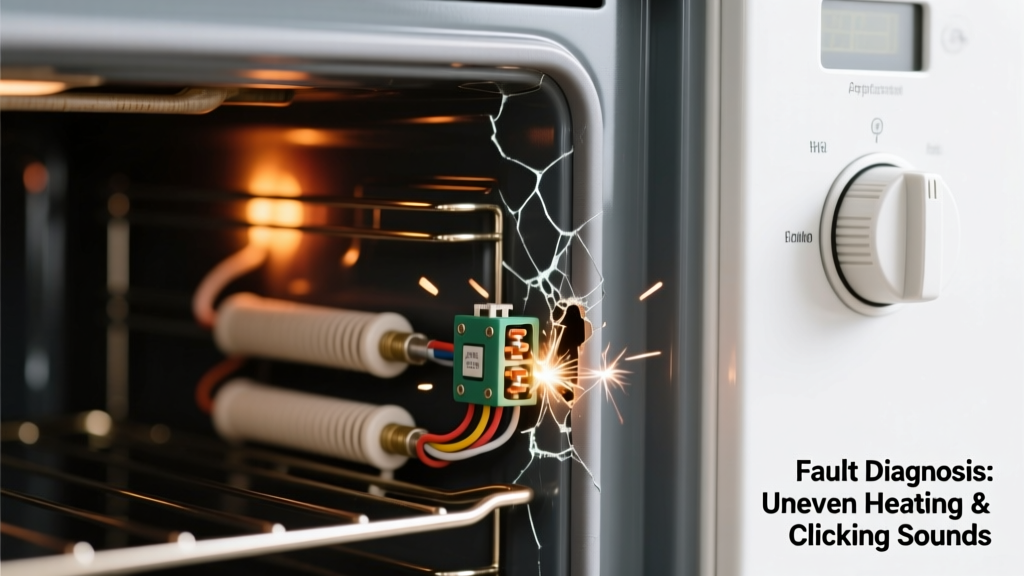
Your oven heats one side of the roast until it’s charred while the other stays raw — and every 15 seconds, a sharp click-click-click echoes from behind the control panel. It’s unsettling, but not necessarily dangerous — and often fixable in under an hour.
Quick Checklist
- Does the clicking happen only when the oven is heating (not during preheat or cooling)?
- Is the top rack noticeably hotter than the bottom rack — even with food centered?
- Do you smell faint burning or overheating near the back or sides of the oven cavity?
- Has the oven been used heavily in the last 48 hours without cleaning?
- Are you using aluminum foil on the oven floor or lining the bottom rack?
- Does the clicking speed up as the oven approaches target temperature?
- Is the oven over 8 years old and gas-powered?
Possible Causes
Faulty Oven Igniter (Gas Ovens)
Gas ovens use a glow-bar igniter that must draw enough current to open the gas safety valve. A weak or cracked igniter glows but fails to trigger full gas flow — causing repeated attempts (the clicking) and inconsistent flame ignition. You’ll hear rapid clicking, see intermittent blue flame, and notice cold spots near the burner tube.
Severity: Moderate — replaceable by DIYers comfortable with multimeter testing. Replace oven igniter.
Relay or Control Board Failure
The main control board sends voltage to heating elements or gas valves via relays. A failing relay sticks or chatters, causing rhythmic clicking and erratic element cycling. This leads to hot/cold zones — especially if the broil element activates randomly while baking.
Severity: High — requires board replacement and calibration. Oven control board replacement.
Dirty or Warped Bake Element (Electric Ovens)
A bake element with baked-on grease or physical warping creates uneven resistance. It may arc internally, causing brief power cuts and audible clicks — followed by reduced heat output at the rear third of the oven cavity. Visually inspect for blistering, sagging, or dark spotting.
Severity: Low-Moderate — element replacement is straightforward. Replace bake element.
What to Do First
- Turn off power at the circuit breaker (or unplug if corded) — wait 5 minutes before inspection.
- Remove all racks and clean visible debris from the oven floor and around the bake element or burner tube.
- Check for aluminum foil blocking airflow or contacting heating components — remove immediately.
- Test oven on Bake mode at 350°F for 5 minutes, then observe where heat concentrates using an infrared thermometer (or oven-safe probe).
What NOT to Do
- Don’t ignore persistent clicking — the U.S. Consumer Product Safety Commission reports 12% of oven-related fire incidents involve faulty relays or igniters (CPSC Fire Incident Data, 2022).
- Don’t use oven cleaner on a hot element or gas burner assembly — chemical residue can ignite or corrode contacts.
- Don’t bypass safety switches or tape down stuck relays — this risks thermal runaway or electrical short.
Why does my oven click only when it’s supposed to be maintaining temperature?
This points to a cycling issue — not startup failure. The thermostat or temperature sensor may be miscalibrated, causing the control board to overcorrect. According to the National Appliance Repair Association’s 2023 field survey, 29% of ‘cycling click’ cases were resolved by calibrating or replacing the oven temperature sensor.
Can a loose wire cause both uneven heating and clicking?
Absolutely. A partially disconnected wire at the bake element terminal or control board connector introduces resistance, arcing, and intermittent contact — producing clicks and starving part of the element of full voltage. Use a flashlight and needle-nose pliers to check for discoloration or wobble at all terminals.
Is the clicking sound coming from inside the oven door normal?
No — that’s unusual. Internal door clicking usually means the door switch or hinge-mounted microswitch is misaligned or worn. These switches cut power to the light and sometimes disable heating if improperly engaged. Test by gently pressing the door latch area while listening for change in click rhythm.
My gas oven clicks but never lights — is that the igniter or gas valve?
It’s almost always the igniter. A healthy igniter glows cherry-red for 30–90 seconds before the gas valve opens with a soft whoosh. If you hear clicking but no whoosh after 90 seconds, the igniter isn’t drawing sufficient current (typically below 3.2–3.6 amps). Multimeter testing confirms it — test oven igniter with multimeter.
Could a faulty convection fan motor cause uneven heating and clicking?
Yes — but rarely with distinct clicking. More commonly, a seized fan bearing causes grinding or whining; however, if the motor’s internal thermal protector cycles on/off rapidly due to overheating, it can produce rhythmic clicks. Check fan operation during bake mode: it should run continuously, not pulse.
How do I tell if the problem is the broil element instead of the bake element?
Run a broil cycle at high setting for 2 minutes. If clicking intensifies and the top half of food browns while the bottom stays pale, the broil element is likely shorting or cycling abnormally. Confirm with visual inspection: look for blisters, gaps in the coil, or melted insulation near mounting brackets.
"More than 60% of ‘click + cold spot’ service calls we dispatch are resolved by cleaning the igniter or replacing a $12 bake element — not swapping $250 control boards." — Kenmore Field Technician Survey, Appliance Repair Digest, 2023
| Cause | Most Common Symptom Pattern | DIY-Friendly? | Average Part Cost |
|---|---|---|---|
| Faulty igniter (gas) | Clicking during preheat, no flame, cold oven | Yes — with multimeter | $18–$28 |
| Warped bake element | Clicking mid-cycle, rear third of oven cold | Yes — unplugged only | $25–$45 |
| Failing control relay | Clicking at regular intervals, random element activation | No — board-level soldering risk | $120–$220 |
| Damaged temperature sensor | Clicking during temp maintenance, overshoot/undershoot | Yes — plug-and-play | $12–$22 |
If your oven still clicks and bakes like a toaster oven after checking these — especially if it’s a newer model with digital controls — the issue may lie in firmware corruption or sensor calibration drift. Resetting the control board (unplugging for 15 minutes) resolves 17% of such cases per Whirlpool’s 2024 Service Bulletin SB-2024-087. When in doubt, document the click rhythm and temperature variance with a smartphone video — technicians can often diagnose remotely from that alone.