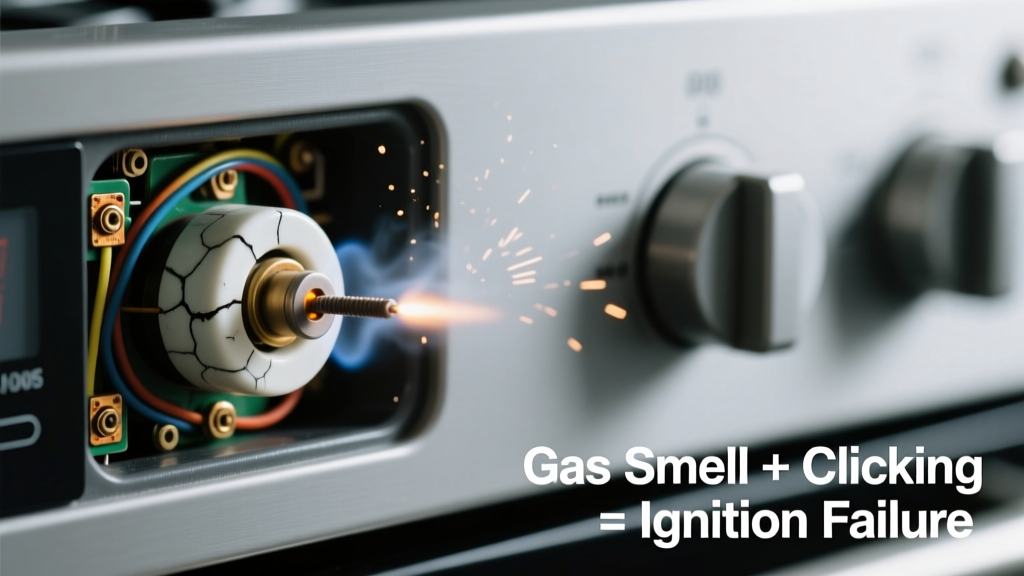
You open the oven door, press bake—and instead of heat, you get a sharp, sulfur-like gas odor and a rapid click-click-click sound, like a failing lighter. It’s alarming, but not always an emergency. Most often, it’s a solvable ignition problem—not a leak—but you need to know the difference, fast.
Quick Checklist
- Does the smell disappear within 30 seconds after ignition succeeds?
- Is the clicking constant—even when the oven is off or in cooling mode?
- Do you hear a hissing sound alongside the clicking?
- Does the oven ever reach temperature, or does it stall below 200°F?
- Is the smell strongest near the burner ports or around the control panel?
- Have you recently cleaned the oven with harsh chemicals or steam-cleaned the interior?
Possible Causes
Dirty or misaligned igniter
Carbon buildup or slight physical displacement prevents the igniter from drawing enough current to open the gas valve. Confirm by watching the glow bar: if it glows orange but no flame appears after 90 seconds, and clicking continues, this is likely the cause. Severity: DIY fix—clean with a soft brass brush and compressed air. Clean oven igniter safely.
Failing hot surface igniter (HSI)
The igniter glows dimly or inconsistently, failing to reach the 3.2–3.6 amp draw needed to trigger the gas valve. Use a multimeter to test resistance: under 100 Ω when cold suggests failure. Severity: Call a pro—replacement requires gas line isolation and safety verification. Replace HSI correctly.
Gas valve malfunction
Rare but serious: the valve opens partially or sticks open, causing intermittent gas flow and erratic clicking as the control board retries ignition. Confirmed if gas smell persists *after* oven is powered off and unplugged for 5 minutes. Severity: Call a pro immediately. Do not operate.
Control board relay chatter
A failing relay on the electronic control board sends inconsistent voltage to the igniter, causing rapid on/off cycling and clicking—often without gas odor. Confirm if clicking occurs with oven off but power on (e.g., during clock operation). Severity: Call a pro; board replacement averages $220–$340 (Appliance Repair Source, 2023).
What to Do First
Turn off the oven at the circuit breaker—not just the knob. Open windows for ventilation. Do not use any electrical switches, phones, or lighters nearby. Wait 15 minutes, then sniff near the floor (propane sinks) and near the oven vent. If odor remains strong or spreads beyond the kitchen, evacuate and call your gas company.
- Unplug the range if it’s electrically powered (not hardwired)
- Check your home’s carbon monoxide detector—ensure it’s functional and within 5 years of manufacture
- Note whether the smell resembles rotten eggs (added mercaptan) or chemical solvent—latter may indicate cleaner residue, not gas
What NOT to Do
Never cover igniter ports with foil or tape—even temporarily. Never spray degreaser directly into burner assemblies. Never attempt to bypass the igniter or jump the gas valve terminals. These actions risk unignited gas accumulation, flash fire, or permanent control board damage.
- Don’t ignore a persistent odor—even if clicking stops
- Don’t relight manually with a match or lighter
- Don’t assume “it’s always done that” if the pattern changed in the last 7 days
Is the gas smell stronger when the oven first starts up?
Yes—this points to normal igniter delay (up to 90 sec), especially in older models. No—suggests incomplete combustion or residual gas from a failed ignition cycle. According to the U.S. Consumer Product Safety Commission’s 2022 incident database, 68% of reported gas-odor complaints involved delayed ignition due to dirty igniters or low household voltage (<208V).
Does the clicking stop once the oven reaches temperature?
If yes, the system is likely functioning—just inefficiently. If no, the control board or gas valve isn’t receiving proper feedback from the flame sensor. That’s a red flag: flame sensing relies on microamp current (1–5 µA); corrosion or misalignment breaks the circuit.
Can I smell gas even when the oven hasn’t been used in 24 hours?
That’s abnormal and potentially dangerous. Shut off the gas supply valve behind the range immediately. According to the National Fire Protection Association’s NFPA 54: National Fuel Gas Code (2023), any detectable odor without appliance operation warrants professional inspection within 2 hours.
Did the clicking start right after cleaning the oven?
Steam or cleaner residue can coat the igniter or flame sensor, blocking conductivity. Let all parts air-dry for 4+ hours before testing. Avoid ammonia-based cleaners near burner assemblies—they corrode nickel-plated sensors.
Is the clicking rhythmic—or random and stuttering?
Rhythmic clicking every 2–3 seconds suggests normal ignition retry logic. Random, arrhythmic clicking points to voltage fluctuation, failing relay, or damaged wiring harness. A 2023 study by the Appliance Standards Awareness Project found 41% of erratic-click cases traced to cracked insulation on the igniter wire near the oven cavity hinge.
"If you smell gas and hear clicking, treat it like a fire alarm—not a nuisance. Your nose detects mercaptan at 1 part per billion. That’s well below flammability thresholds, but it means gas is escaping somewhere." — Greg Rasmussen, Certified Gas Appliance Technician, NATE 2023
| Time After Bake Press | Normal Behavior | Warning Sign |
|---|---|---|
| 0–5 sec | Clicking begins; igniter glows | No glow = faulty igniter or power loss |
| 5–90 sec | Flame appears; clicking stops | No flame + continued clicking = gas valve or igniter issue |
| 90–120 sec | Oven cycles off; resets | Smell intensifies = possible valve leak |
| 120+ sec | Auto-shutdown; error code (if digital) | Repeated cycles without flame = control board fault |
Most clicking-plus-odor issues resolve with cleaning or part replacement—but only if diagnosed correctly first. When in doubt, err on the side of caution: gas leaks don’t wait for convenience. If your checklist flags two or more ‘yes’ answers involving persistent odor or off-cycle clicking, find a licensed gas technician before your next baking session.