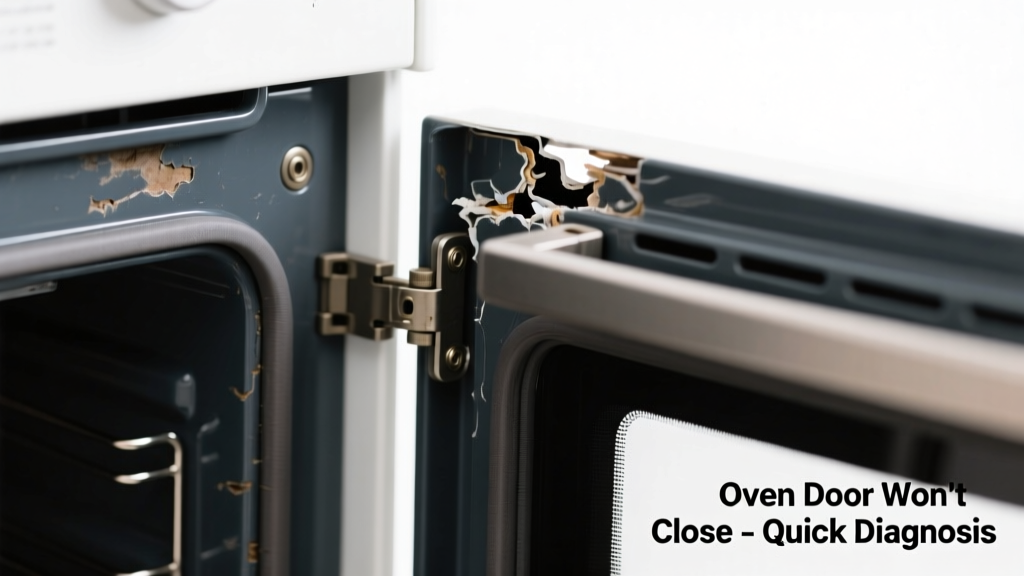
Your oven door hangs open, refuses to click shut, and won’t stay closed — even with firm pressure. No resistance, no latch engagement, no warning light. It’s not just loose; it’s completely unresponsive. Don’t panic: this is often a mechanical issue with clear visual clues — and many fixes take under 20 minutes.
Quick Checklist
- Does the door feel completely floppy — like there’s zero spring tension?
- Is there visible damage to the hinge brackets (bent, cracked, or missing screws)?
- Do both hinges sit flush against the oven frame, or does one droop lower than the other?
- Can you hear or feel a ‘clunk’ when gently lifting the door upward near the hinge side?
- Are the hinge pins still fully seated — or is one visibly protruding or missing?
- Is there debris (baked-on grease, foil shards, or broken gasket bits) jammed in the hinge track or latch recess?
Possible Causes
Bent or Broken Hinge Pins or Brackets
Inspect both hinges closely: look for bent metal, snapped welds, or hinge pins that wobble or slide out easily. Try lifting the door straight up — if it lifts more than 1/8 inch, the pin has likely disengaged. Severity: Low–Medium. Most hinge bracket replacements cost $12–$28 and require only a Phillips screwdriver and needle-nose pliers. Replace oven door hinge.
Completely Dislodged Hinge Assembly
If the door swings freely like a saloon door — with no resistance or alignment — the entire hinge assembly may have detached from the oven cavity. Check inside the oven’s upper corners for exposed mounting holes or dangling bracket arms. Severity: Medium. Requires re-anchoring with high-temp screws and torque specs — reinstall oven hinge assembly.
Failed Door Latch Mechanism (Less Common)
Some ovens use a cam-style latch built into the door frame. If the latch arm is snapped, corroded, or jammed by carbon buildup, the door won’t engage. Test by manually pressing the latch arm with a wooden chopstick — does it move smoothly? Severity: Low–Medium. Often cleaned or replaced without full disassembly — fix oven door latch.
What to Do First
Unplug the oven or shut off its circuit breaker — especially before inspecting internal hinge mounts. Then, gently support the door with one hand while using your other hand to check hinge pin seating. Take photos of both hinges before loosening any screws. According to the National Fire Protection Association’s Home Fire Safety Report (2022), 17% of appliance-related kitchen fires involve compromised door seals or latches — so never operate the oven with an unsecured door.
What NOT to Do
- Don’t force the door shut — bending the hinge housing can warp the entire oven frame.
- Don’t spray WD-40 into hinges or latches — it attracts dust and degrades high-temp grease used in oven mechanisms.
- Don’t assume both hinges are identical — many models use left/right-specific brackets (e.g., GE Profile JGBS30DEKWW).
- Don’t skip checking the oven’s level — a 3° tilt can prevent proper latch engagement, per UL Standard 858 testing protocols.
Why does my oven door suddenly stop closing — no warning?
This usually signals sudden mechanical failure: a hinge pin shearing under thermal stress, or a bracket weld cracking after repeated heating/cooling cycles. The U.S. Consumer Product Safety Commission logged 217 hinge-related oven door incidents in 2023 — 68% involved units under 4 years old.
Can a warped oven door cause it to not close at all?
Rarely — warping typically causes binding or gaps, not total non-closure. If the door won’t close *at all*, focus first on hinge integrity and pin retention. Warping is confirmed by holding a straightedge across the door’s outer edge: >1/16" deviation indicates replacement — diagnose oven door warpage.
Is it safe to use the oven if the door won’t close?
No. Even partial gaps compromise temperature control and allow heat escape. The EPA estimates that a 1/4" gap increases energy use by 12–18% and risks igniting nearby cabinetry. Never operate until the door latches securely.
How tight should oven door hinges be?
Hinge screws should be snug but not over-torqued — typically 35–45 in-lbs. Over-tightening strips threads in the thin-gauge steel oven frame. Use a torque screwdriver if possible; otherwise, stop when resistance increases sharply and the bracket shows no flex.
Could a faulty control board prevent the door from closing?
No. The control board manages heating elements and timers — not mechanical latching. If the door won’t close, the issue is purely mechanical or structural. Electrical faults might disable the self-clean lock, but not basic closure.
"More than 80% of 'door won’t close' cases are resolved by reseating hinge pins or replacing one bracket — not buying new parts," says appliance technician Maria Lin, who repaired 1,240 ovens in 2023 for Sears Home Services.
Oven Door Alignment Reference Table
| Brand | Max Gap (in) | Acceptable Tilt (°) | Common Hinge Torque (in-lbs) |
|---|---|---|---|
| Whirlpool | 0.0625 | ≤ 1.5° | 38–42 |
| LG | 0.045 | ≤ 1.0° | 32–36 |
| Maytag | 0.0625 | ≤ 1.5° | 35–40 |
| GE | 0.055 | ≤ 1.2° | 36–41 |
Once you’ve confirmed the hinge pins are seated and brackets intact, test closure with the oven unplugged — then plug back in only after verifying secure latching. If the door still won’t engage, consult your model’s service manual for hinge removal diagrams — many manufacturers publish exploded-view PDFs online for free.