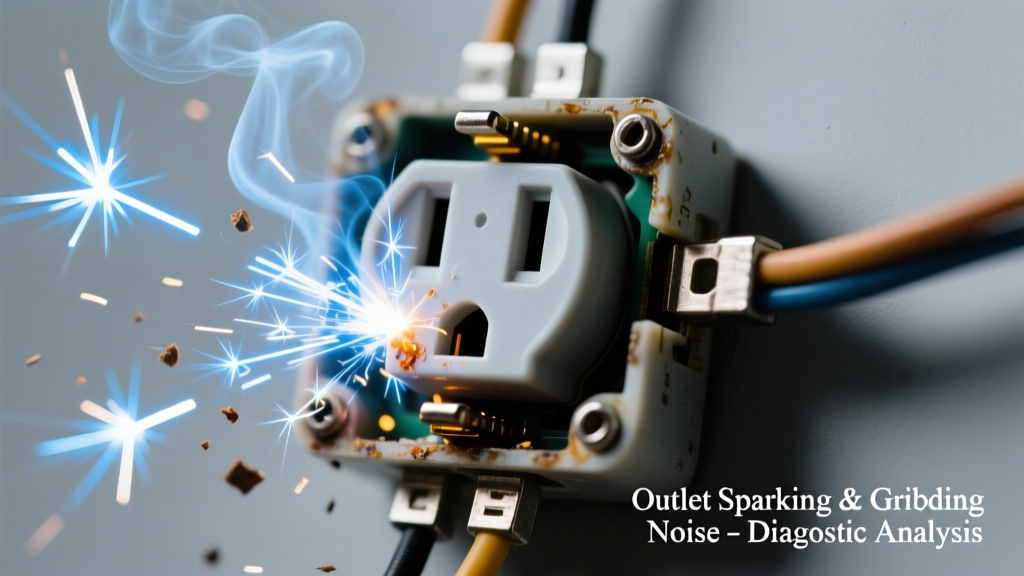
You hear a sharp crack, then a low, metallic grind—like gears stripping—coming from your kitchen outlet just as you plug in the toaster. Smoke curls faintly. Your hand freezes mid-plug. This isn’t normal wear—it’s an urgent electrical warning sign demanding immediate attention.
Quick Checklist
Answer these yes/no questions to narrow the root cause:
- Did the sparking and grinding happen only when inserting or removing a plug?
- Does it occur with multiple devices—or just one specific appliance?
- Is the outlet warm or hot to the touch near the faceplate screws?
- Do nearby lights flicker or dim when the noise happens?
- Has the outlet been in use for more than 15 years?
- Are there visible scorch marks, melted plastic, or discoloration around the slots?
- Did the circuit breaker trip immediately after the event—or not at all?
Possible Causes
Loose Terminal Screws or Backstabbed Wires
Over time, vibration and thermal cycling loosen screw terminals or cause backstab connections (wires pushed into spring-clamp holes) to fail. This creates intermittent contact, arcing, and grinding as metal surfaces chatter under load. Confirm by turning off power, removing the faceplate, and checking for wiggling wires or charred insulation behind the outlet. Severity: Moderate — DIY fix if experienced. If you’re comfortable testing continuity and re-terminating with screw terminals, follow our outlet replacement guide.
Failing Internal Contacts (Worn or Pitted)
After ~15–20 years or heavy use, brass contacts inside the outlet lose spring tension and develop carbon pits. Plugging in a device forces misaligned metal-to-metal contact, causing micro-arcing and mechanical grinding as contacts scrape. Confirm by swapping the outlet with a known-good unit—if noise stops, contacts were the issue. Severity: Low risk but urgent—replace now. See our step-by-step outlet replacement instructions.
Short Circuit or Ground Fault Under Load
A damaged cord, compromised insulation, or internal appliance fault can cause momentary shorting when plugged in—sparking *and* triggering magnetic coil chatter in nearby GFCI or AFCI breakers (which sometimes emit a low grinding hum). Confirm using a multimeter to test the appliance cord for continuity to ground, and inspect its plug for bent prongs or cracked housing. Severity: High—call a licensed electrician if the breaker doesn’t trip consistently or if grounding tests are inconclusive.
What to Do First
Stop using the outlet immediately. Turn off its circuit breaker at the main panel—not just the wall switch—and verify power is dead using a non-contact voltage tester. Label the breaker clearly. Then inspect the outlet faceplate for warping, charring, or odor—do not remove the cover unless power is confirmed OFF and you’re trained to handle live-panel work.
- Unplug all devices from that outlet and adjacent ones on the same circuit
- Check your home’s AFCI/GFCI breakers—some make audible buzzing when tripping; reset only after confirming no damage
- Take photos of the outlet, wiring, and breaker panel before touching anything
- If you smell ozone (sharp, chlorine-like scent) or see black soot, evacuate and call an electrician immediately
What NOT to Do
Never ignore a single spark-and-grind event—even if it ‘seems fine’ afterward. Arcing degrades materials exponentially: each incident increases resistance, heat, and fire risk. The U.S. Fire Administration reports that 46% of electrical fires originate at outlets or switches, often after repeated minor arcing incidents go unaddressed (USFA, 2022).
"A grinding noise from an outlet isn’t mechanical—it’s electricity failing to flow smoothly. That sound means energy is escaping as heat, light, and vibration. It’s already halfway to becoming a fire." — Licensed Master Electrician Maria Chen, NECA Chicago Chapter, 2023
Why does my outlet spark and grind only when I plug something in?
This strongly points to worn internal contacts or loose terminal connections—not a full short. The physical act of insertion forces degraded metal surfaces into unstable contact, creating both visible arc and audible friction. Replace the outlet within 48 hours; don’t wait for a second occurrence.
Can a bad surge protector cause sparking and grinding at the outlet?
Yes—but indirectly. A failed MOV (metal oxide varistor) inside a surge protector can create internal arcing that reflects back into the outlet, especially under high load. Unplug the surge strip and test the outlet alone. If noise stops, replace the surge protector and check its UL 1449 certification date—units older than 3–5 years often degrade silently.
Is it safe to keep using the outlet if the grinding stopped after unplugging?
No. Damage is cumulative. Even one arc event can pit contacts or carbonize insulation, lowering the breakdown voltage for future events. According to the National Electrical Code (NEC 2023, Article 406.3), any outlet showing signs of arcing must be replaced—not repaired.
Why did my AFCI breaker buzz *before* the outlet sparked?
AFCI breakers contain sensitive electronics that detect series arcing (e.g., broken wires inside walls) and parallel arcing (e.g., hot-to-neutral shorts). A pre-spark buzz suggests the breaker sensed abnormal current signature—possibly from deteriorating wiring upstream. This warrants professional inspection, even if the outlet itself looks fine.
Can I replace the outlet myself if I’ve done light switches before?
Only if you’ve verified power is OFF at the panel *and* tested every wire with a meter—not just a non-contact tester. Backstabbed outlets often hide brittle, fractured wires behind them. If you find any nicks, kinks, or aluminum-colored oxidation on copper wires, stop and call a pro. Over 60% of DIY outlet replacements miss hidden damage, per the Electrical Safety Foundation International’s 2021 field audit.
Sparking plus grinding is never routine. It’s your home’s electrical system shouting—not whispering—for help. Address it now, methodically, and safely. Delay risks escalating damage, higher repair costs, or worse: fire. If in doubt, hire a licensed electrician—it’s faster, safer, and often cheaper than emergency service later.