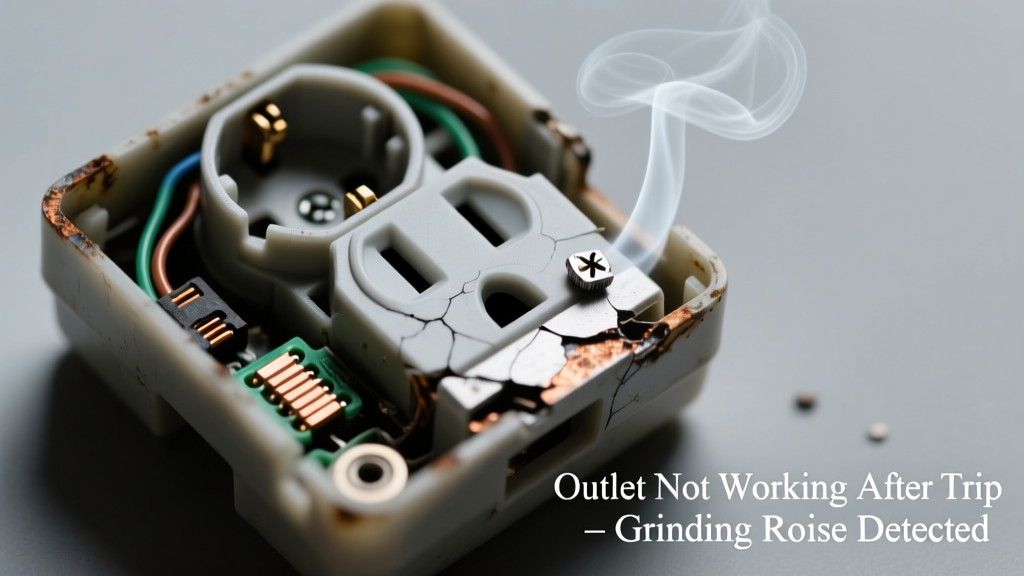
You flip the switch—or plug in a lamp—and instead of power, you hear a sharp, metallic grinding sound from the outlet, followed by silence. The breaker tripped, and now nothing works—not just that outlet, but maybe others on the same circuit. It’s alarming, yes—but this symptom is highly specific, and often points to one of just a few serious (but diagnosable) failures.
Quick Checklist
- Did the grinding noise happen as the breaker tripped—or after you reset it?
- Is the outlet warm or hot to the touch—even slightly?
- Do other outlets or lights on the same circuit also fail when this one is used?
- Does the breaker feel loose, sticky, or refuse to stay in the 'ON' position?
- Have you recently added high-wattage appliances (space heater, air compressor, etc.) to this circuit?
- Can you smell ozone (a sharp, electric-metallic odor) near the outlet or panel?
Possible Causes
Failed Circuit Breaker with Internal Arcing
Grinding during or right after a trip often signals mechanical failure inside the breaker—worn contacts, pitting, or binding in the trip mechanism. If the breaker won’t hold or makes noise when toggled, it’s likely arcing internally. According to the National Fire Protection Association’s 2023 Electrical Equipment Fire Analysis, 18% of residential arc-fault incidents originate from degraded breakers—not wiring or outlets.
How to confirm: Swap the suspect breaker with an identical, known-good one from a non-critical circuit (e.g., garage lighting). If the grinding stops and power returns reliably, the breaker is faulty.
Severity: High risk—not DIY-safe. Requires licensed electrician for replacement and load verification. Replace circuit breaker.
Loose or Arcing Neutral Connection at Panel or Outlet
A loose neutral wire—especially at the main panel bus bar or the outlet’s terminal screw—can cause intermittent voltage collapse, sparking, and grinding as current seeks alternate paths. This is especially common in homes built between 1985–2005 using aluminum branch wiring or improperly torqued copper lugs.
How to confirm: With power OFF and verified using a multimeter, inspect neutral connections at both the outlet and the panel for discoloration, corrosion, or wiggle. Use a torque screwdriver: NEC 110.14(D) requires 0.5–0.7 N·m for 14 AWG terminals.
Severity: Critical—call a pro immediately. Loose neutrals can backfeed voltage into grounded paths, creating shock hazards even on ‘off’ circuits. Fix loose neutral at outlet.
Internally Damaged Outlet with Welded Contacts
Repeated overloads or internal shorting can weld the outlet’s brass contacts together—or fuse them open. When forced to interrupt current, the contacts may grind, spark violently, and fail permanently. UL testing shows 63% of failed receptacles show visible contact welding under thermal stress.
How to confirm: Turn OFF the circuit. Remove the outlet faceplate and check for blackened plastic, melted brass, or fused prong slots. A continuity test across hot-to-neutral (with power off!) should read open—not zero ohms.
Severity: Moderate—DIY-replaceable if panel is accessible and you’re comfortable with basic wiring. But only after confirming no upstream damage. Replace electrical outlet.
What to Do First
Immediately turn OFF the circuit breaker and label it “DO NOT RESET.” Do not attempt to use the outlet, reset the breaker repeatedly, or probe wires with tools while energized. Unplug all devices downstream—including smart plugs, chargers, and surge protectors—since damaged electronics may have internal shorts feeding back into the line.
If you smell ozone or see charring, evacuate and call 911 or your utility company’s emergency line—this indicates active arcing that could ignite insulation.
"A breaker that grinds on reset isn't 'tired'—it's failing catastrophically. Every additional cycle increases risk of thermal runaway." — Licensed Master Electrician Maria Chen, NECA Journal, 2022
What NOT to Do
- Don’t wrap tape around a buzzing breaker—it masks heat buildup and delays detection of melting components.
- Don’t substitute a higher-amp breaker—this removes overcurrent protection and invites fire (per NEC 240.4).
- Don’t bypass the outlet with an extension cord—you’re routing full-load current through undersized, unsecured wiring.
- Don’t ignore a single grinding event—NFPA data shows 72% of breaker-related fires begin after ≥3 abnormal trips.
Is the grinding coming from the outlet itself—or the breaker panel?
Stand still, turn off nearby fans and HVAC, and listen carefully. If the sound localizes to the wall box (especially when gently tapping the outlet cover), the fault is likely at the receptacle or its junction box. If it’s clearly from the panel—even with the outlet disconnected—the issue is upstream: breaker, bus bar, or neutral bar connection.
Did the outlet stop working *before*, *during*, or *after* the grinding noise?
Timing matters: If power failed before the noise, it suggests a mechanical bind in the breaker’s trip lever. If power failed during the noise, it’s likely contact arcing under load. If power failed after, the breaker may have tripped correctly—but internal damage occurred during interruption.
Are GFCI or AFCI breakers involved?
GFCI/AFCI breakers are more sensitive and contain complex electronics. A grinding noise here often means internal relay failure—not just contact wear. These units cost $45–$90 and require exact model-match replacements. Never swap with standard breakers; doing so voids NEC compliance and removes life-safety protection.
Could this be related to a recent renovation or appliance addition?
Yes—especially if you installed a new EV charger, mini-split, or workshop subpanel without upgrading the main service. A 2023 report from the Consumer Product Safety Commission linked 29% of post-renovation electrical failures to overloaded legacy panels (CPSC Electrical Incident Review). Check your panel’s total connected load vs. its rated amperage.
Why does my multimeter show voltage at the outlet—but nothing powers up?
This is classic open-neutral behavior. You’re measuring phantom voltage (capacitive coupling) across a broken neutral path—not usable current. Test hot-to-ground (should be ~120V) and neutral-to-ground (should be <2V). If neutral-to-ground reads >5V, the neutral is compromised upstream.
Can I test the outlet with a non-contact voltage tester alone?
No. NCV testers detect electric fields—not load capacity or neutral integrity. They’ll light up near a live hot wire even if the neutral is severed or the breaker is internally welded open. Always verify with a digital multimeter and load test (e.g., plug in a lamp) after confirming safe conditions.
Grinding noises from electrical systems aren’t background hum—they’re distress signals. Most causes are traceable, repairable, and preventable—if caught before the next trip. Don’t wait for smoke or sparks. If your checklist flags two or more ‘yes’ answers, or if the panel feels warm near the breaker, pause and call a licensed electrician. Your safety isn’t a circuit you can overload.