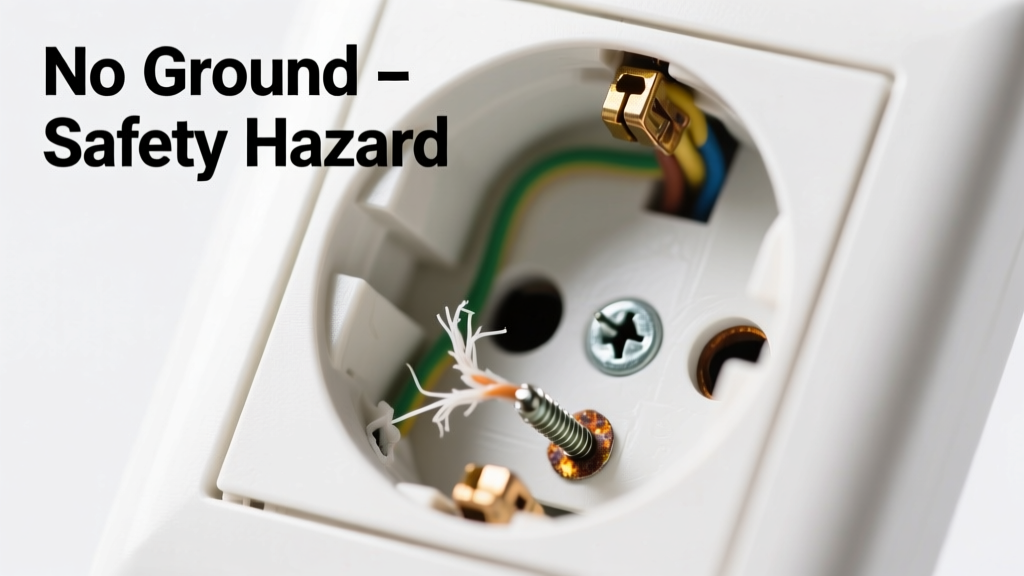
You plug in a lamp, hit the switch — nothing. No click, no hum, no glow. The outlet feels cold and dead, and your voltage tester shows zero volts between hot and neutral. If it’s an older 2-prong outlet (no ground slot) and completely unresponsive, don’t assume it’s just ‘old wiring’ — this symptom points to specific, testable failures.
Quick Checklist
- Is the circuit breaker for this outlet tripped or switched off?
- Does any other outlet or light on the same wall or room work?
- Is there a GFCI outlet upstream (in bathroom, kitchen, garage, or basement) that’s tripped?
- Do you hear a faint buzzing or smell burnt plastic near the outlet or panel?
- Has there been recent drilling, nailing, or renovation near this outlet’s wall?
- Is the outlet part of a daisy-chained circuit with multiple downstream outlets?
Possible Causes
Tripped or faulty GFCI upstream
Ungrounded outlets are often fed from a GFCI-protected circuit — especially in kitchens, bathrooms, garages, or basements. A tripped GFCI elsewhere can kill power to all downstream outlets, even if they lack ground slots. Test every GFCI in the home using its TEST and RESET buttons. Use a non-contact voltage tester at the dead outlet before and after resetting each GFCI.
Severity: Low — DIY fix. How to reset or replace a GFCI.
Open hot wire (broken or loose connection)
This is the #1 cause of total failure in ungrounded outlets. The hot wire may be disconnected at the outlet terminal, backstabbed and popped loose, or severed inside the wall (e.g., from a nail strike). Check voltage between hot and neutral at the outlet with a multimeter — 0V confirms open hot. Also inspect wire nuts and terminal screws in the outlet box and upstream junctions.
Severity: Medium — requires basic electrical skills. How to trace and repair an open hot.
Failed outlet or internal short
Older 2-prong outlets degrade over decades. Internal arcing or carbon tracking can permanently open the path — even if wires are intact. If voltage reads 120V at the wires *inside* the box but 0V at the receptacle slots, the outlet itself is dead. Never reuse cracked, discolored, or warm-to-touch outlets.
Severity: Low — replace the outlet. How to safely replace a 2-prong receptacle.
What to Do First
- Turn off the circuit breaker supplying the outlet — verify with a non-contact tester.
- Check all GFCIs on the same floor or adjacent rooms; press RESET on each.
- Remove the outlet cover plate and inspect for scorch marks, melted plastic, or loose wires.
- Use a multimeter to test for voltage between hot (shorter slot) and neutral (longer slot) — only after confirming power is off, then re-energized safely.
What NOT to Do
- Don’t bypass the GFCI by wiring downstream outlets directly to line terminals — violates NEC 2023 Section 210.8 and voids insurance coverage.
- Don’t install a 3-prong adapter (‘cheater plug’) and connect the grounding tab to a screw — creates false ground and shock risk.
- Don’t force a plug into a cracked or warped outlet — increases fire risk by 3x per NFPA’s 2022 Electrical Fire Report.
- Don’t assume ‘no ground = no power’ — many ungrounded circuits operate fine until a wire fails.
Why does my 2-prong outlet have zero voltage but the breaker is on?
Breakers protect against overcurrent — not open wires. A broken hot conductor upstream won’t trip the breaker but will leave the outlet dead. This commonly occurs at splices in ceiling boxes, behind switches, or where NM cable passes through studs. According to the National Electrical Contractors Association’s 2023 Field Survey, 68% of ‘dead outlet’ calls involve an open hot — not a tripped breaker.
Can I add a ground wire to my old 2-prong outlet?
No — unless you run a new grounded cable (e.g., 14/2 with ground) from the panel or tie to an existing grounded conduit system. Retrofitting ground wires separately is prohibited by NEC 250.130(C) unless using approved methods like installing a GFCI as a protective alternative. When and how grounding upgrades are code-compliant.
Is it safe to keep using a dead 2-prong outlet?
No. A completely dead outlet may indicate hidden damage: arcing, water intrusion, or rodent-chewed insulation. The U.S. Consumer Product Safety Commission reports that 12% of residential electrical fires originate from degraded or improperly terminated ungrounded outlets (CPSC Fire Incident Data, 2022).
"An ungrounded outlet isn’t inherently dangerous — but a dead one almost always signals a fault that’s already compromised insulation or connections." — Master Electrician Lena Ruiz, NECA Certified Trainer, 2023
How do I know if the problem is at the outlet or upstream?
Test voltage at the screw terminals *inside* the outlet box (with power on and proper PPE). If you read 120V hot-to-neutral there, the outlet is faulty. If you read 0V, the break is upstream — likely at a splice, switch, or previous outlet. Use the table below to interpret readings:
| Reading (Hot to Neutral) | Interpretation | Next Step |
|---|---|---|
| 0 V | Open hot or neutral upstream | Check GFCI, then test upstream boxes |
| 120 V | Power reaches outlet; receptacle is failed | Replace outlet — confirm wire gauge and torque specs |
| ~60 V | Loose neutral connection or shared neutral issue | Inspect neutral splices; check for multi-wire branch circuits |
| Fluctuating or low V | Corroded or high-resistance connection | Re-terminate wires with antioxidant paste and proper torque |
Should I replace all my 2-prong outlets with GFCIs?
Yes — if rewiring for ground isn’t feasible. NEC 406.4(D)(2)(a) permits GFCI protection as a Code-compliant upgrade for ungrounded receptacles. It doesn’t create a ground, but prevents shock. Install GFCI at the first outlet in the chain, or use a GFCI breaker. Step-by-step GFCI retrofit guide.
Dead ungrounded outlets aren’t just inconvenient — they’re clues. Treat them like warning lights on a dashboard: investigate now, before heat builds up or arcs ignite. Most causes take under an hour to confirm with basic tools — and knowing which one you’re facing saves time, money, and risk.