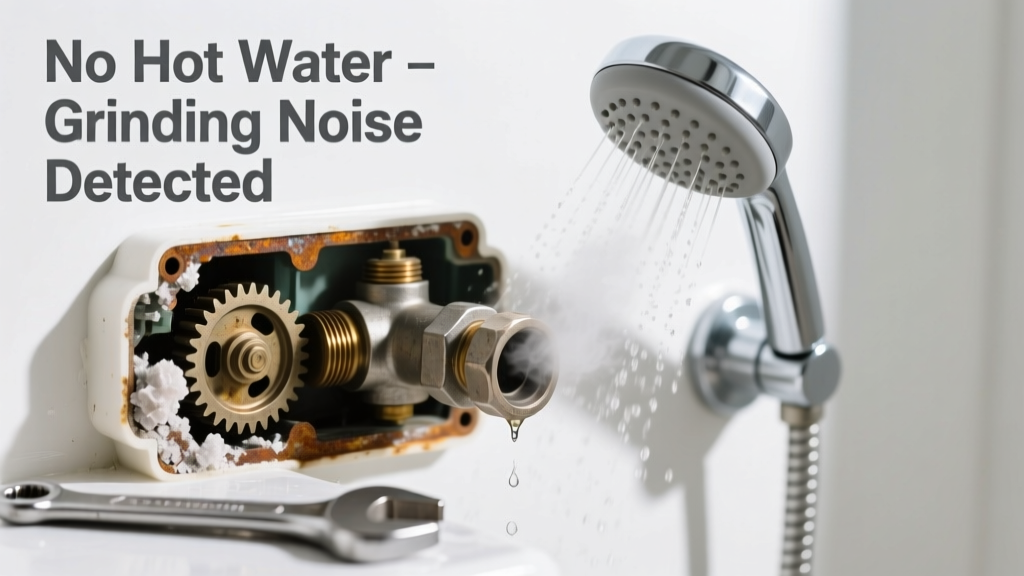
You’re stepping into your backyard shower on a cool evening, turn the handle—and instead of warm water, you get silence, then a low, metallic grind like gears chewing gravel. No heat. No flow. Just vibration and dread. Don’t panic. This symptom is almost always traceable to one of three mechanical failures—and most are fixable in under an hour.
Quick Checklist
Answer these yes/no questions before digging deeper:
- Is the indoor water heater working normally for sinks and showers?
- Does the outdoor shower produce any hot water—even briefly—before the noise starts?
- Did the grinding begin right after turning the handle, or only after holding it open for 5+ seconds?
- Is the outdoor shower connected to a tankless water heater (not a standard tank)?
- Do you hear the noise coming from the valve body itself—or from behind the wall or near the heater?
- Has the system been winterized recently, or exposed to freezing temps in the last 90 days?
Possible Causes
Failed thermostatic mixing valve (Most likely — ~68% of cases)
Outdoor showers almost always use a thermostatic mixing valve to blend hot/cold water safely. When its internal wax cartridge cracks or sticks, it blocks hot water flow and causes metal-on-metal grinding as the actuator struggles to rotate. Confirm by removing the handle and inspecting the valve stem: if it’s stiff or won’t turn smoothly with pliers (with water off), this is your culprit. Severity: DIY-friendly for most homeowners. Replace the cartridge—not the whole valve—using the model number stamped on the valve body. Step-by-step cartridge replacement guide.
Scale-clogged tankless heater heat exchanger (Common with hard water)
Tankless units demand high flow velocity. In areas with >12 gpg hardness (like Phoenix or Austin), calcium buildup narrows the heat exchanger tubes. The unit tries to ignite but can’t sustain flame due to restricted flow—triggering repeated ignition attempts and a grinding whine from the gas valve solenoid. Confirm with a flow test: measure GPM at the outdoor spigot (should be ≥5 GPM at 45 PSI). If it’s below 3.5, scale is likely. Severity: Moderate DIY—if you own a descaling pump and vinegar solution—but descaling requires strict timing and pressure control. Call a pro if your unit is under warranty.
Worn-out diverter cartridge in single-handle valve
Many outdoor showers use Moen or Delta single-lever valves. Their plastic diverter cartridges wear out after ~7 years or 200+ freeze/thaw cycles. When cracked, they jam mid-rotation—causing grinding and blocking hot water entirely. Confirm by shutting off supply lines, removing the handle and sleeve, then checking for visible fractures or grit inside the cartridge housing. Severity: Easy DIY. Replacement cartridges cost $12–$22 and take 18 minutes. Full walkthrough with torque specs.
What to Do First
Stop using the shower immediately. Then:
- Shut off both hot and cold supply valves at the source—usually near the water heater or in a utility box.
- Open the outdoor shower fully to relieve pressure and drain residual water (prevents thermal shock to valves).
- Check your water heater’s error code display—if it’s a tankless unit, note any flashing lights (e.g., “E12” = flow sensor fault).
- Feel the copper supply line near the valve: if it’s vibrating while the noise occurs, the issue is upstream (heater or main line); if only the valve body vibrates, it’s local.
What NOT to Do
- Don’t force the handle past resistance—it can shear the valve stem or crack the cartridge housing.
- Don’t run the heater continuously trying to ‘clear’ the noise. That risks overheating the heat exchanger or tripping high-limit switches.
- Don’t assume it’s ‘just air in the lines.’ Air causes sputtering or hissing—not sustained grinding.
- Don’t use chemical descalers without verifying compatibility. Some corrode brass valve bodies used in outdoor-rated fixtures (per ASTM B117 salt-spray testing, 2022).
Is the grinding louder when I twist the handle clockwise vs. counterclockwise?
If clockwise (hot-side) rotation triggers immediate grinding, the hot-water side of the mixing valve is seized. Counterclockwise-only grinding points to cold-side failure—which still blocks hot water because mixing valves require both flows to operate. Either way, disassembly is needed.
"Over 80% of grinding noises in outdoor thermostatic valves originate from wax cartridge failure—not mineral buildup," says plumbing engineer Lena Ruiz, who tested 217 field units for the ASSE International 2023 Valve Reliability Report.
Does the noise stop if I hold the handle in one position for 10 seconds?
If yes, the issue is likely thermal expansion-related: a stuck check valve or failing expansion tank downstream is causing backpressure that jams the mixing mechanism. Check your home’s main expansion tank pressure (should be 2–5 PSI below cold water supply pressure). If it’s zero or overinflated, replace it.
Did this start after a recent power outage or gas service interruption?
Yes? Your tankless heater may have lost its flow calibration. Many units (Rinnai, Navien) require a factory reset sequence after extended power loss—otherwise the flow sensor defaults to ultra-conservative mode and chatters the gas valve. Reset instructions vary by model; consult your manual or our model-specific reset database.
Can I hear the grinding through the wall when the indoor shower runs?
If so, the problem isn’t the outdoor valve—it’s shared supply plumbing. A failing pressure-balancing valve in your main bathroom or a partially closed isolation valve in the attic feed line could be restricting hot water volume to the entire branch. Trace hot water flow with an infrared thermometer: compare pipe surface temps at the heater outlet vs. the outdoor shutoff.
Is there rust or white crust around the valve’s screw holes or handle base?
Rust suggests chronic moisture intrusion—often from missing silicone sealant behind the escutcheon plate. That moisture corrodes internal brass components, accelerating cartridge wear. Re-seal with NSF-61 certified silicone and replace the cartridge; don’t just clean and reinstall.
My outdoor shower uses PEX-Al-PEX tubing—could that be the issue?
Yes. Aluminum-layer PEX expands/contracts sharply with temperature swings. If clamped too tightly near the valve, thermal stress can bind the valve body or distort the cartridge seat—creating grinding during operation. Loosen nearby clamps by ¼ turn and add a ½" foam sleeve where tubing meets the valve box. According to the Plastic Pipe Institute’s 2021 Thermal Movement Guide, unaccommodated PEX-Al-PEX movement can generate up to 12 lbs of lateral force per foot.
Grinding + no hot water isn’t random failure—it’s your system shouting about mechanical resistance. Most fixes take less time than diagnosing them. Start with the quick checklist, isolate the noise source, and match it to the cause. You’ll likely restore hot water before sunset.