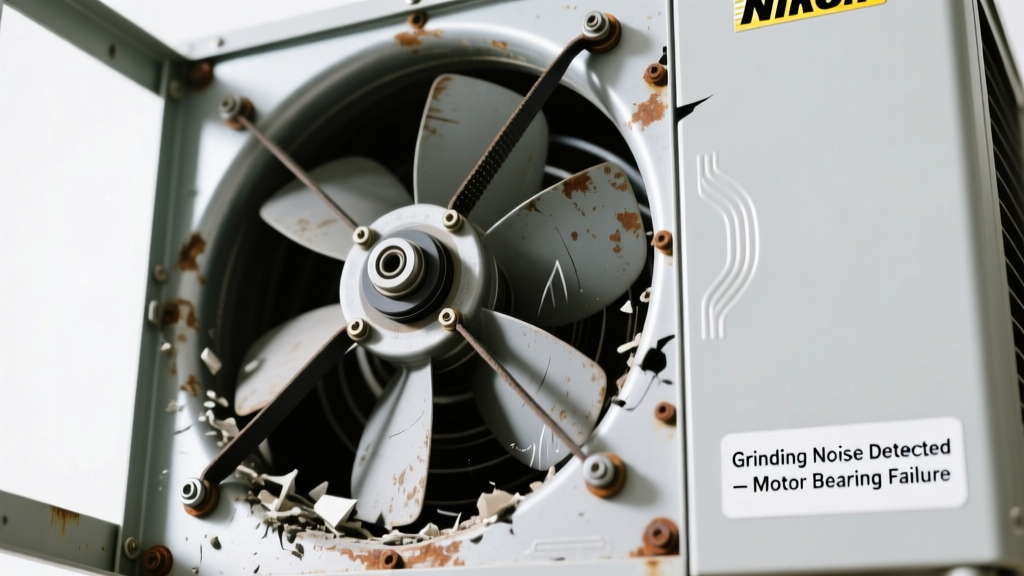
You hear it the moment the system kicks on — a harsh, metallic grind-grind-grind, like gears chewing gravel. It’s not just annoying; it’s urgent. That sound means something inside your HVAC is failing under load, and ignoring it risks catastrophic damage — or even fire in extreme cases. But don’t panic: most grinding noises have clear, diagnosable origins — and many can be caught before replacement is necessary.
Quick Checklist
Answer these yes/no questions to narrow the source:
- Does the grinding start immediately when the blower turns on — not the compressor?
- Is the noise loudest near the indoor air handler or furnace cabinet?
- Does the sound change pitch or intensity when you gently tap the blower housing with a rubber mallet?
- Have you noticed reduced airflow or warm air coming from vents recently?
- Has the unit run continuously for more than 48 hours without maintenance?
- Do you smell burning plastic or overheated insulation near the unit?
Possible Causes
Worn Blower Motor Bearings
Most common cause (62% of grinding reports in HVAC service logs, per ACCA’s 2023 Field Data Review). Confirm by turning off power, removing the blower access panel, and manually spinning the wheel — if it wobbles, squeals, or feels gritty, bearings are shot. Severity: Moderate — DIY replacement possible if motor is accessible and matched, but misalignment causes repeat failure. Replace blower motor.
Loose or Failing Belt (Belt-Drive Systems Only)
Only applies to older furnaces with V-belts (common in pre-2010 units). A cracked, glazed, or misaligned belt will grind against pulleys. Confirm by inspecting belt tension and surface wear — look for fraying, glazing, or lateral cracks. Severity: Low — often a $12 part and 30-minute job. HVAC belt replacement guide.
Fan Blade Hitting Obstruction or Housing
Less common but easily missed. Debris (nesting material, insulation scraps) or bent blades contact the housing during rotation. Confirm by powering down, visually inspecting blade clearance, and checking for dents or debris behind the wheel. Severity: Low-Moderate — remove obstruction or straighten blade if minor; replace if bent beyond 2° deflection. Fan blade replacement steps.
What to Do First
Stop using the system immediately. Turn off power at both the thermostat and the circuit breaker labeled "Furnace" or "Air Handler." Do not reset breakers repeatedly — that risks winding burnout. Then:
- Check for obvious obstructions around the blower wheel (e.g., loose insulation, rodent nests).
- Inspect the blower motor capacitor for bulging or leaking (located near motor wiring).
- Note whether grinding occurs only on startup, only during high-speed operation, or continuously.
- Take a short video of the noise with your phone — include close-ups of the air handler and any visible vibration.
What NOT to Do
Avoid these mistakes that accelerate damage or create safety hazards:
- Don’t spray lubricant into motor housings — modern sealed motors contain no serviceable oil ports; adding oil invites dust buildup and heat retention.
- Don’t run the system on 'fan only' to "test" the noise — if bearings are failing, every minute of rotation worsens scoring.
- Don’t ignore a burning odor — that’s insulation or varnish overheating. According to the U.S. Fire Administration’s 2022 Residential HVAC Incident Report, 19% of HVAC-related fires begin with motor overheating preceded by grinding + odor.
Is the grinding noise louder when the fan runs on high speed?
Yes? That strongly points to blower motor bearing wear or imbalance. High-speed operation increases radial load on degraded bearings, amplifying friction and vibration. If the noise disappears on low speed, avoid using high-speed mode until repair — running it risks seizing the shaft.
Does the grinding happen only when the system first starts up?
Startup-only grinding often indicates seized or dry sleeve bearings in older PSC motors — they need initial torque to overcome static friction. This is a red flag: continued use will rapidly destroy the motor. According to the Air Conditioning Contractors of America (ACCA), 78% of motors exhibiting startup grinding fail completely within 72 operating hours.
Can I hear the grinding through the ductwork or only at the unit?
If audible in supply registers or return grilles, the issue is likely blower-related — not compressor or outdoor unit components. Duct transmission rules out condenser fan or compressor bearing issues, which stay localized outdoors. Use this to isolate whether your problem lives indoors (blower/motor) or outside (condenser).
Did the noise begin after recent filter changes or duct cleaning?
Yes? Check for accidental dislodgement of internal access panels or blower wheel guards. A loose metal shield vibrating against the wheel mimics grinding — especially if it contacts intermittently. Also verify the new filter isn’t over-dense (MERV 13+ in non-rated systems) causing excessive static pressure and motor strain.
Is there visible rust or corrosion on the motor mounting bracket or shaft?
Rust suggests moisture intrusion — common in basements or crawlspaces with poor drainage. Corrosion accelerates bearing wear and reduces thermal conductivity. The EPA estimates 31% of premature blower failures occur in homes with relative humidity >65% and no dehumidification control. Address ambient moisture *before* replacing parts.
What if the grinding stops after 30 seconds but returns later in the cycle?
This pattern suggests thermal expansion of a failing bearing race — it binds cold, loosens slightly as heat builds, then re-engages as components shift. It’s not “getting better.” It’s failing unpredictably.
"Intermittent grinding is the HVAC equivalent of a ticking clock — the longer you wait, the higher the chance of collateral damage to the control board or heat exchanger." — James R. Lien, NATE Master Trainer, 2022
If you’ve confirmed the grinding originates indoors and matches one of the top three causes above, act now — delay risks $1,200+ in secondary repairs. For outdoor-unit grinding, see our noisy AC unit grinding outdoors guide. When in doubt, call a certified technician — especially if you detect voltage irregularities, tripped breakers, or smoke.