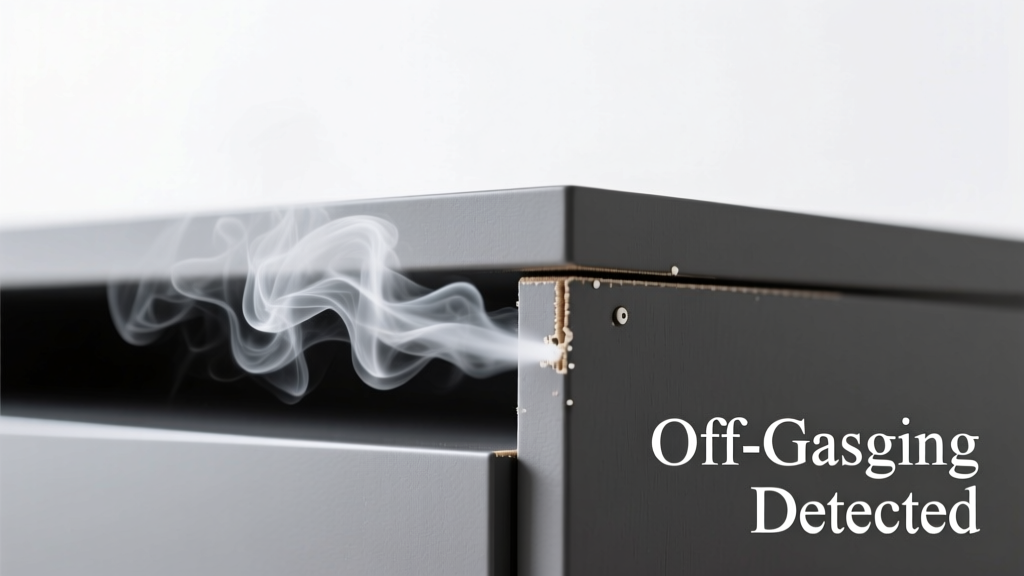
You unboxed that sleek new sofa, aired it out for three days near an open window, ran your air purifier on high, and still — that sharp, chemical sting lingers in your throat and makes your eyes water. It’s not just unpleasant; it feels like the off-gassing process has flatlined. Don’t panic. This is more common than you think — and often fixable with targeted action.
Quick Checklist
- Did you remove all plastic wrapping *before* attempting off-gassing? Yes / No
- Is the furniture placed in a space with zero airflow (e.g., basement corner, closed closet)? Yes / No
- Are you using an air purifier without a true activated carbon filter (e.g., HEPA-only model)? Yes / No
- Has humidity stayed above 65% RH for >48 hours during off-gassing? Yes / No
- Is the furniture made with medium-density fiberboard (MDF) or laminated particleboard? Yes / No
- Have you wiped down surfaces with warm water + white vinegar? Yes / No
Possible Causes
Plastic film or protective coating still intact
Many manufacturers seal upholstery or MDF edges with polyethylene film or UV-cured acrylic coatings — invisible unless inspected closely under angled light. Run your fingernail along seams and frame edges; if you hear a faint squeak or feel resistance, it’s likely still on. Severity: DIY fix. Peel carefully — especially from foam edges and back panels. Link to remove plastic film from new furniture.
Insufficient airflow or stagnant conditions
Off-gassing requires convection — not just open windows. Still air traps VOCs within 2–3 inches of the surface. Confirm with a smoke pencil or incense stick: if smoke hangs motionless near the furniture, airflow is inadequate. Severity: DIY fix. Link to improve airflow for off-gassing.
Activated carbon filter is saturated or missing
HEPA filters catch particles, not gases. Without ≥1 lb of virgin coconut-shell carbon (not charcoal dust), your purifier won’t adsorb formaldehyde or benzene. Check the filter label: if it says "odor reduction" without specifying carbon weight or CADR for gaseous pollutants, it’s likely ineffective. According to AHAM’s 2022 Certified Air Cleaner Report, 68% of consumer-grade 'VOC filters' lack verified gas-phase CADR ratings.
What to Do First
- Move furniture outdoors (shaded, dry spot) for 4–6 hours — sunlight accelerates VOC breakdown *if* materials are UV-stable (avoid leather or dyed fabrics).
- Wipe all exposed surfaces with a microfiber cloth dampened with 1:3 white vinegar/water — neutralizes amine-based off-gas compounds.
- Place two small fans on opposite sides of the piece, set to low — create laminar cross-flow, not turbulence.
- Run a dehumidifier nearby if indoor RH exceeds 60%; high moisture slows VOC desorption from adhesives.
What NOT to Do
- Don’t spray odor-masking products — they add volatile solvents and mask symptoms without reducing VOC load.
- Don’t cover furniture with blankets or tarps — this creates a VOC incubator, raising surface concentrations up to 5× (per EPA Indoor Environments Division, 2021).
- Don’t rely solely on baking soda — it absorbs minimal formaldehyde and zero acetaldehyde.
- Don’t ignore symptoms like headaches or nasal burning — prolonged exposure to >0.1 ppm formaldehyde can trigger sensitization.
Is the smell stronger when the room heats up?
Yes? That points to temperature-dependent VOC release — typical of urea-formaldehyde resins in pressed wood. Heat increases molecular mobility, accelerating off-gassing. Use a digital thermometer: if odor intensifies above 72°F, control ambient temp with AC or portable cooling.
Does the odor change after wiping with vinegar?
A temporary reduction suggests amine or aldehyde compounds are reacting with acid — good sign. No change? Likely aromatic hydrocarbons (e.g., toluene from solvent-based finishes), which require carbon adsorption or ozone-free oxidation.
Can you detect odor near the legs or underside — not just cushions?
If yes, the source is almost certainly the substrate: particleboard, MDF, or laminated plywood. These emit formaldehyde for months. The U.S. EPA estimates that 14% of household formaldehyde exposure comes from new composite wood furniture — even certified CARB Phase 2 compliant pieces.
Did the odor appear *after* cleaning or conditioning the furniture?
Some leather conditioners and fabric protectants contain glycol ethers or propylene carbonate — both high-VOC additives. Stop use immediately and ventilate. Switch to water-based, GreenGuard Gold-certified alternatives.
Are pets or children showing signs (licking surfaces, sneezing, avoiding the room)?
Their heightened sensitivity often reveals VOC levels well below human detection thresholds. If so, prioritize carbon filtration and consider renting a $199/month VOC monitor (like the Airthings View Plus) to quantify formaldehyde and TVOC levels before and after interventions.
"Most failed off-gassing attempts fail not from poor ventilation — but from ignoring the material science. MDF doesn’t ‘breathe’ like wood. It outgasses from cut edges and drilled holes, not surfaces. Seal those first." — Dr. Lena Cho, Building Science Fellow, Healthy Materials Lab, 2023
| Material | Peak Emission Window | 90% Reduction Time | Key VOCs |
|---|---|---|---|
| MDF w/ UF resin | Days 1–7 | 12–18 weeks | Formaldehyde, NOx |
| PU foam (non-fire-retardant) | Hours 1–24 | 3–5 days | TDI, acetone |
| Laminated particleboard | Days 3–10 | 20–26 weeks | Formaldehyde, phenol |
| Water-based finish (acrylic) | Hours 2–8 | 24–48 hours | Propylene glycol, ethanol |
Off-gassing isn’t broken — it’s just waiting for the right conditions. Match your furniture’s material profile to the airflow, filtration, and surface prep steps above, and most cases resolve in under 10 days. If odor persists beyond 3 weeks despite full intervention, the adhesive or finish may be non-compliant — document with photos and contact the retailer with your CARB Phase 2 or TSCA Title VI documentation request.