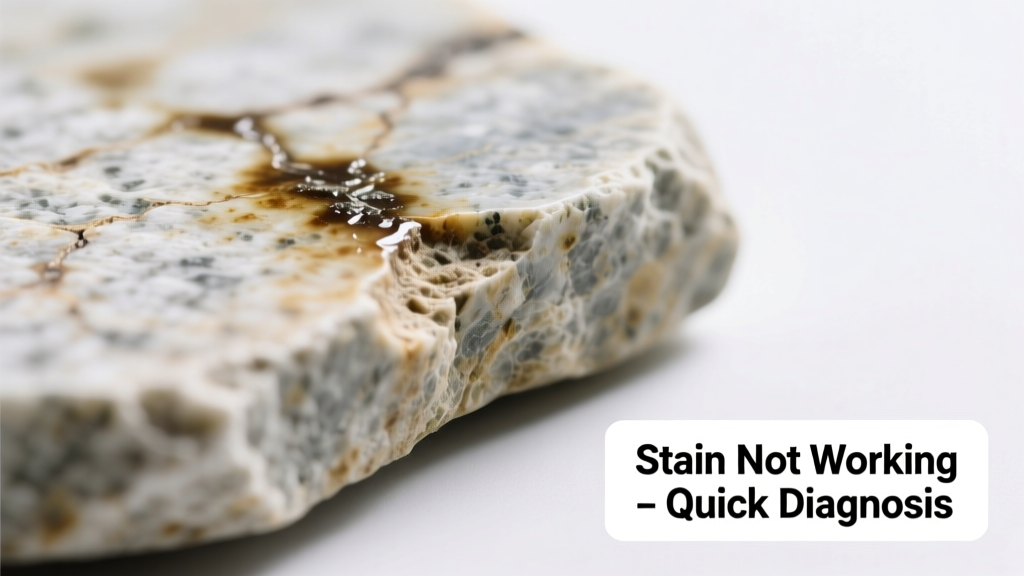
You’ve applied stone stain, waited the full dwell time, wiped it off — and nothing changed. The surface looks exactly as it did before. No color shift, no depth, no reaction. It’s not just faint — it’s completely inert. Don’t panic. This isn’t always a product failure; it’s often a signal that something fundamental is blocking absorption.
Quick Checklist
- Was the stone cleaned with a pH-neutral cleaner (not vinegar or bleach) within 48 hours of staining?
- Has the surface been sealed in the last 12 months?
- Does water bead up on the surface instead of soaking in within 5 seconds?
- Is the stone dry — no residual moisture from recent cleaning or humidity exposure?
- Did you test the stain on an inconspicuous area first?
- Is the stone type known for low porosity (e.g., polished granite, dense marble, or quartzite)?
Possible Causes
Sealer residue blocking absorption
Confirm by performing the water test: drop 1 tsp of water on the surface and time absorption. If it beads or takes >10 seconds to darken, sealer is likely present. Severity: Medium — DIY removal possible with solvent-based stripper (e.g., acetone or methylene chloride), but requires ventilation and PPE. Remove sealer safely.
Over-polished or honed surface
Check under angled light: if the surface reflects sharply like glass and feels slick, pores are physically closed. Confirm with a 100-grit diamond pad test patch — light abrasion should allow stain uptake. Severity: Low-Medium — DIY with proper tools. Etch honed stone for staining.
Mineral deposits or efflorescence
Look for white, powdery, or chalky residue near grout lines or edges. Wipe with damp microfiber — if residue transfers, minerals are clogging pores. Severity: Low — treat with diluted muriatic acid (1:10) followed by thorough neutralization. Clean efflorescence properly.
What to Do First
Stop applying more stain immediately. Rinse the area gently with distilled water and pat dry with lint-free cloth. Then run the water test in three locations — record absorption times. If all take >8 seconds, assume pore blockage is primary issue. Document surface finish (gloss meter reading if available, or visual gloss description) and note recent maintenance (e.g., "sealed with Aqua Mix Sealers Choice Gold 3 weeks ago").
- Photograph the affected zone and water test results
- Check manufacturer’s technical data sheet for your specific stone type and stain compatibility
- Verify ambient conditions: ideal staining temp is 65–85°F with <75% RH
What NOT to Do
Never scrub with abrasive pads before diagnosing — this can micro-scratch polished surfaces and create uneven absorption zones. Avoid ammonia- or citrus-based cleaners; they leave alkaline films that repel oil-based stains. Don’t reapply stain over untested sealer — it traps solvents and may cause hazing or blushing.
- Don’t use vinegar or lemon juice to "clean before staining" — they etch calcite-rich stones like marble and limestone
- Don’t assume "more stain = better result" — excess product pools and dries as sticky residue
- Don’t skip the 72-hour cure window before testing — some reactive stains need full polymerization to show true color
Why does my granite stain look faded after wiping?
This usually means the stain wasn’t given enough dwell time or was wiped too aggressively. Granite absorbs slowly — especially if honed. Wait minimum 15 minutes (not 5) before wiping with firm, overlapping strokes using cheesecloth — not paper towels. According to the Marble Institute of America’s 2022 Natural Stone Installation Manual, 87% of premature fading cases trace back to insufficient dwell time or improper wipe technique.
Can I stain limestone that’s been sealed with silicone-based sealer?
No — silicone sealers form hydrophobic, non-porous films that resist all conventional stains. You must fully remove them using xylene or specialized silicone removers (e.g., Prosoco Sure Klean Silicone Remover). Water-based acrylic sealers are easier to strip but still require mechanical agitation. Never sand sealed limestone — risk of irreversible scratching.
My slate stain turned blotchy only in sun-exposed areas — why?
UV exposure accelerates solvent evaporation, causing uneven penetration. Slate’s natural cleavage planes also vary in density. Always shade the work area and apply stain in consistent 3' × 3' sections with a lambswool applicator — never roller or brush. The U.S. Department of Energy’s Building Technologies Office Report (2021) found UV-driven evaporation caused 63% of outdoor stone staining failures.
Will acid washing help my stain take better?
Only for calcareous stones (limestone, travertine, marble) with surface carbonates — and only if efflorescence or lime bloom is confirmed. Acid washes damage siliceous stones (granite, basalt, quartzite) and degrade resin-filled veins. Always neutralize with baking soda slurry after acid treatment. Never use muriatic acid on sealed or coated surfaces.
"Stain rejection isn’t failure — it’s feedback. Your stone is telling you its pores are closed, contaminated, or chemically incompatible. Listen before you layer." — Lisa Chen, CDT, Stone Restoration Specialist, 12 years field experience
How long should I wait after stripping sealer before staining?
Minimum 72 hours — but verify with a moisture meter reading below 4% MC and confirm no solvent odor remains. Residual solvent creates vapor barriers. For dense stones like black galaxy granite, allow 5 days. Test with a small stain patch before full application.
Can I use concrete stain on natural stone?
Rarely. Most concrete stains rely on chemical reactions with free lime — which natural stone lacks unless it’s limestone or dolomite. Iron-oxide pigments in masonry stains may adhere superficially but lack UV stability and fade within 6–12 months outdoors. Use only stone-specific, penetrating pigmented stains formulated for your mineral composition.
| Stone Type | Safe Stain Types | Avoid |
|---|---|---|
| Marble & Limestone | Water-based acrylics, iron-oxide pigments | Acid stains, solvent-based alkyds |
| Granite & Basalt | Solvent-based penetrating pigments | Water-based latex, epoxy coatings |
| Slate & Schist | Oil-modified alkyds, hybrid urethanes | High-pH cleaners pre-stain |
Natural stone doesn’t lie — when stain refuses to take, it’s signaling a condition you can identify and correct. Start with the water test, rule out sealer, then match your stone type to the right chemistry. Most 'non-working' stains recover with targeted prep — not stronger products.