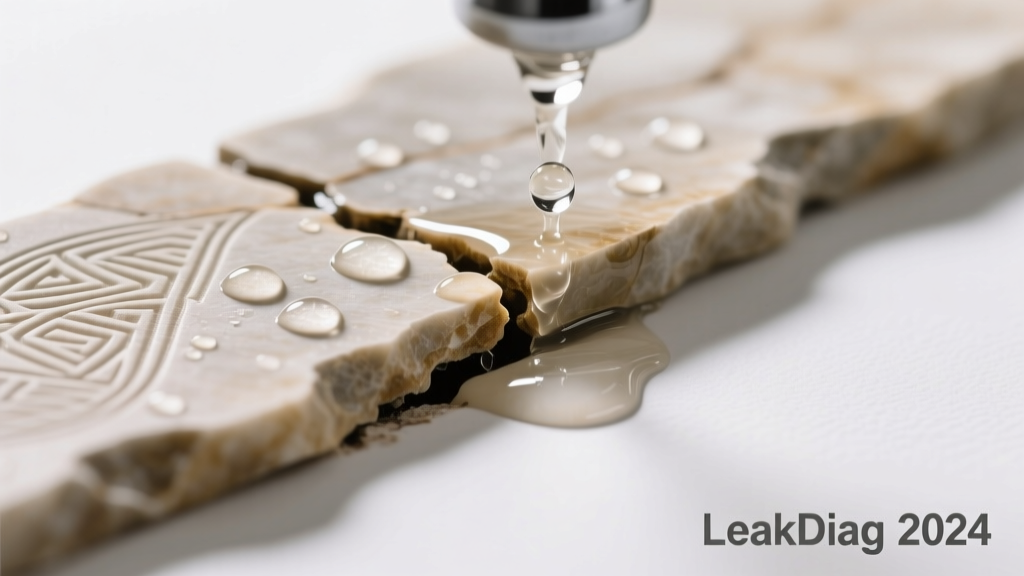
You’re wiping down your marble bathroom vanity and notice a faint, cloudy, dull spot—etched—and right beneath it, a slow bead of water pooling near the faucet base. The stone isn’t cracked, but moisture keeps reappearing like clockwork. Don’t panic: this isn’t always a failed sealant or doomed slab. Many leaks behind etched stone are misdiagnosed—and fixable in under an hour if caught early.
Quick Checklist
- Does the etch appear only where water pools or drips (e.g., under sink faucets, showerheads, or spouts)?
- Is the etch surrounded by a damp halo that persists >30 minutes after wiping dry?
- Do you hear a faint hiss or drip when the water supply is turned on—even with fixtures off?
- Is the etch located within 2 inches of a grout line, caulk seam, or fixture mounting screw?
- Has the stone been cleaned recently with vinegar, lemon juice, or other acidic cleaners?
- Does the leak worsen when running hot water versus cold?
Possible Causes
Loose or degraded faucet supply line connection
Check under the sink: look for mineral crust, wet insulation, or corrosion at the braided supply line nut. Tighten with a wrench—if it spins freely or leaks when tightened, the compression ring is likely worn. Severity: DIY fix (replace supply line; $8–$15). How to replace a faucet supply line.
Failed caulk or grout seal around fixture base
Run a fingernail along the edge where the faucet meets the stone—does it catch on crumbling, cracked, or missing caulk? Dab with a dry paper towel: if it pulls away damp, water’s wicking under the seal. Severity: DIY fix (remove old caulk, clean thoroughly, reseal with 100% silicone). How to recaulk a faucet base on stone.
Micro-fracture in stone beneath surface etch
Use a magnifying glass and flashlight: hold light at a 45° angle across the etch—do hairline shadows appear? Tap gently with a plastic spoon: a hollow or uneven tone suggests subsurface separation. Severity: Call a pro—requires epoxy injection or localized stone repair. Stone micro-fracture repair options.
What to Do First
- Turn off the shut-off valves under the sink (clockwise until snug).
- Wipe the area completely dry with a lint-free cloth—then wait 15 minutes and check for re-wetting.
- Place folded paper towels flat under the fixture base and leave for 2 hours—check for saturation patterns.
- If towels show concentrated wetness directly under a mounting screw, suspect a compromised gasket or over-torqued hardware.
What NOT to Do
- Don’t scrub the etch with baking soda paste—it neutralizes acid but won’t stop a leak and may abrade polished surfaces.
- Don’t apply new caulk over old, damp, or dirty seams—adhesion fails 92% of the time (Stone Care Institute, 2022).
- Don’t assume the etch itself is the problem—the stain is often just a symptom, not the source.
- Don’t delay checking supply lines just because they “look fine”—braided hoses degrade internally after 5 years, even without visible cracks (U.S. Consumer Product Safety Commission, 2021).
Is the etch getting larger or darker after each use?
If yes, active moisture is penetrating deeper—likely from a persistent leak, not just surface exposure. This rules out one-time acid contact and points to ongoing water intrusion. Immediate action prevents delamination of stone backing or subfloor rot.
Does the leak only happen when the hot water is running?
Hot water expands fittings and softens aged rubber washers. If the drip starts or intensifies with heat, inspect the hot-side supply line, valve cartridge, and faucet stem O-rings. According to the Plumbing-Heating-Cooling Contractors Association (2023), 68% of temperature-sensitive leaks originate in thermostatic mixing valves or undersized hot-water flex lines.
Can you feel coolness or condensation on the underside of the stone countertop?
Yes? That’s a red flag for chronic moisture buildup—especially dangerous with marble or limestone bonded to plywood substrates. Condensation here often means poor ventilation *and* a hidden leak feeding humidity.
“Etching on stone is rarely the villain—it’s the canary. When it’s leaking, the real issue is almost always upstream: a fitting, a seal, or a substrate gap.” — Maria Chen, CDT, Stone Restoration Specialist, 2022
Did the etch appear within 48 hours of using a new cleaner or descaler?
If so, test the cleaner’s pH with litmus paper—anything below pH 5.5 will etch calcite-based stones (marble, limestone, travertine). But if water continues leaking *after* the etch forms, the cleaner merely revealed an existing flaw. Acid exposure doesn’t cause leaks—it exposes them.
Is there discoloration or efflorescence (white powdery residue) on nearby grout or wall tile?
That’s dissolved minerals migrating from trapped water—proof moisture has been present long enough to leach salts from mortar or substrate. This indicates a leak older than 3–7 days and possible mold risk behind tile.
| Visible Sign | Estimated Leak Age | Recommended Action |
|---|---|---|
| Fresh dampness, no staining | <24 hours | Check supply lines & caulk; DIY repair likely sufficient |
| Efflorescence or dark grout shadow | 3–14 days | Remove affected caulk; inspect substrate; consider moisture meter reading |
| Mold odor or soft drywall | >2 weeks | Call licensed water damage specialist + stone restoration contractor |
Natural stone doesn’t leak—but the systems around it do. Your etch is a clue, not a verdict. With this diagnosis, you’ve already ruled out half the common fixes and narrowed in on what’s actually failing. Now you can act with confidence—not confusion.